119661
论文已发表
注册即可获取德孚的最新动态
IF 收录期刊
- 3.6 Breast Cancer (Dove Med Press)
- 4.3 Clin Epidemiol
- 2.6 Cancer Manag Res
- 3.2 Infect Drug Resist
- 4.1 Clin Interv Aging
- 6.1 Drug Des Dev Ther
- 4.1 Int J Chronic Obstr
- 8.7 Int J Nanomed
- 2.5 Int J Women's Health
- 3.2 Neuropsych Dis Treat
- 2.4 OncoTargets Ther
- 2.6 Patient Prefer Adher
- 2.6 Ther Clin Risk Manag
- 3.1 J Pain Res
- 3.5 Diabet Metab Synd Ob
- 4.5 Psychol Res Behav Ma
- 3.4 Nat Sci Sleep
- 2.4 Pharmgenomics Pers Med
- 2.6 Risk Manag Healthc Policy
- 4.6 J Inflamm Res
- 2.3 Int J Gen Med
- 3.9 J Hepatocell Carcinoma
- 3.3 J Asthma Allergy
- 2.5 Clin Cosmet Investig Dermatol
- 3.0 J Multidiscip Healthc

Δ133p53/FLp53 可预测食管鳞状细胞癌的不良临床结果
Authors Tu Q, Gong H, Yuan C, Liu G, Huang J, Li Z, Luo J
Received 19 May 2020
Accepted for publication 25 July 2020
Published 18 August 2020 Volume 2020:12 Pages 7405—7417
DOI https://doi.org/10.2147/CMAR.S263559
Checked for plagiarism Yes
Review by Single anonymous peer review
Peer reviewer comments 3
Editor who approved publication: Dr Yong Teng
Background: p53 isoform Δ 133p53 is directly transactivated by p53 and antagonizes p53 activities in cancer progression. However, its correlation with prognosis and cancer recurrence in esophageal squamous cell carcinoma (ESCC) is still unclear.
Patients and Methods: Expression of Δ 133p53 and Δ 133p53/full-length p53 (FLp53) in tissues and serums of 180 ESCC patients was evaluated using qRT-PCR. Patients were divided into high- and low-expression groups according to the cutoff value determined by X-tile 3.6.1 software. Survival analysis was performed by the Kaplan–Meier method. Univariate and multivariate Cox survival analyses were applied to assess the hazard ratios (HRs).
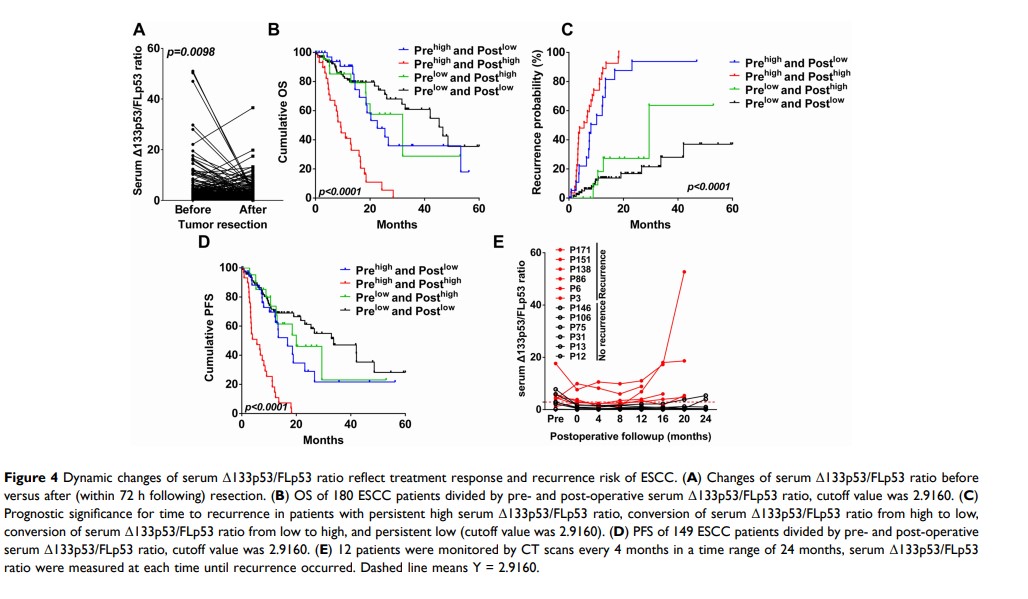
Results: Tissue Δ 133p53 expression and Δ 133p53/FLp53 ratio were significantly increased in ESCC tissue compared with adjacent normal tissue. Pre-operative Δ 133p53 expression and Δ 133p53/FLp53 ratio in tissue or serum samples were positively associated with TNM stage and post-operative recurrence. Kaplan–Meier curve and multivariate cox regression analyses revealed that the tissue and serum Δ 133p53/FLp53 ratios (cutoff value: 2.9160) were independent prognostic factors for overall survival (OS) and progression-free survival (PFS) in ESCC patients and showed no statistical difference in receiver-operating characteristic curve (ROC) analysis, while serum Δ 133p53 showed no significant prognostic value. More importantly, the serum Δ 133p53/FLp53 ratio in ESCC patients was significantly decreased within 72 h post tumor resection and patients with a consistently high serum Δ 133p53/FLp53 ratio (≥ 2.9160) had higher recurrence rates than those with consistently low ratio values. In addition, dynamic detection in each follow-up timepoint showed that serum Δ 133p53/FLp53 ratios were higher than 2.9160 upon recurrence, and they even increased prior to radiologic progression.
Conclusion: The serum Δ 133p53/FLp53 ratio can be a novel predictor for survival outcome and may serve as a real-time parameter for monitoring recurrence in ESCC patients after surgery.
Keywords: esophageal squamous cell carcinoma, p53, Δ 133p53, prognosis, recurrence