119661
论文已发表
注册即可获取德孚的最新动态
IF 收录期刊
- 3.6 Breast Cancer (Dove Med Press)
- 4.3 Clin Epidemiol
- 2.6 Cancer Manag Res
- 3.2 Infect Drug Resist
- 4.1 Clin Interv Aging
- 6.1 Drug Des Dev Ther
- 4.1 Int J Chronic Obstr
- 8.7 Int J Nanomed
- 2.5 Int J Women's Health
- 3.2 Neuropsych Dis Treat
- 2.4 OncoTargets Ther
- 2.6 Patient Prefer Adher
- 2.6 Ther Clin Risk Manag
- 3.1 J Pain Res
- 3.5 Diabet Metab Synd Ob
- 4.5 Psychol Res Behav Ma
- 3.4 Nat Sci Sleep
- 2.4 Pharmgenomics Pers Med
- 2.6 Risk Manag Healthc Policy
- 4.6 J Inflamm Res
- 2.3 Int J Gen Med
- 3.9 J Hepatocell Carcinoma
- 3.3 J Asthma Allergy
- 2.5 Clin Cosmet Investig Dermatol
- 3.0 J Multidiscip Healthc

妇科癌脊柱转移的临床特征和预后分析:单中心回顾性研究
Authors Liu S, Zhou X, Song A, Huo Z, Yao S, Wang Y, Liu Y, Pan LY
Received 17 June 2020
Accepted for publication 6 August 2020
Published 20 August 2020 Volume 2020:12 Pages 7515—7525
DOI https://doi.org/10.2147/CMAR.S268075
Checked for plagiarism Yes
Review by Single anonymous peer review
Peer reviewer comments 2
Editor who approved publication: Dr Eileen O'Reilly
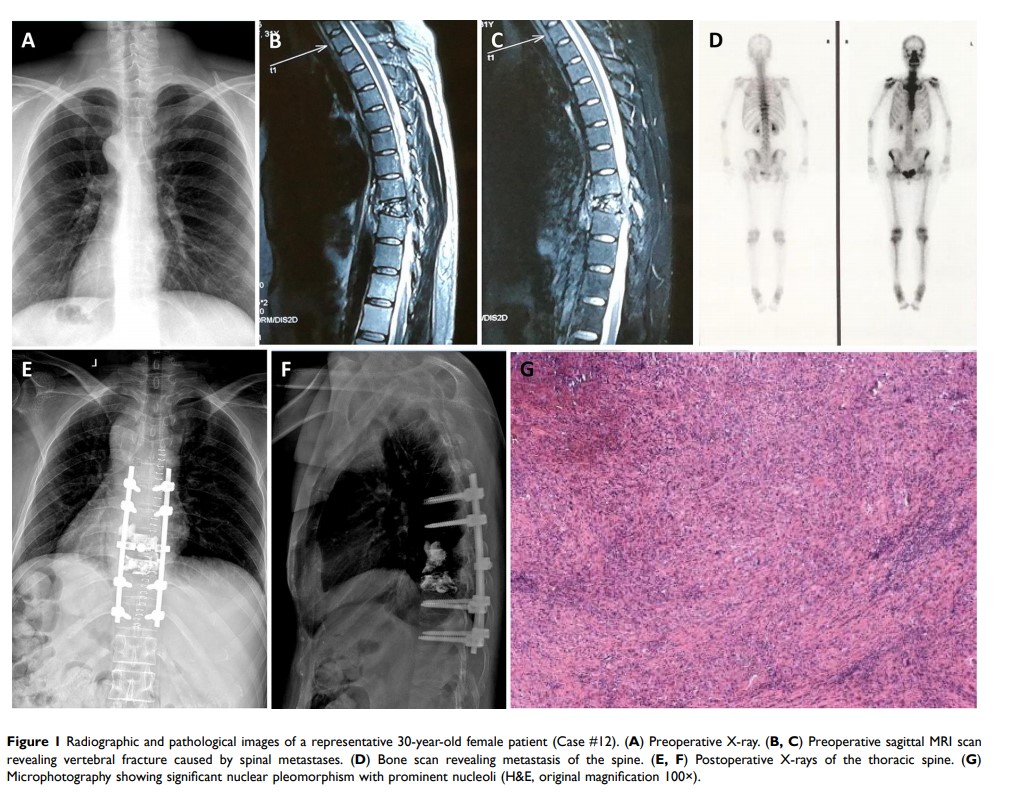
Objective: The purpose of this study is to provide key information on the clinical characteristics, surgical treatment, and potential prognostic factors in patients with metastatic spinal gynecologic cancer (MSGC), with a view to their application in clinical practice.
Methods: From January 2010 to January 2020, we performed a retrospective analysis of 14 patients with MSGC who underwent surgical treatment in a single center. Surgical treatment was performed on 14 patients, and a total of 14 operations were performed. The survival time of patients after spinal surgery was analyzed by Kaplan–Meier and Cox regression analysis.
Results: The average age of patients was 51.9 years (range 25‒70). The average time from initial surgery to the discovery of spinal metastasis was 60.3 months (2‒180), and the average follow-up time was 19.2 months (2‒55). Spinal tumor progression was found in 9 patients, and 12 patients (85.7%) died during follow-up. In univariate analysis, extraosseous visceral metastasis (p = 0.024), revised Tokuhashi stage (p = 0.025), Tomita stage (p = 0.005), and number of spinal lesions (p = 0.038) were associated with overall survival (OS). Extraosseous visceral metastasis (p = 0.026), revised Tokuhashi stage (p = 0.014), Tomita stage (p = 0.001), and gynecological cancer type (p = 0.039) were associated with progression-free survival.
Conclusion: Surgical treatment is an effective treatment for MSGC and relieves pain, restores function and rebuilds stability. Based on our single-center experience, extraosseous visceral metastasis, revised Tokuhashi stage, Tomita stage, and gynecological cancer type may be potential prognostic factors for OS.
Keywords: clinical prognosis, gynecological cancer, overall survival, progression-free survival, spinal metastasis, surgical treatment