115195
论文已发表
注册即可获取德孚的最新动态
IF 收录期刊
- 3.6 Breast Cancer (Dove Med Press)
- 4.3 Clin Epidemiol
- 2.6 Cancer Manag Res
- 3.2 Infect Drug Resist
- 4.1 Clin Interv Aging
- 6.1 Drug Des Dev Ther
- 4.1 Int J Chronic Obstr
- 8.7 Int J Nanomed
- 2.5 Int J Women's Health
- 3.2 Neuropsych Dis Treat
- 2.4 OncoTargets Ther
- 2.6 Patient Prefer Adher
- 2.6 Ther Clin Risk Manag
- 3.1 J Pain Res
- 3.5 Diabet Metab Synd Ob
- 4.5 Psychol Res Behav Ma
- 3.4 Nat Sci Sleep
- 2.4 Pharmgenomics Pers Med
- 2.6 Risk Manag Healthc Policy
- 4.6 J Inflamm Res
- 2.3 Int J Gen Med
- 3.9 J Hepatocell Carcinoma
- 3.3 J Asthma Allergy
- 2.5 Clin Cosmet Investig Dermatol
- 3.0 J Multidiscip Healthc

卡铂通过 IncRNA XIST/miR-200a-3p/NRP1 轴抑制视网膜母细胞瘤的进展
Authors Zhao H, Wan J, Zhu Y
Received 3 April 2020
Accepted for publication 10 June 2020
Published 21 August 2020 Volume 2020:14 Pages 3417—3427
DOI https://doi.org/10.2147/DDDT.S256813
Checked for plagiarism Yes
Review by Single anonymous peer review
Peer reviewer comments 2
Editor who approved publication: Dr Qiongyu Guo
Objective: This study was set out to explore the expression and related mechanism of XIST and miR-200a-3p in retinoblastoma (Rb).
Patients and Methods: Fifty-four children with Rb who came to our hospital for surgery from January 2018 to September 2019 were collected. In addition, Rb cells and human retinal epithelial cells were purchased. XIST-siRNA (si-XIST), XIST-shRNA (sh-XIST), empty vector plasmid (siRNA-NC), miR-200a-3p-mimics and miR − 200a-3p-inhibition were transfected into Y79 cells. The expression of XIST and miR-200a-3p in the samples were determined by qRT-PCR. β-catenin, cyclin B1, cyclin D1, Bax, Caspase-3, N-cadherin, vimentin, Snail, E-Cadherin and ZO-1 protein levels were measured by WB. MTT, Transwell and flow cytometry were utilized to detect cell proliferation, invasion, and apoptosis, respectively.
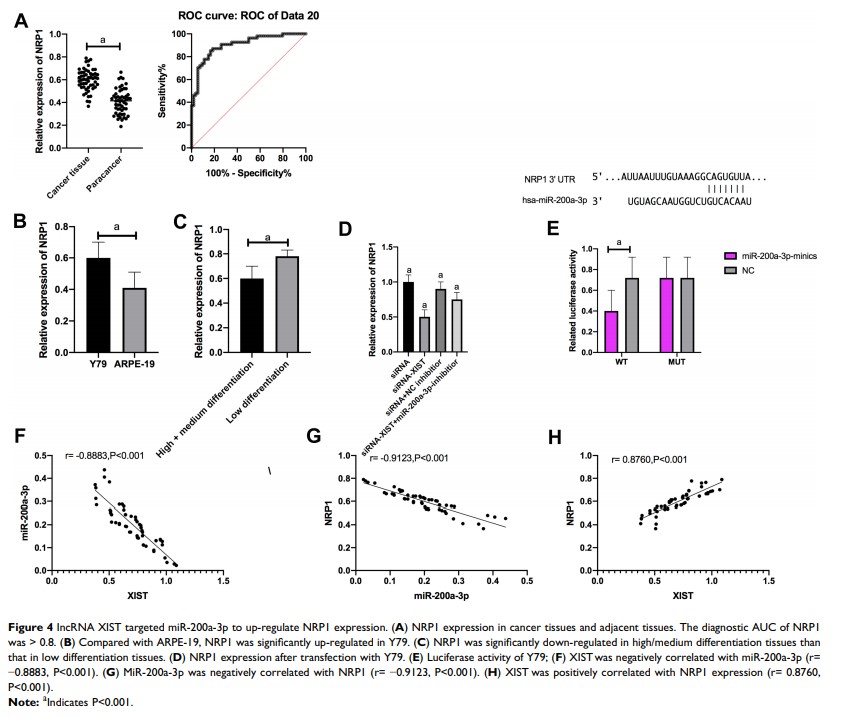
Results: XIST was highly expressed while miR-200a-3p was lowly expressed in patients’ tissues, and the AUC of both was over 0.8. XIST and miR-200a-3p was related to differentiation degree in Rb patients. Y79 cells were selected for transfection. Compared with the siRNA-NC group, XIST was significantly reduced in the siRNA-XIST group, and it was significantly increased in the shRNA-XIST group (P< 0.01). The proliferation capacity of siRNA-XIST group was decreased, while that of shRNA-XIST group was up-regulated. The apoptosis rate of siRNA-XIST group was significantly up-regulated, while that of shRNA-XIST group was decreased (P< 0.001). The invasive capacity of siRNA-XIST group was decreased, while that of shRNA-XIST group was up-regulated (P< 0.001). Silencing XIST and over-expressed miR-200a-3p could inhibit cell epithelial–mesenchymal transition (EMT), proliferation, invasion, and promote apoptosis. WB detection showed that Carboplatin + LncRNA XIST intervention group could more significantly inhibit β-catenin, cyclin B1, cyclin D1, N-cadherin, vimentin, Snail protein, and promote the up-regulation of Bax, Caspase-3, E-Cadherin and ZO-1 expression.
Conclusion: Inhibition of XIST expression can up-regulate miR-200a-3p-mediated PI3K-Akt/MAPK-ERK signaling pathway and affect cell EMT, proliferation, invasion, and apoptosis, which is expected to be a potential therapeutic target for Rb.
Keywords: lncRNA-XIST, miR-200a-3p, NRP1, epithelial–mesenchymal transition, retinoblastoma, biological mechanism