115195
论文已发表
注册即可获取德孚的最新动态
IF 收录期刊
- 3.6 Breast Cancer (Dove Med Press)
- 4.3 Clin Epidemiol
- 2.6 Cancer Manag Res
- 3.2 Infect Drug Resist
- 4.1 Clin Interv Aging
- 6.1 Drug Des Dev Ther
- 4.1 Int J Chronic Obstr
- 8.7 Int J Nanomed
- 2.5 Int J Women's Health
- 3.2 Neuropsych Dis Treat
- 2.4 OncoTargets Ther
- 2.6 Patient Prefer Adher
- 2.6 Ther Clin Risk Manag
- 3.1 J Pain Res
- 3.5 Diabet Metab Synd Ob
- 4.5 Psychol Res Behav Ma
- 3.4 Nat Sci Sleep
- 2.4 Pharmgenomics Pers Med
- 2.6 Risk Manag Healthc Policy
- 4.6 J Inflamm Res
- 2.3 Int J Gen Med
- 3.9 J Hepatocell Carcinoma
- 3.3 J Asthma Allergy
- 2.5 Clin Cosmet Investig Dermatol
- 3.0 J Multidiscip Healthc

源自卵巢的腹膜假黏液瘤的临床病理特征
Authors Yan F, Shi F, Li X, Yu C, Lin Y, Li Y, Jin M
Received 29 May 2020
Accepted for publication 3 August 2020
Published 21 August 2020 Volume 2020:12 Pages 7569—7578
DOI https://doi.org/10.2147/CMAR.S264474
Checked for plagiarism Yes
Review by Single anonymous peer review
Peer reviewer comments 2
Editor who approved publication: Dr Eileen O'Reilly
Objective: This study aims to demonstrate clinicopathological characteristics and immunohistopathological phenotypes of pseudomyxoma peritonei (PMP) originated from ovaries.
Methods: The primary origin of PMP was explored by reviewing H&E sections retrospectively and performing a series of immunohistochemical staining on CK7, CK20, CDX2, CEA, Villin, SATB2, CA125, ER, PR, and MUC.
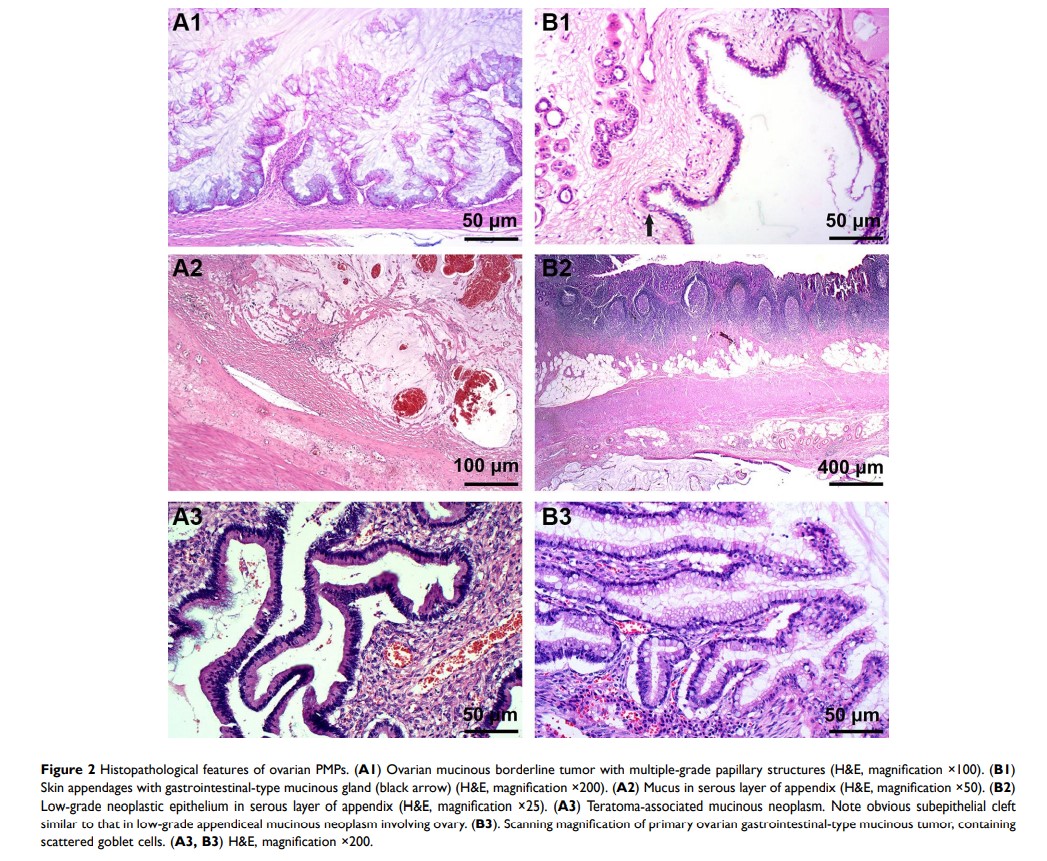
Results: Among 310 PMP patients, a few originated from extra-appendix, whereas eight cases were of ovarian origin (2.6%), including three teratoma-associated ovarian mucinous tumors and five primary ovarian mucinous tumors with spontaneous or iatrogenic rupture, respectively. Most peritoneal metastases were acellular mucin or low-grade mucinous carcinoma peritonei (6/8, 75%), while the rest were high-grade mucinous carcinoma peritonei (2/8, 25%). Tumors were positive for CK20, CDX2, CEA, and Villin. SATB2 was specifically diffuse positive in teratoma-associated ovarian mucinous tumors, and negative in primary ovarian mucinous tumors. Differential expression of MUC was observed in these tumors.
Conclusion: PMP of ovarian origin is extremely rare. The precise diagnosis requires serial sections of the appendix or suspicious tissue to exclude appendiceal mucinous neoplasms, as well as comprehensive analysis of clinical features, surgical findings, histopathological characteristics, and immunohistochemistry on specific biomarkers.
Keywords: pseudomyxoma peritonei, PMP, ovary, mucinous tumor