119661
论文已发表
注册即可获取德孚的最新动态
IF 收录期刊
- 3.6 Breast Cancer (Dove Med Press)
- 4.3 Clin Epidemiol
- 2.6 Cancer Manag Res
- 3.2 Infect Drug Resist
- 4.1 Clin Interv Aging
- 6.1 Drug Des Dev Ther
- 4.1 Int J Chronic Obstr
- 8.7 Int J Nanomed
- 2.5 Int J Women's Health
- 3.2 Neuropsych Dis Treat
- 2.4 OncoTargets Ther
- 2.6 Patient Prefer Adher
- 2.6 Ther Clin Risk Manag
- 3.1 J Pain Res
- 3.5 Diabet Metab Synd Ob
- 4.5 Psychol Res Behav Ma
- 3.4 Nat Sci Sleep
- 2.4 Pharmgenomics Pers Med
- 2.6 Risk Manag Healthc Policy
- 4.6 J Inflamm Res
- 2.3 Int J Gen Med
- 3.9 J Hepatocell Carcinoma
- 3.3 J Asthma Allergy
- 2.5 Clin Cosmet Investig Dermatol
- 3.0 J Multidiscip Healthc

戊四氮诱发的小鼠癫痫发作中,硒纳米颗粒的治疗前逆行为、氧化损伤、神经元丢失和神经化学变化
Authors Yuan X, Fu Z, Ji P, Guo L, Al-Ghamdy AO, Alkandiri A, Habotta OA, Abdel Moneim AE, Kassab RB
Received 21 April 2020
Accepted for publication 30 July 2020
Published 24 August 2020 Volume 2020:15 Pages 6339—6353
DOI https://doi.org/10.2147/IJN.S259134
Checked for plagiarism Yes
Review by Single anonymous peer review
Peer reviewer comments 2
Editor who approved publication: Dr Linlin Sun
Introduction: Epilepsy is a chronic neurological condition characterized by behavioral, molecular, and neurochemical alterations. Current antiepileptic drugs are associated with various adverse impacts. The main goal of the current study is to investigate the possible anticonvulsant effect of selenium nanoparticles (SeNPs) against pentylenetetrazole (PTZ)-mediated epileptic seizures in mice hippocampus. Sodium valproate (VPA) was used as a standard anti-epileptic drug.
Methods: Mice were assigned into five groups (n=15): control, SeNPs (5 mg/kg, orally), PTZ (60 mg/kg, intraperitoneally), SeNPs+PTZ and VPA (200 mg/kg)+PTZ. All groups were treated for 10 days.
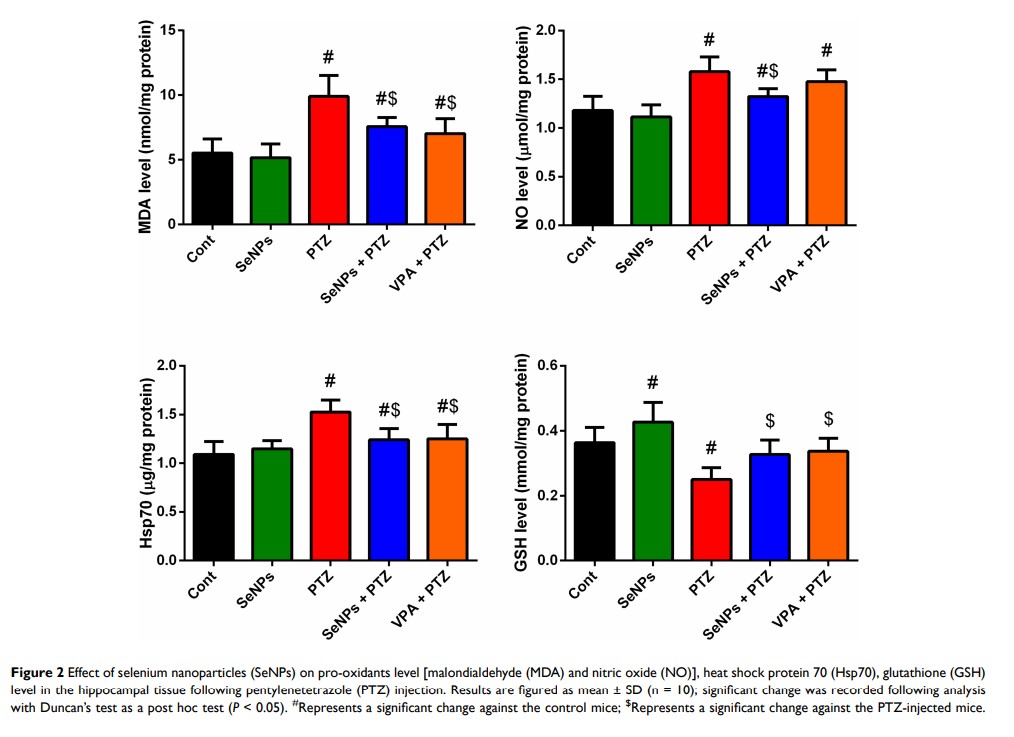
Results: PTZ injection triggered a state of oxidative stress in the hippocampal tissue as represented by the elevated lipoperoxidation, heat shock protein 70 level, and nitric oxide formation while decreased glutathione level and antioxidant enzymes activity. Additionally, the blotting analysis showed downregulation of nuclear factor erythroid 2-related factor 2 (Nrf2) and heme oxygenase-1 (HO-1) in the epileptic mice. A state of neuroinflammation was recorded following the developed seizures represented by the increased pro-inflammatory cytokines. Moreover, neuronal apoptosis was recorded following the development of epileptic convulsions. At the neurochemical level, acetylcholinesterase activity and monoamines content were decreased in the epileptic mice, accompanied by high glutamate and low GABA levels in the hippocampal tissue. However, SeNP supplementation was found to delay the onset and decreased the duration of tonic, myoclonic, and generalized seizures following PTZ injection. Moreover, SeNPs were found to provide neuroprotection through preventing the development of oxidative challenge via the upregulation of Nrf2 and HO-1, inhibiting the inflammatory response and apoptotic cascade. Additionally, SeNPs reversed the changes in the activity and levels of neuromodulators following the development of epileptic seizures.
Conclusion: The obtained results suggest that SeNPs could be used as a promising anticonvulsant drug due to its potent antioxidant, anti-inflammatory, and neuromodulatory activities.
Keywords: epilepsy, selenium nanoparticles, oxidative stress, neuroinflammation and apoptosis, monoamines, GABA and glutamate