115195
论文已发表
注册即可获取德孚的最新动态
IF 收录期刊
- 3.6 Breast Cancer (Dove Med Press)
- 4.3 Clin Epidemiol
- 2.6 Cancer Manag Res
- 3.2 Infect Drug Resist
- 4.1 Clin Interv Aging
- 6.1 Drug Des Dev Ther
- 4.1 Int J Chronic Obstr
- 8.7 Int J Nanomed
- 2.5 Int J Women's Health
- 3.2 Neuropsych Dis Treat
- 2.4 OncoTargets Ther
- 2.6 Patient Prefer Adher
- 2.6 Ther Clin Risk Manag
- 3.1 J Pain Res
- 3.5 Diabet Metab Synd Ob
- 4.5 Psychol Res Behav Ma
- 3.4 Nat Sci Sleep
- 2.4 Pharmgenomics Pers Med
- 2.6 Risk Manag Healthc Policy
- 4.6 J Inflamm Res
- 2.3 Int J Gen Med
- 3.9 J Hepatocell Carcinoma
- 3.3 J Asthma Allergy
- 2.5 Clin Cosmet Investig Dermatol
- 3.0 J Multidiscip Healthc

中国人群 SMAD3/SMAD6 单核苷酸多态性与食管鳞状细胞癌风险的关系
Authors Yu J, Dong Y, Tang W, Pan H, Lv L, Long T, Zhou Q, Qi J, Liu J, Ding G, Yin J, Tan L
Received 16 February 2020
Accepted for publication 20 July 2020
Published 24 August 2020 Volume 2020:13 Pages 355—363
DOI https://doi.org/10.2147/PGPM.S250076
Checked for plagiarism Yes
Review by Single anonymous peer review
Peer reviewer comments 2
Editor who approved publication: Dr Martin Bluth
Background: The TGF-β signal pathways play a key role in the development and promotion of squamous cell carcinoma (SCC). The pathway is mediated by the SMAD family proteins that include SMAD3 and SMAD6 . Our study aimed to evaluate the relationship between single nucleotide polymorphism (SNP) of SMAD3/SMAD6 and susceptibility to esophageal squamous cell carcinoma (ESCC) in the Chinese population.
Patients and Methods: This was a hospital-based case–control study compromised of 1043 ESCC patients and 1315 non-cancer patients. Seven SMAD3/SMAD6 (rs8028147, rs3743343, rs3743342, rs8025774, rs8031440, rs803167, and rs34643453) SNPs were selected and used to evaluate their correlation with ESCC susceptibility. Genetic model tests, stratified analyses, linkage disequilibrium analyses, and haplotype analyses were performed in our study.
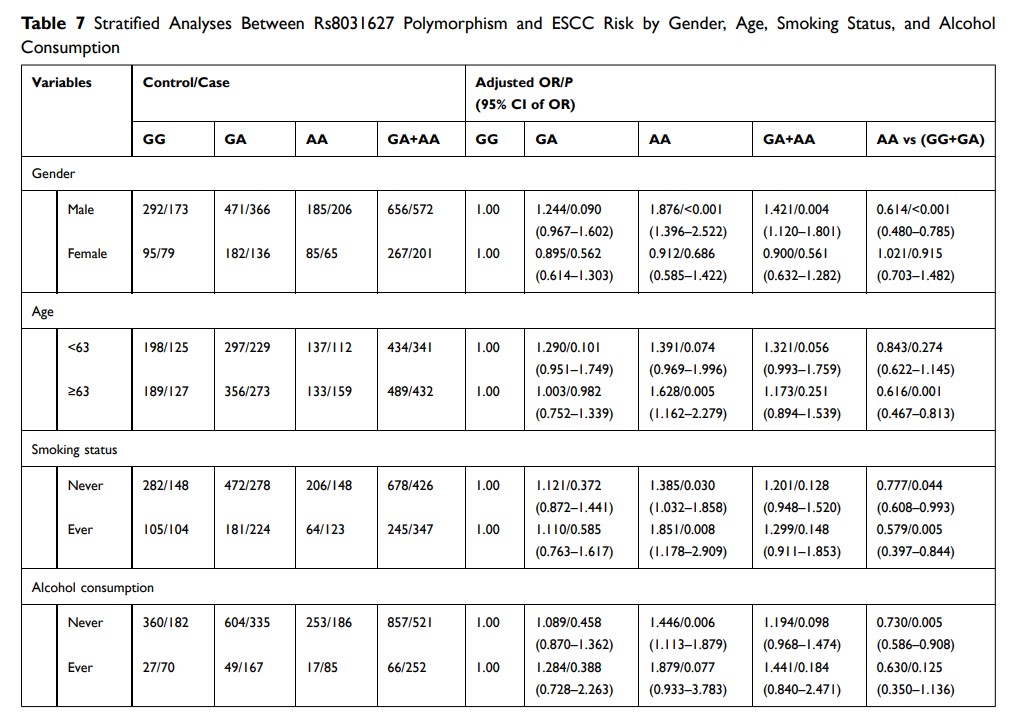
Results: Participants with SMAD3 rs3743342 C>T, rs8025774 C>T, rs8031440 G>A or rs8031627 G>A had a significantly higher risk of ESCC. This was more evident in males, older patients (> 63 years), smokers, and non-alcohol drinking participants. Linkage disequilibrium analyses further revealed that there were strong correlations between SMAD3 rs3743342 C>T, rs8025774 C>T, rs8031440 G>A, and rs8031627 G>A. In the same line, haplotype analyses revealed that SMAD3 ACCCGGSMAD6 A and SMAD3 AGCCGGSMAD6 A were associated with less susceptibility to ESCC while SMAD3 ATTTAASMAD6 A was associated with a higher risk of ESCC.
Conclusion: SNPs of SMAD3 were related to higher susceptibility to ESCC. As such, they may contribute to the development of viable strategies for early diagnosis and treatment of ESCC. However, more detailed association mechanisms between SMAD3/SMAD6 SNPs and ESCC need further experiments to prove.
Keywords: SMAD , single nucleotide polymorphism, esophageal squamous cell carcinoma