119661
论文已发表
注册即可获取德孚的最新动态
IF 收录期刊
- 3.6 Breast Cancer (Dove Med Press)
- 4.3 Clin Epidemiol
- 2.6 Cancer Manag Res
- 3.2 Infect Drug Resist
- 4.1 Clin Interv Aging
- 6.1 Drug Des Dev Ther
- 4.1 Int J Chronic Obstr
- 8.7 Int J Nanomed
- 2.5 Int J Women's Health
- 3.2 Neuropsych Dis Treat
- 2.4 OncoTargets Ther
- 2.6 Patient Prefer Adher
- 2.6 Ther Clin Risk Manag
- 3.1 J Pain Res
- 3.5 Diabet Metab Synd Ob
- 4.5 Psychol Res Behav Ma
- 3.4 Nat Sci Sleep
- 2.4 Pharmgenomics Pers Med
- 2.6 Risk Manag Healthc Policy
- 4.6 J Inflamm Res
- 2.3 Int J Gen Med
- 3.9 J Hepatocell Carcinoma
- 3.3 J Asthma Allergy
- 2.5 Clin Cosmet Investig Dermatol
- 3.0 J Multidiscip Healthc

恶性肠梗阻的手术和保守治疗:结果和预后因素
Authors Yu K, Liu L, Zhang X, Zhang Z, Rao B, Chen Y, Li S, Shi H
Received 31 March 2020
Accepted for publication 5 August 2020
Published 24 August 2020 Volume 2020:12 Pages 7797—7803
DOI https://doi.org/10.2147/CMAR.S256219
Checked for plagiarism Yes
Review by Single anonymous peer review
Peer reviewer comments 2
Editor who approved publication: Dr Beicheng Sun
Purpose: Malignant bowel obstruction (MBO) is a common problem in late-stage cancer patients. Many factors are suggested to be associated with the prognosis of MBO. The current investigation was designed to explore the factors associated with the prognosis of conservative and surgery treatment in one single institution.
Patients and Methods: Sixty-four patients of MBO were recruited into the study. Demographic and clinical data including gender, age, primary cancer, radiological and laboratory examinations, and nutritional and pain index scaling were extracted for further analysis. Kaplan–Meier analysis and logistic regression analysis were used to compare the prognosis and detect significant factors.
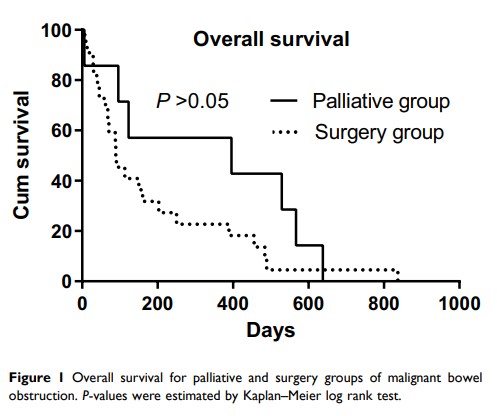
Results: Of the 64 patients, there is no statistical difference in baseline features between conservative and surgical group. However, the length of stay, total medical costs, re-admission interval, and re-admission rate are statistically significant. There is no significance in Kaplan–Meier log rank test for median survival time, though the overall survival time in the conservative group is longer than that of the surgery group. Logistic regression analysis has found that prior chemotherapy is a significant predictor for final survival outcome.
Conclusion: The election of surgery might not improve the overall survival time. Non-surgical procedures, especially chemotherapy, might be preferable for MBO patients.
Keywords: malignant bowel obstruction, surgical treatment, conservative management, prognosis, survival