119661
论文已发表
注册即可获取德孚的最新动态
IF 收录期刊
- 3.6 Breast Cancer (Dove Med Press)
- 4.3 Clin Epidemiol
- 2.6 Cancer Manag Res
- 3.2 Infect Drug Resist
- 4.1 Clin Interv Aging
- 6.1 Drug Des Dev Ther
- 4.1 Int J Chronic Obstr
- 8.7 Int J Nanomed
- 2.5 Int J Women's Health
- 3.2 Neuropsych Dis Treat
- 2.4 OncoTargets Ther
- 2.6 Patient Prefer Adher
- 2.6 Ther Clin Risk Manag
- 3.1 J Pain Res
- 3.5 Diabet Metab Synd Ob
- 4.5 Psychol Res Behav Ma
- 3.4 Nat Sci Sleep
- 2.4 Pharmgenomics Pers Med
- 2.6 Risk Manag Healthc Policy
- 4.6 J Inflamm Res
- 2.3 Int J Gen Med
- 3.9 J Hepatocell Carcinoma
- 3.3 J Asthma Allergy
- 2.5 Clin Cosmet Investig Dermatol
- 3.0 J Multidiscip Healthc

双参数 MRI 和 TRUS 引导的系统性活检对预测前列腺癌不良病理的临床参数的附加价值
Authors Liu H, Tang K, Xia D, Wang X, Zhu W, Wang L, Yang W, Peng E, Chen Z
Received 7 May 2020
Accepted for publication 6 August 2020
Published 24 August 2020 Volume 2020:12 Pages 7761—7770
DOI https://doi.org/10.2147/CMAR.S260986
Checked for plagiarism Yes
Review by Single anonymous peer review
Peer reviewer comments 2
Editor who approved publication: Dr Sanjeev Srivastava
Objective: To develop novel models for predicting extracapsular extension (EPE), seminal vesicle invasion (SVI), or upgrading in prostate cancer (PCa) patients using clinical parameters, biparametric magnetic resonance imaging (bp-MRI), and transrectal ultrasonography (TRUS)-guided systematic biopsies.
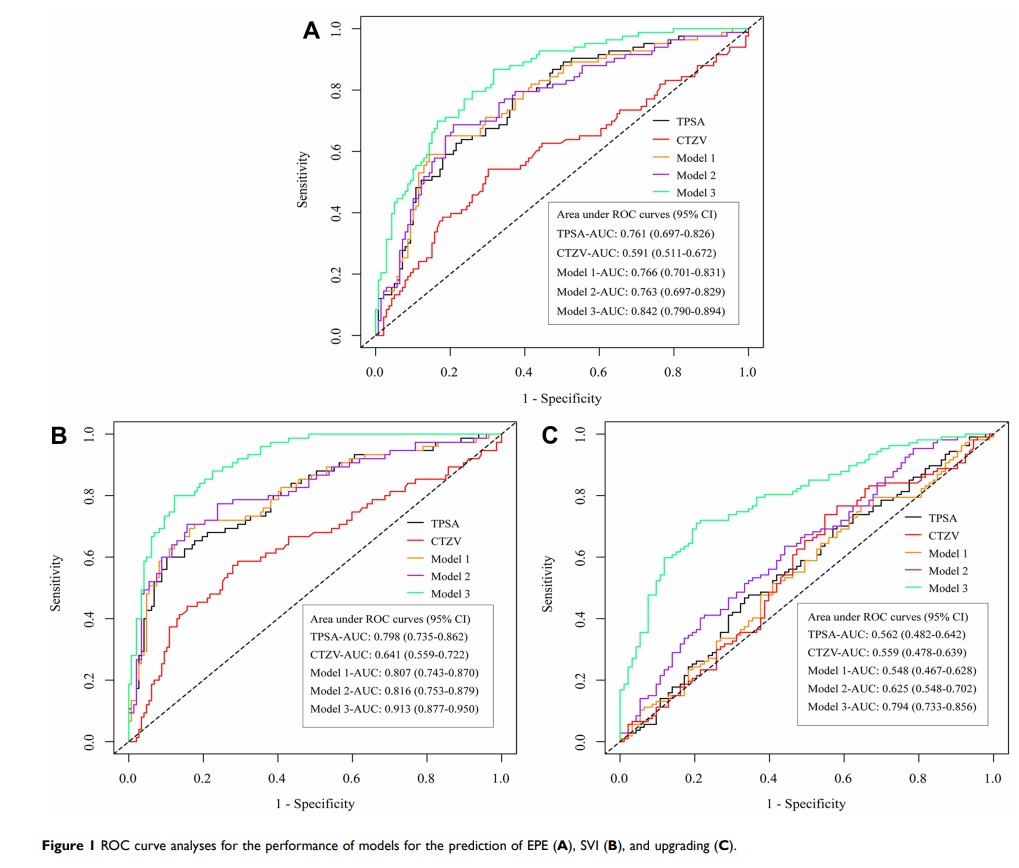
Patients and Methods: We retrospectively collected data from PCa patients who underwent standard (12-core) systematic biopsy and radical prostatectomy. To develop predictive models, the following variables were included in multivariable logistic regression analyses: total prostate-specific antigen (TPSA), central transition zone volume (CTZV), prostate-specific antigen (PSAD), maximum diameter of the index lesion at bp-MRI, EPE at bp-MRI, SVI at bp-MRI, biopsy Gleason grade group, and number of positive biopsy cores. Three risk calculators were built based on the coefficients of the logit function. The area under the curve (AUC) was applied to determine the models with the highest discrimination. Decision curve analyses (DCAs) were performed to evaluate the net benefit of each risk calculator.
Results: A total of 222 patients were included in this study. Overall, 83 (37.4%), 75 (33.8%), and 107 (48.2%) patients had EPE, SVI, and upgrading at final pathology, respectively. The addition of bp-MRI data improved the discrimination of models for predicting SVI (0.807 vs 0.816) and upgrading (0.548 vs 0.625) but not EPE (0.766 vs 0.763). Similarly, models including clinical parameters, bp-MRI data, and information on systematic biopsies achieved the highest AUC in the prediction of EPE (0.842), SVI (0.913), and upgrading (0.794), and the three corresponding risk calculators yielded the highest net benefit.
Conclusion: We developed three easy-to-use risk calculators for the prediction of adverse pathological features based on patient clinical parameters, bp-MRI data, and information on systematic biopsies. This may be greatly beneficial to urologists in the decision-making process for PCa patients.
Keywords: prostate cancer, extracapsular extension, seminal vesicle invasion, upgrading, biparametric MRI, systematic biopsy, predictive model