119942
论文已发表
注册即可获取德孚的最新动态
IF 收录期刊
- 3.6 Breast Cancer (Dove Med Press)
- 4.3 Clin Epidemiol
- 2.6 Cancer Manag Res
- 3.2 Infect Drug Resist
- 4.1 Clin Interv Aging
- 6.1 Drug Des Dev Ther
- 4.1 Int J Chronic Obstr
- 8.7 Int J Nanomed
- 2.5 Int J Women's Health
- 3.2 Neuropsych Dis Treat
- 2.4 OncoTargets Ther
- 2.6 Patient Prefer Adher
- 2.6 Ther Clin Risk Manag
- 3.1 J Pain Res
- 3.5 Diabet Metab Synd Ob
- 4.5 Psychol Res Behav Ma
- 3.4 Nat Sci Sleep
- 2.4 Pharmgenomics Pers Med
- 2.6 Risk Manag Healthc Policy
- 4.6 J Inflamm Res
- 2.3 Int J Gen Med
- 3.9 J Hepatocell Carcinoma
- 3.3 J Asthma Allergy
- 2.5 Clin Cosmet Investig Dermatol
- 3.0 J Multidiscip Healthc

苹果酸酶 1 可显示乳腺癌的较差预后,并且通过控制活性氧簇促进转移
Authors Liu C, Cao J, Lin S, Zhao Y, Zhu M, Tao Z, Hu X
Received 5 April 2020
Accepted for publication 10 August 2020
Published 26 August 2020 Volume 2020:13 Pages 8735—8747
DOI https://doi.org/10.2147/OTT.S256970
Checked for plagiarism Yes
Review by Single anonymous peer review
Peer reviewer comments 2
Editor who approved publication: Dr William Cho
Purpose: Malic enzyme 1 (ME1) catalyzes malate to pyruvate and thus promotes glycolysis. Its function in breast cancer remains to be fully clarified. The aim of this work was to investigate the prognostic value of ME1 and its possible mechanism in breast cancer.
Methods: We evaluated ME1 expression in 220 early breast cancer patients with tissue microarray-based immunohistochemistry and explored the relationships between ME1 expression and clinicopathological features. Survival analyses were further performed to determine its prognostic value. The public database was used to confirm tissue microarray results. Further, cell proliferation, migration, invasion ability and reactive oxygen species (ROS) were examined in breast cancer cells.
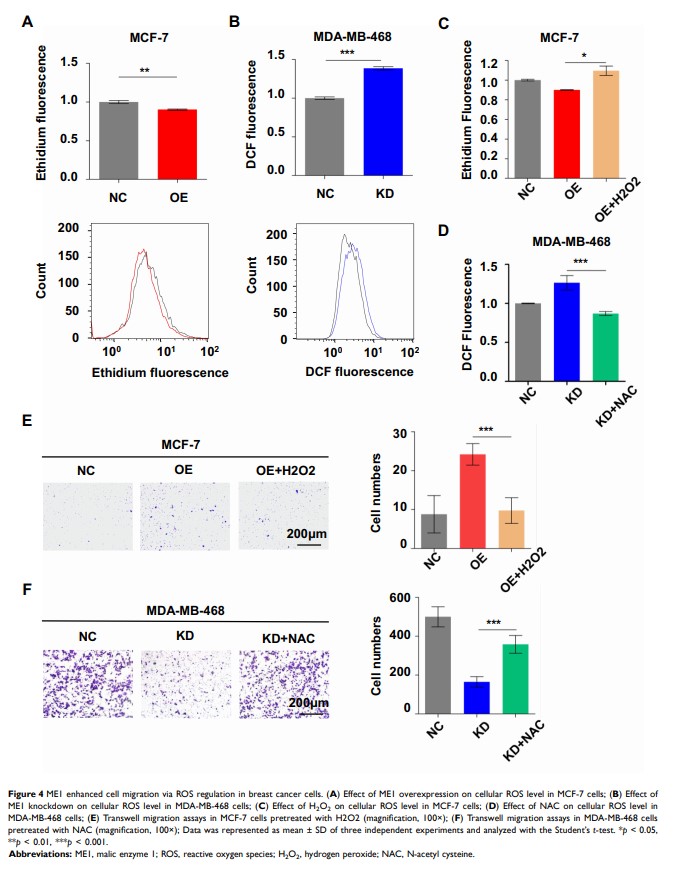
Results: In breast cancer tissues, high ME1 expression was significantly associated with larger tumor size, higher incidence of lymph node metastasis and higher incidence of lymph-vascular invasion. High ME1 expression significantly correlated with worse recurrence-free survival (RFS), and was an independent prognostic factor for RFS, which was confirmed by mRNA results in the public database. In vitro, upregulation of ME1 by transfecting MCF-7 cells with virus vector remarkably enhanced viability, motility and epithelial–mesenchymal transition (EMT) and decreased ROS levels, whereas knockdown in MDA-MB-468 cells produced totally opposite effects as expected. When pretreated with oxidizing agent, MCF-7 cells overexpressing ME1 lost its motility, whereas MDA-MB-468 cells with knockdown of ME1 restored its motility when pretreated with antioxidant.
Conclusion: To our knowledge, these clinical and experiment works first suggested that ME1 may be a novel biomarker and potential therapeutic target for breast cancer metastasis, and its biological effect is mainly controlled by manipulating ROS.
Keywords: malic enzyme 1, breast cancer, prognosis, metastasis, reactive oxygen species