115195
论文已发表
注册即可获取德孚的最新动态
IF 收录期刊
- 3.6 Breast Cancer (Dove Med Press)
- 4.3 Clin Epidemiol
- 2.6 Cancer Manag Res
- 3.2 Infect Drug Resist
- 4.1 Clin Interv Aging
- 6.1 Drug Des Dev Ther
- 4.1 Int J Chronic Obstr
- 8.7 Int J Nanomed
- 2.5 Int J Women's Health
- 3.2 Neuropsych Dis Treat
- 2.4 OncoTargets Ther
- 2.6 Patient Prefer Adher
- 2.6 Ther Clin Risk Manag
- 3.1 J Pain Res
- 3.5 Diabet Metab Synd Ob
- 4.5 Psychol Res Behav Ma
- 3.4 Nat Sci Sleep
- 2.4 Pharmgenomics Pers Med
- 2.6 Risk Manag Healthc Policy
- 4.6 J Inflamm Res
- 2.3 Int J Gen Med
- 3.9 J Hepatocell Carcinoma
- 3.3 J Asthma Allergy
- 2.5 Clin Cosmet Investig Dermatol
- 3.0 J Multidiscip Healthc

FAM46B 通过抑制 MYC-LDHA 轴来促进前列腺癌细胞的细胞凋亡并遏制糖酵解
Authors Liang T, Ye X, Yan D, Deng C, Li Z, Tian B
Received 17 April 2020
Accepted for publication 18 July 2020
Published 1 September 2020 Volume 2020:13 Pages 8771—8782
DOI https://doi.org/10.2147/OTT.S258724
Checked for plagiarism Yes
Review by Single anonymous peer review
Peer reviewer comments 2
Editor who approved publication: Dr Sanjay Singh
Objective: Increased dependence on glycolysis is a known element of cancer. This study was designed to examine critical glycolysis components including transcription factor MYC and its downstream target lactate dehydrogenase A (LDHA), potential upstream regulators of glycolysis such as family with sequence similarity 46 member B (FAM46B), and the impact of the abundance of these proteins on apoptosis and glycolysis in prostate cancer.
Materials and Methods: A total of 70 primary prostate cancer patient samples were compared to normal tissues for FAM46B and LDHA expression and the corresponding patients’ survival was monitored for 60 months. Prostate cancer cell lines were employed for protein expression manipulation, glucose uptake and LDH assays, and apoptosis measurements. A xenograft mouse model was used to quantify the role of FAM46B and LDHA on tumor growth in vivo.
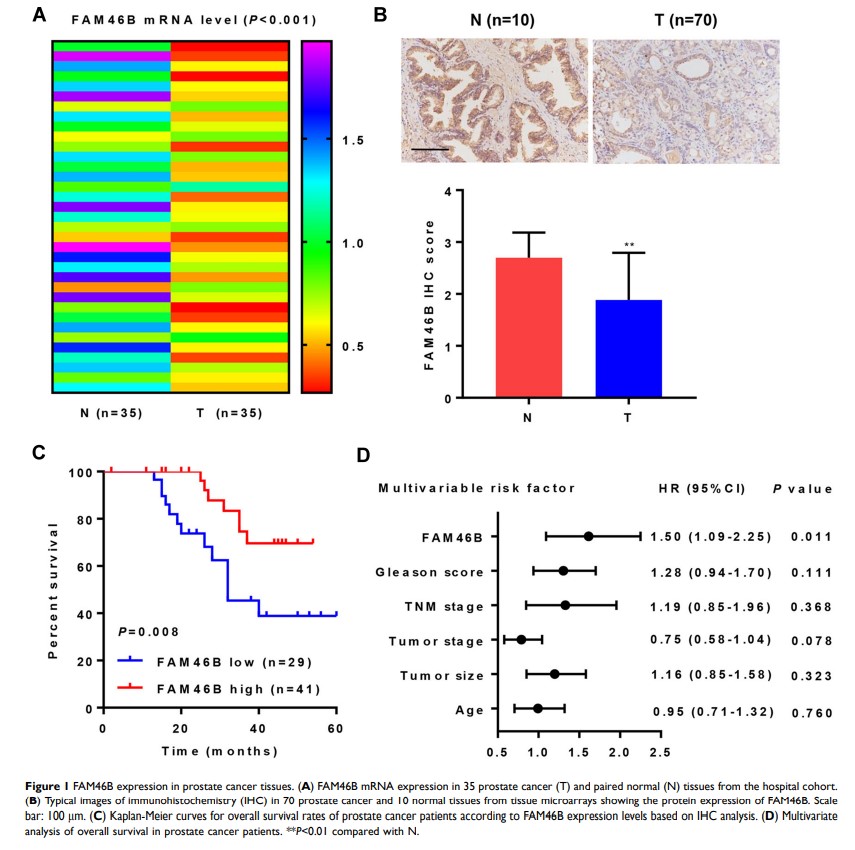
Results: FAM46B expression was reduced in prostate tumor tissue compared to normal tissue and prostate cancer patients who expressed low amounts of FAM46B had shortened average lifespans compared to those who expressed higher amounts of FAM46B (p =0.008). FAM46B overexpression reduced glucose uptake, decreased LDH activity, and induced apoptosis in prostate cancer cell lines while FAM46B shRNA increased MYC levels in a non-malignant prostate cell line (P69). Conversely, forced expression of LDHA in LNCaP cells produced an increase in glycolysis markers with a corresponding decrease in apoptosis. FAM46B-overexpressing xenografts had starkly blunted growth which was restored with co-overexpression of LDHA.
Conclusion: FAM46B plays a central role in regulating glycolysis and apoptosis in prostate cancer and operates through the regulation of LDHA via MYC. FAM46B’s keystone status in prostate cancer makes it a potential, robust biomarker for prostate cancer prognosis and a promising therapeutic target.
Keywords: prostate cancer, LDHA, FAM46B, glycolysis