115195
论文已发表
注册即可获取德孚的最新动态
IF 收录期刊
- 3.6 Breast Cancer (Dove Med Press)
- 4.3 Clin Epidemiol
- 2.6 Cancer Manag Res
- 3.2 Infect Drug Resist
- 4.1 Clin Interv Aging
- 6.1 Drug Des Dev Ther
- 4.1 Int J Chronic Obstr
- 8.7 Int J Nanomed
- 2.5 Int J Women's Health
- 3.2 Neuropsych Dis Treat
- 2.4 OncoTargets Ther
- 2.6 Patient Prefer Adher
- 2.6 Ther Clin Risk Manag
- 3.1 J Pain Res
- 3.5 Diabet Metab Synd Ob
- 4.5 Psychol Res Behav Ma
- 3.4 Nat Sci Sleep
- 2.4 Pharmgenomics Pers Med
- 2.6 Risk Manag Healthc Policy
- 4.6 J Inflamm Res
- 2.3 Int J Gen Med
- 3.9 J Hepatocell Carcinoma
- 3.3 J Asthma Allergy
- 2.5 Clin Cosmet Investig Dermatol
- 3.0 J Multidiscip Healthc

慢性阻塞性肺疾病和牙周炎患者的牙周状况和微生物病原体:一个病例对照研究
Authors Zhou X, Wang J, Liu W, Huang X, Song Y, Wang Z, Jia X
Received 7 June 2020
Accepted for publication 11 August 2020
Published 3 September 2020 Volume 2020:15 Pages 2071—2079
DOI https://doi.org/10.2147/COPD.S266612
Checked for plagiarism Yes
Review by Single anonymous peer review
Peer reviewer comments 3
Editor who approved publication: Dr Richard Russell
Purpose: To evaluate clinical periodontal status and microbiologic pathogens in patients with chronic obstructive pulmonary disease (COPD) and periodontitis.
Patients and Methods: We conducted a case–control study of 60 periodontitis patients with COPD (case group) and 60 periodontitis patients with normal pulmonary function (control group). Their periodontal status and respiratory function were clinically examined. Real-time polymerase chain reaction assays were used to measure five dental pathogens and four respiratory pathogens in subgingival dental plaque. Spearman’s rank correlation coefficients (r2) were calculated to assess correlations of pathogens. Principal component analysis (PCA) was employed to assess the similarity of bacterial diversity between the two groups. Logistic regression was performed to examine the associations of periodontal variables and pathogens with COPD risk.
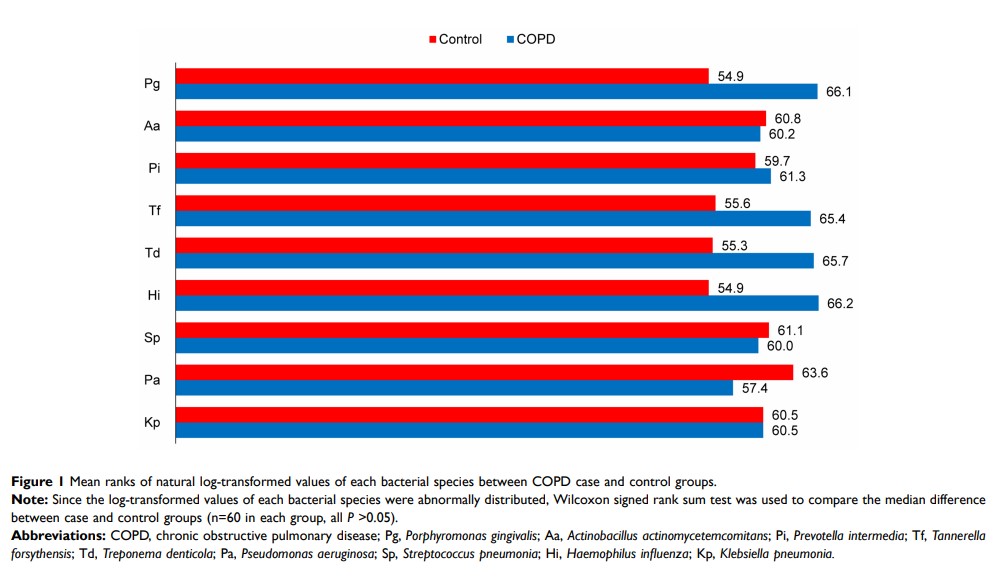
Results: COPD patients had fewer remaining teeth, higher plaque index (PLI), and more severe site percentages of clinical attachment level (CAL) than the controls. Although COPD patients tended to have relatively higher ranked means of Porphyromonas gingivalis, Tannerella forsythensis, Treponema denticola , and Haemophilus influenza than control participants, the differences were not significant. Some periodontal pathogens and respiratory pathogens were positively correlated with each other (r2 =0.29 to 0.47, all P < 0.05). The PCA graph showed that the distributions of pathogens were more dispersed but less discriminated in the COPD group than those in the control group. PLI (P = 0.045) and CAL ≥ 5mm site percentages (P = 0.01) were significantly associated with an increased risk of COPD, while pathogens were not associated with COPD.
Conclusion: Our results from this study do not indicate periodontal pathogens as potential predictors of COPD risk, despite significantly poor periodontal status associated with COPD.
Keywords: periodontal, COPD, bacteria, observational research