119942
论文已发表
注册即可获取德孚的最新动态
IF 收录期刊
- 3.6 Breast Cancer (Dove Med Press)
- 4.3 Clin Epidemiol
- 2.6 Cancer Manag Res
- 3.2 Infect Drug Resist
- 4.1 Clin Interv Aging
- 6.1 Drug Des Dev Ther
- 4.1 Int J Chronic Obstr
- 8.7 Int J Nanomed
- 2.5 Int J Women's Health
- 3.2 Neuropsych Dis Treat
- 2.4 OncoTargets Ther
- 2.6 Patient Prefer Adher
- 2.6 Ther Clin Risk Manag
- 3.1 J Pain Res
- 3.5 Diabet Metab Synd Ob
- 4.5 Psychol Res Behav Ma
- 3.4 Nat Sci Sleep
- 2.4 Pharmgenomics Pers Med
- 2.6 Risk Manag Healthc Policy
- 4.6 J Inflamm Res
- 2.3 Int J Gen Med
- 3.9 J Hepatocell Carcinoma
- 3.3 J Asthma Allergy
- 2.5 Clin Cosmet Investig Dermatol
- 3.0 J Multidiscip Healthc

由聚多巴胺介导的 BMP-2 固定的静电纺纤维与自体肌腱结合,可修复猪模型的髋关节发育异常
Authors Wu R, Gao G, Xu Y
Received 24 April 2020
Accepted for publication 10 August 2020
Published 7 September 2020 Volume 2020:15 Pages 6563—6577
DOI https://doi.org/10.2147/IJN.S259028
Checked for plagiarism Yes
Review by Single anonymous peer review
Peer reviewer comments 3
Editor who approved publication: Dr Mian Wang
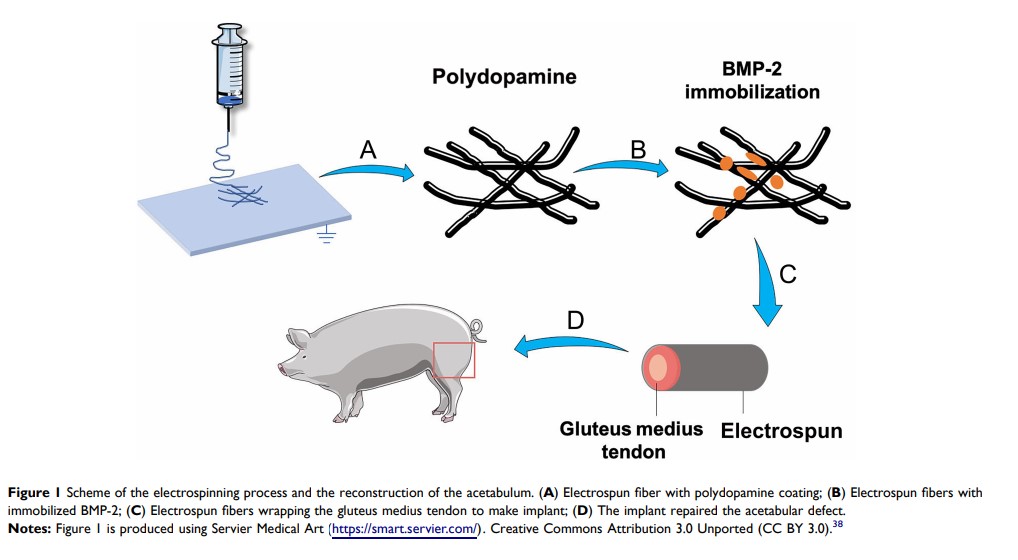
Purpose: Developmental dysplasia of the hip (DDH) can increase the pressure between the joints, which causes secondary hip osteoarthritis. The aim of the present study was to fabricate poly(D, L-lactic acid)-poly(ethylene glycol)-poly(D, L-lactic acid) (PELA) electrospun fibrous scaffolds, immobilized with bone morphogenetic protein-2 (BMP-2), to repair the acetabulum defects.
Methods: The characteristics of PELA electrospun were analyzed using scanning electron microscopy, the release kinetics of BMP-2 in vitro were analyzed using enzyme-linked immunosorbent assays. Human mesenchymal stem cells (hMSCs) were used for in vitro experiments, the biocompatibility of the electrospinning materials was investigated using a cell counting kit-8 (CCK-8) kit, and osteogenic differentiation was tested via alkaline phosphatase (ALP) activity and relative gene expression. Eighteen miniature pig animal models were used in the in vivo experiment. The pigs were sacrificed at 24 weeks after surgery, and the reconstructed acetabulum was evaluated using histological sections.
Results: Structural analysis revealed that the diameter of the PELA electrospun fiber was 0.8195 ± 0.16 μm. The PELA electrospun fiber materials showed good hydrophilicity and biocompatibility and could continuously release BMP-2 within 27 days: 16.07 ± 0.11 ng of BMP-2 was released from the scaffold. A total of sixteen implants fully filled the defects, and hematoxylin and eosin staining and Goldner’s trichrome staining showed that the simple tendon group (T group) was mostly fibrous tissues, lots of fibroblasts and small amounts of chondrocytes were observed in the polydopamine-coated electrospun fiber group (DP group). The DP plus BMP-2 (DPB) group showed a large number of chondrocytes and partial new bone tissues.
Conclusion: PELA electrospun fibrous scaffolds are good sustained-release carriers, which can not only induce implant differentiation into cartilage and bone but also are completely degraded without toxicity. Therefore, the material can be used for bone and cartilage regeneration.
Keywords: electrospun fibers, acetabulum reconstruction, bone marrow stem cells, osteogenic growth factor