119942
论文已发表
注册即可获取德孚的最新动态
IF 收录期刊
- 3.6 Breast Cancer (Dove Med Press)
- 4.3 Clin Epidemiol
- 2.6 Cancer Manag Res
- 3.2 Infect Drug Resist
- 4.1 Clin Interv Aging
- 6.1 Drug Des Dev Ther
- 4.1 Int J Chronic Obstr
- 8.7 Int J Nanomed
- 2.5 Int J Women's Health
- 3.2 Neuropsych Dis Treat
- 2.4 OncoTargets Ther
- 2.6 Patient Prefer Adher
- 2.6 Ther Clin Risk Manag
- 3.1 J Pain Res
- 3.5 Diabet Metab Synd Ob
- 4.5 Psychol Res Behav Ma
- 3.4 Nat Sci Sleep
- 2.4 Pharmgenomics Pers Med
- 2.6 Risk Manag Healthc Policy
- 4.6 J Inflamm Res
- 2.3 Int J Gen Med
- 3.9 J Hepatocell Carcinoma
- 3.3 J Asthma Allergy
- 2.5 Clin Cosmet Investig Dermatol
- 3.0 J Multidiscip Healthc

代谢综合征可预测血管内血栓切除术后急性缺血性卒中患者的预后不良
Authors Chen Z, Su M, Li Z, Du H, Zhang S, Pu M, Zhang Y
Received 24 May 2020
Accepted for publication 10 August 2020
Published 7 September 2020 Volume 2020:16 Pages 2045—2052
DOI https://doi.org/10.2147/NDT.S264300
Checked for plagiarism Yes
Review by Single anonymous peer review
Peer reviewer comments 2
Editor who approved publication: Dr Yuping Ning
Background and Aims: The metabolic syndrome (MetS) is believed to contribute to a higher probability of developing cardiovascular diseases. This study aimed to investigate whether MetS could predict the prognosis in ischemic stroke patients after endovascular thrombectomy (EVT).
Methods: Between January 2016 and September 2019, patients treated with EVT due to large vessel occlusions in anterior circulation were prospectively recruited. MetS was defined using the International Diabetes Federation criteria after admission. The primary outcome was a 3-month poor outcome (modified Rankin scale score of 3– 6). Secondary outcomes included symptomatic intracranial hemorrhage (sICH) and mortality at 3 months. Multivariable logistic regression models were used to assess the relationship between MetS and clinical outcomes.
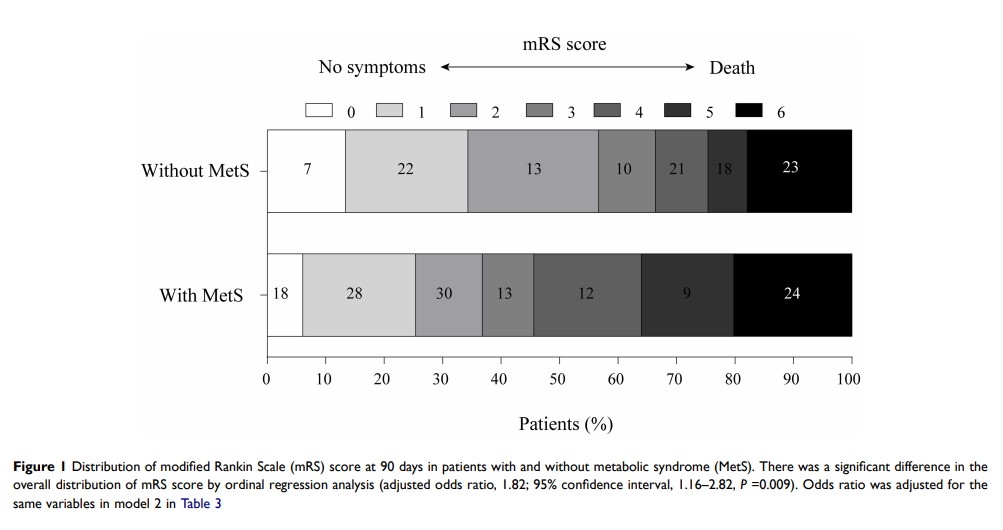
Results: A total of 248 patients were enrolled (mean age, 66.7 years; 37.5% female) and 114 (46.0%) met with the MetS criteria. The median National Institutes of Health Stroke Scale score was 15.0. There were 131 (52.8%) patients achieving the poor outcome at 3 months, among which 26 (10.5%) patients developed sICH. The mortality at 3 months was 19.0% (47/248). In multivariable analysis, MetS was significantly correlated to poor outcome (odds ratio [OR], 2.48; 95% confidence interval [CI], 1.29– 4.78, P = 0.014). The risk for poor outcome was positively associated with the increased number of MetS components (OR 1.78; 95% CI 1.39– 2.35, P = 0.001). No significant findings were found in the association of MetS with sICH and mortality.
Conclusion: Our data demonstrated that MetS was associated with poor prognosis in acute ischemic patients treated with EVT.
Keywords: metabolic syndrome, ischemic stroke, endovascular thrombectomy, prognosis