119942
论文已发表
注册即可获取德孚的最新动态
IF 收录期刊
- 3.6 Breast Cancer (Dove Med Press)
- 4.3 Clin Epidemiol
- 2.6 Cancer Manag Res
- 3.2 Infect Drug Resist
- 4.1 Clin Interv Aging
- 6.1 Drug Des Dev Ther
- 4.1 Int J Chronic Obstr
- 8.7 Int J Nanomed
- 2.5 Int J Women's Health
- 3.2 Neuropsych Dis Treat
- 2.4 OncoTargets Ther
- 2.6 Patient Prefer Adher
- 2.6 Ther Clin Risk Manag
- 3.1 J Pain Res
- 3.5 Diabet Metab Synd Ob
- 4.5 Psychol Res Behav Ma
- 3.4 Nat Sci Sleep
- 2.4 Pharmgenomics Pers Med
- 2.6 Risk Manag Healthc Policy
- 4.6 J Inflamm Res
- 2.3 Int J Gen Med
- 3.9 J Hepatocell Carcinoma
- 3.3 J Asthma Allergy
- 2.5 Clin Cosmet Investig Dermatol
- 3.0 J Multidiscip Healthc

叉指电极表面的粉煤灰基沸石复合聚乙烯乙二醇,用于高效测定糖尿病
Authors Chen Y, Zhao Y, Wang Y
Received 26 May 2020
Accepted for publication 24 August 2020
Published 8 September 2020 Volume 2020:15 Pages 6619—6629
DOI https://doi.org/10.2147/IJN.S264645
Checked for plagiarism Yes
Review by Single anonymous peer review
Peer reviewer comments 2
Editor who approved publication: Dr Linlin Sun
Background: Diabetes is a complex metabolic disorder known to induce a high blood glucose level that fluctuates outside the normal range. Diabetes affects and damages the organs in the body and causes heart issues, blindness and kidney failure. Continuous monitoring is mandatory to keep the blood glucose level within a healthy range.
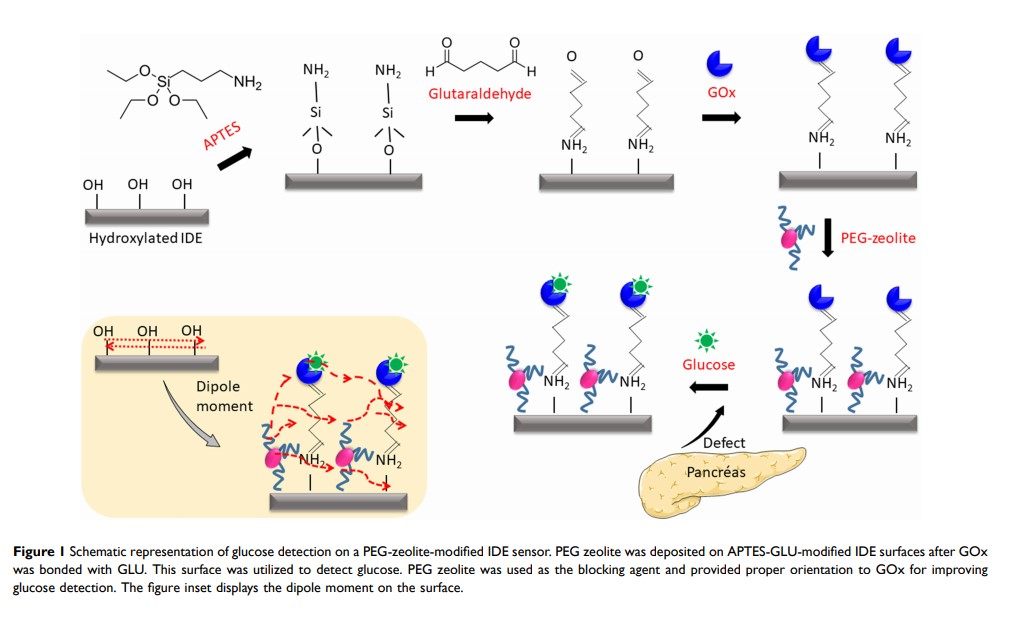
Materials and Methods: This research was focused on diagnosing diabetes mellitus on zeolite nanoparticle-polyethylene glycol complex-immobilized interdigitated electrode sensor (IDE) surfaces. Zeolite nanoparticles were extracted from the fly ash of a thermal power plant by alkaline extraction. The surface morphology of the synthesized nanoparticles was observed by field-emission scanning electron microscopy and transmission electron microscopy, and the presence of certain elements and the particle size were determined by energy-dispersive X-ray spectroscopy and particle size analysis, respectively.
Results: The crystalline PEG-zeolite nanoparticles were synthesized with a size of 40± 10 nm according to high-resolution microscopy. A particle size analyzer revealed the sizes of the fly ash and PEG-zeolite particles as 60± 10 μm and 50± 10 nm, respectively. The IDE surface was evaluated for its ability to display antifouling properties and sense glucose levels on the abovementioned nanoparticle-modified surface. Glucose oxidase was probed on the PEG-zeolite-modified IDE surface, and glucose was detected. PEG zeolite performed well with excellent antifouling properties on the IDE sensor surface and improved the glucose detection limit to 0.03 mg/mL from 0.08 mg/mL, as determined by linear regressions [y = 5.365x - 6.803; R2 = 0.9035 (zeolite surface) and y = 5.498x + 5.914R2 = 0.9061 (PEG-zeolite surface)]. This enhancement was ∼ 3-fold, and sensitivities were found to be 0.03 and 0.06 mg/mL glucose for the PEG-zeolite- and zeolite-modified surfaces, respectively, showing a 2-fold difference.
Conclusion: The excellent biocompatible surface modified by PEG zeolite exhibited high performance and is useful for medical diagnosis.
Keywords: blood glucose, dielectric sensor, biosensor, nanomaterial, nanoparticle