115195
论文已发表
注册即可获取德孚的最新动态
IF 收录期刊
- 3.6 Breast Cancer (Dove Med Press)
- 4.3 Clin Epidemiol
- 2.6 Cancer Manag Res
- 3.2 Infect Drug Resist
- 4.1 Clin Interv Aging
- 6.1 Drug Des Dev Ther
- 4.1 Int J Chronic Obstr
- 8.7 Int J Nanomed
- 2.5 Int J Women's Health
- 3.2 Neuropsych Dis Treat
- 2.4 OncoTargets Ther
- 2.6 Patient Prefer Adher
- 2.6 Ther Clin Risk Manag
- 3.1 J Pain Res
- 3.5 Diabet Metab Synd Ob
- 4.5 Psychol Res Behav Ma
- 3.4 Nat Sci Sleep
- 2.4 Pharmgenomics Pers Med
- 2.6 Risk Manag Healthc Policy
- 4.6 J Inflamm Res
- 2.3 Int J Gen Med
- 3.9 J Hepatocell Carcinoma
- 3.3 J Asthma Allergy
- 2.5 Clin Cosmet Investig Dermatol
- 3.0 J Multidiscip Healthc

骨肉瘤肿瘤微环境中肿瘤外泌体的信息传递及其生物学意义
Authors Pu F, Chen F, Zhang Z, Liu J, Shao Z
Received 9 June 2020
Accepted for publication 18 August 2020
Published 8 September 2020 Volume 2020:13 Pages 8931—8940
DOI https://doi.org/10.2147/OTT.S266835
Checked for plagiarism Yes
Review by Single anonymous peer review
Peer reviewer comments 3
Editor who approved publication: Prof. Dr. Takuya Aoki
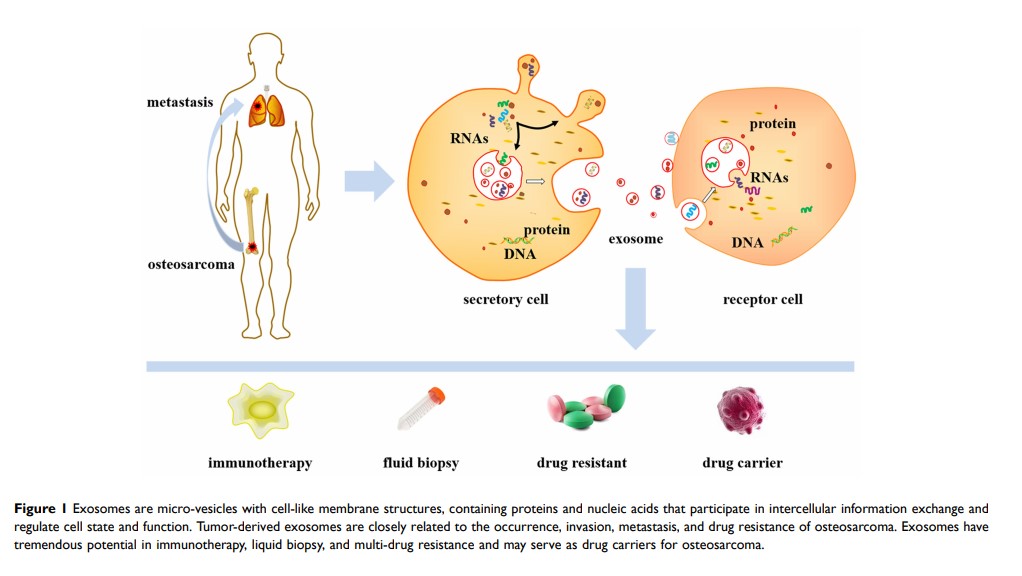
Abstract: Osteosarcoma is a highly invasive kind of malignant bone tumor. Exosomes are a type of extracellular vesicles that play an important role in intercellular communication in the microenvironment. Tumor cell progression is promoted through the interaction between exosomes and cells in the microenvironment (including immune cells, mesenchymal cells, and endothelial cells) during tumor development. Neoplastic exosomes can carry a variety of biological information molecules, such as proteins, lipids, and nucleic acids. These molecules play an important clinical role, not only being able domesticate the recipient cells but also being recognized as tumor specific markers. At the same time, exosomes secreted by osteosarcoma can also cooperate with antigen-presenting cells to activate the body’s immune response and then to exert anti-tumor effects. Studies on exosomes may be a breakthrough in the search for a new osteosarcoma treatment. In this study, we review the role of neoplastic exosomes in the osteosarcoma microenvironment, summarize their potential as tumor markers, and investigate their clinical application prospects.
Keywords: osteosarcoma, exosome, diagnosis, treatment, drug carrier, antitumor drug