115195
论文已发表
注册即可获取德孚的最新动态
IF 收录期刊
- 3.6 Breast Cancer (Dove Med Press)
- 4.3 Clin Epidemiol
- 2.6 Cancer Manag Res
- 3.2 Infect Drug Resist
- 4.1 Clin Interv Aging
- 6.1 Drug Des Dev Ther
- 4.1 Int J Chronic Obstr
- 8.7 Int J Nanomed
- 2.5 Int J Women's Health
- 3.2 Neuropsych Dis Treat
- 2.4 OncoTargets Ther
- 2.6 Patient Prefer Adher
- 2.6 Ther Clin Risk Manag
- 3.1 J Pain Res
- 3.5 Diabet Metab Synd Ob
- 4.5 Psychol Res Behav Ma
- 3.4 Nat Sci Sleep
- 2.4 Pharmgenomics Pers Med
- 2.6 Risk Manag Healthc Policy
- 4.6 J Inflamm Res
- 2.3 Int J Gen Med
- 3.9 J Hepatocell Carcinoma
- 3.3 J Asthma Allergy
- 2.5 Clin Cosmet Investig Dermatol
- 3.0 J Multidiscip Healthc

血根碱通过调节 A549 细胞的外泌体抑制巨噬细胞以促进肺癌转移和增殖的机制
Authors Yu Y, Luo Y, Fang Z, Teng W, Yu Y, Tian J, Guo P, Xu R, Wu J, Li Y
Received 3 May 2020
Accepted for publication 16 August 2020
Published 10 September 2020 Volume 2020:13 Pages 8989—9003
DOI https://doi.org/10.2147/OTT.S261054
Checked for plagiarism Yes
Review by Single anonymous peer review
Peer reviewer comments 3
Editor who approved publication: Dr Leo Jen-Liang Su
Objective: Sanguinarine (SNG) is a benzophenanthridine alkaloid obtained from the roots of Sanguinaria canadensis and has an anticancer effect. The aim of this study was to explore the mechanism of SNG in inhibiting macrophages via regulating the exosomes derived from lung carcinoma cells to reduce metastasis and proliferation of lung carcinoma.
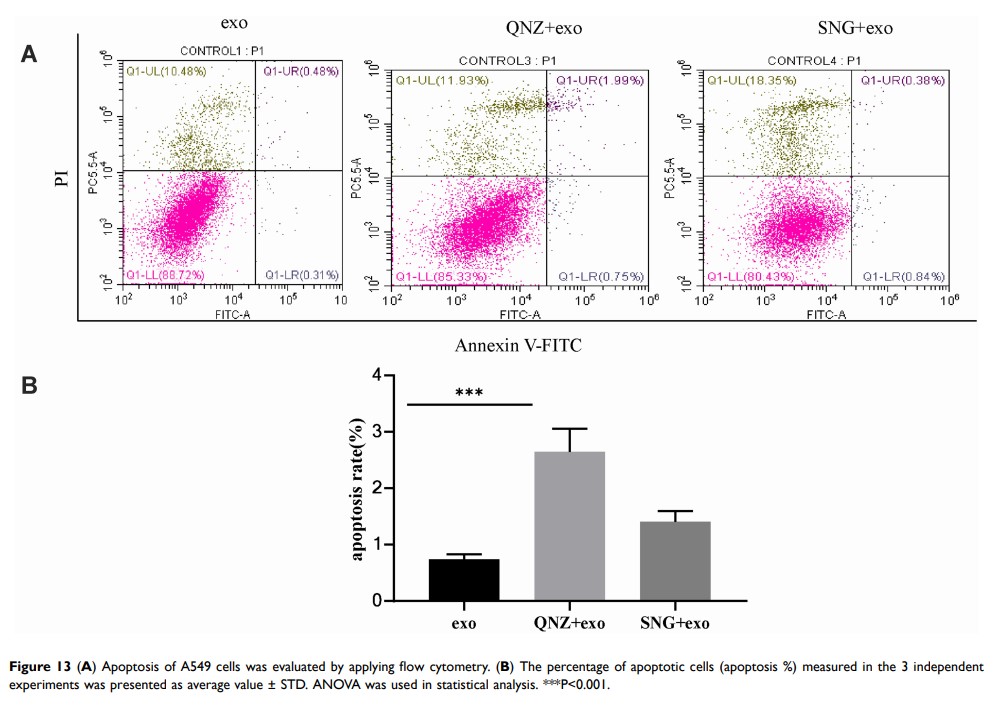
Methods: Human lung cancer cells (A549 cells) were treated with 4μM of SNG. Exosomes of A549 cells were extracted from A549 cells supernatant, and THP-1 cells were cultured with exosomes. Then, the supernatant of THP-1 cells was collected and cultured with A549 cells. Cell proliferation was measured via plate clone formation and CCK-8 assays. Migration was assessed by using Transwell assay and scratch test. Cellular invasion was detected by Transwell assay. Apoptosis was determined using flow cytometry. Moreover, the protein expressions of GAPDH, P65 and P-P65 in THP-1 cells were measured by Western blot. Levels of tumor necrosis factor-α (TNF-α), interleukin-6 (IL-6), and chemotactic cytokines ligand 2 (CCL-2) extracted from THP-1 cells were determined by reverse transcription-polymerase chain reaction (RT-PCR).
Results: Compared to the control group, exosomes could activate THP-1 cells, and the invasion, migration, and proliferation of A549 cells were consequently enhanced. Exosomes could increase the protein expression of p-p65 and the RNA expression levels of TNF-α, IL-6, and CCL-2 in THP-1 cells. Compared with the exosome group, SNG-treated exosomes inhibited THP-1 cells so that the invasion, proliferation, and migration of A549 cells were attenuated and apoptosis was promoted. In THP-1 cells, SNG-treated exosomes inhibited P-P65 expression and the RNA expression levels of TNF-α, IL-6, and CCL-2.
Conclusion: Exosomes treated by SNG inhibited THP-1 cells so that the invasion, proliferation, and migration of A549 cells were inhibited, and the apoptosis was promoted. The mechanism is possibly associated with the inhibition of NF-κB pathway in THP-1 cells.
Keywords: SNG, exosomes, THP-1 cells, NF-κB signaling pathway