115195
论文已发表
注册即可获取德孚的最新动态
IF 收录期刊
- 3.6 Breast Cancer (Dove Med Press)
- 4.3 Clin Epidemiol
- 2.6 Cancer Manag Res
- 3.2 Infect Drug Resist
- 4.1 Clin Interv Aging
- 6.1 Drug Des Dev Ther
- 4.1 Int J Chronic Obstr
- 8.7 Int J Nanomed
- 2.5 Int J Women's Health
- 3.2 Neuropsych Dis Treat
- 2.4 OncoTargets Ther
- 2.6 Patient Prefer Adher
- 2.6 Ther Clin Risk Manag
- 3.1 J Pain Res
- 3.5 Diabet Metab Synd Ob
- 4.5 Psychol Res Behav Ma
- 3.4 Nat Sci Sleep
- 2.4 Pharmgenomics Pers Med
- 2.6 Risk Manag Healthc Policy
- 4.6 J Inflamm Res
- 2.3 Int J Gen Med
- 3.9 J Hepatocell Carcinoma
- 3.3 J Asthma Allergy
- 2.5 Clin Cosmet Investig Dermatol
- 3.0 J Multidiscip Healthc

阻塞性睡眠呼吸暂停综合症患者面部情绪化表情的自动处理功能障碍:一项事件相关电位的研究
Authors Lv R, Nie S, Liu Z, Guo Y, Zhang Y, Xu S, Hou X, Chen J, Ma Y, Fan Z, Liu X
Received 25 June 2020
Accepted for publication 12 August 2020
Published 15 September 2020 Volume 2020:12 Pages 637—647
DOI https://doi.org/10.2147/NSS.S267775
Checked for plagiarism Yes
Review by Single anonymous peer review
Peer reviewer comments 3
Editor who approved publication: Professor Steven A Shea
Aim: Obstructive sleep apnea syndrome (OSAS) is a prevalent chronic disease characterized by sleep fragmentation and intermittent hypoxemia. Several studies suggested that electrophysiological changes and neurocognitive abnormalities occurred in OSAS patients. In this study, we compared automatic processing of emotional facial expressions schematic in OSAS patients and matched healthy controls via assessing expression-related mismatch negativity (EMMN).
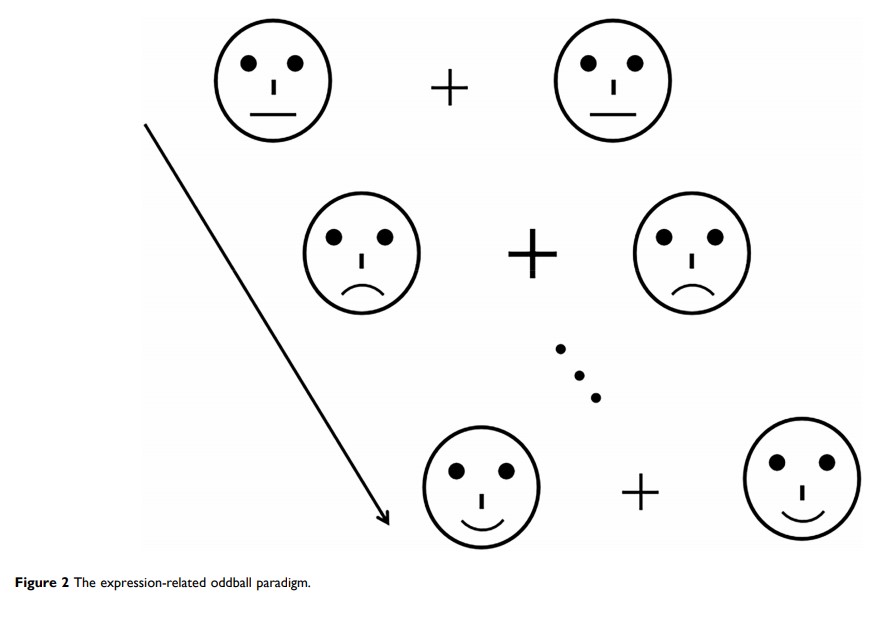
Methods: Twenty-two OSAS patients (mean age 44.59 years) and twenty-one healthy controls (mean age 42.71 years) were enrolled in this study. All participants underwent Montreal Cognitive Assessment (MoCA) scale test and polysomnographic recording. An expression-related oddball paradigm was used to elicit EMMN and the electroencephalogram was recorded and analyzed. Furthermore, Pearson’s correlations were calculated to discuss the correlation between neuropsychological test scores, clinical variables and electrophysiological data.
Results: Compared with healthy controls, OSAS sufferers demonstrated significantly reduced EMMN mean amplitudes within corresponding time intervals, regardless of happy or sad conditions. Meanwhile, we observed that amplitude of sad EMMN was larger (more negative) than happy EMNN in healthy controls, while not in patients. Moderate correlations were found between MoCA test scores, sleep parameters and EMMN amplitudes.
Conclusion: Our findings suggested pre-attentive dysfunction of processing emotional facial expressions in patients with OSAS, without the existence of negative bias effect. Moreover, correlation analysis showed that clinical characteristics of OSAS patients could affect EMMN amplitudes. Further studies on the advantages of EMMN as clinical and electrophysiological indicators of OSAS are warranted.
Keywords: OSAS, EMMN, facial expressions, pre-attentive processing, negative bias effect