115195
论文已发表
注册即可获取德孚的最新动态
IF 收录期刊
- 3.6 Breast Cancer (Dove Med Press)
- 4.3 Clin Epidemiol
- 2.6 Cancer Manag Res
- 3.2 Infect Drug Resist
- 4.1 Clin Interv Aging
- 6.1 Drug Des Dev Ther
- 4.1 Int J Chronic Obstr
- 8.7 Int J Nanomed
- 2.5 Int J Women's Health
- 3.2 Neuropsych Dis Treat
- 2.4 OncoTargets Ther
- 2.6 Patient Prefer Adher
- 2.6 Ther Clin Risk Manag
- 3.1 J Pain Res
- 3.5 Diabet Metab Synd Ob
- 4.5 Psychol Res Behav Ma
- 3.4 Nat Sci Sleep
- 2.4 Pharmgenomics Pers Med
- 2.6 Risk Manag Healthc Policy
- 4.6 J Inflamm Res
- 2.3 Int J Gen Med
- 3.9 J Hepatocell Carcinoma
- 3.3 J Asthma Allergy
- 2.5 Clin Cosmet Investig Dermatol
- 3.0 J Multidiscip Healthc

基于纳米粒子的光动力疗法和光热疗法的病理机制
Authors Hou Y, Yang X, Liu R, Zhao D, Guo C, Zhu A, Wen M, Liu Z, Qu G, Meng H
Received 25 June 2020
Accepted for publication 25 August 2020
Published 15 September 2020 Volume 2020:15 Pages 6827—6838
DOI https://doi.org/10.2147/IJN.S269321
Checked for plagiarism Yes
Review by Single anonymous peer review
Peer reviewer comments 4
Editor who approved publication: Dr Thomas Webster
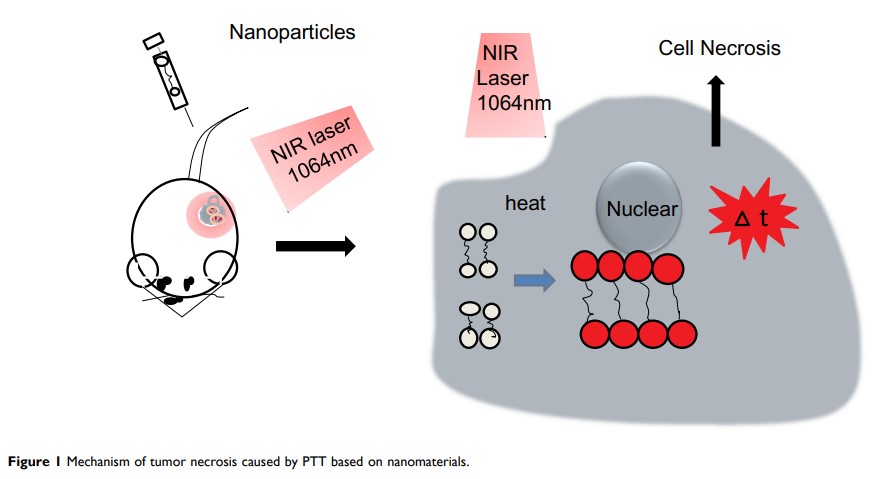
Abstract: The ultimate goal of phototherapy based on nanoparticles, such as photothermal therapy (PTT) which generates heat and photodynamic therapy (PDT) which not only generates reactive oxygen species (ROS) but also induces a variety of anti-tumor immunity, is to kill tumors. In addition, due to strong efficacy in clinical treatment with minimal invasion and negligible side effects, it has received extensive attention and research in recent years. In this paper, the generations of nanomaterials in PTT and PDT are described separately. In clinical application, according to the different combination pathway of nanoparticles, it can be used to treat different diseases such as tumors, melanoma, rheumatoid and so on. In this paper, the mechanism of pathological treatment is described in detail in terms of inducing apoptosis of cancer cells by ROS produced by PDT, immunogenic cell death to provoke the maturation of dendritic cells, which in turn activate production of CD4+ T cells, CD8+T cells and memory T cells, as well as inhibiting heat shock protein (HSPs), STAT3 signal pathway and so on.
Keywords: pathological mechanism, nanoparticles, photothermal therapy, PTT, photodynamic therapy, PDT