115195
论文已发表
注册即可获取德孚的最新动态
IF 收录期刊
- 3.6 Breast Cancer (Dove Med Press)
- 4.3 Clin Epidemiol
- 2.6 Cancer Manag Res
- 3.2 Infect Drug Resist
- 4.1 Clin Interv Aging
- 6.1 Drug Des Dev Ther
- 4.1 Int J Chronic Obstr
- 8.7 Int J Nanomed
- 2.5 Int J Women's Health
- 3.2 Neuropsych Dis Treat
- 2.4 OncoTargets Ther
- 2.6 Patient Prefer Adher
- 2.6 Ther Clin Risk Manag
- 3.1 J Pain Res
- 3.5 Diabet Metab Synd Ob
- 4.5 Psychol Res Behav Ma
- 3.4 Nat Sci Sleep
- 2.4 Pharmgenomics Pers Med
- 2.6 Risk Manag Healthc Policy
- 4.6 J Inflamm Res
- 2.3 Int J Gen Med
- 3.9 J Hepatocell Carcinoma
- 3.3 J Asthma Allergy
- 2.5 Clin Cosmet Investig Dermatol
- 3.0 J Multidiscip Healthc

长非编码 RNA PART1 通过靶向 miR-590-3p/HMGB2 轴促进肝细胞癌进展
Authors Pu J, Tan C, Shao Z, Wu X, Zhang Y, Xu Z, Wang J, Tang Q, Wei H
Received 1 May 2020
Accepted for publication 3 August 2020
Published 16 September 2020 Volume 2020:13 Pages 9203—9211
DOI https://doi.org/10.2147/OTT.S259962
Checked for plagiarism Yes
Review by Single anonymous peer review
Peer reviewer comments 2
Editor who approved publication: Dr XuYu Yang
Introduction: In East Asia, hepatocellular carcinoma (HCC) is one of the most commonly diagnosed cancer types. Long noncoding RNA (lncRNA) prostate androgen-regulated transcript 1 (PART1 ) was reported to play crucial roles in regulating cancer progression. However, roles and mechanisms of action of PART1 in hepatocellular carcinoma (HCC) still remain unknown.
Methods: Quantitative real-time polymerase chain reaction (RT-qPCR) method was used to detect the PART1 expression level in HCC cells. Cell proliferation, colony formation, and transwell invasion assays were performed to investigate the biological roles of PART1 on HCC cell behaviors. Bioinformatic analysis methods were performed to analyze connections of microRNA-590-3p (miR-590-3p) with PART1 or high mobility group box 2 (HMGB2 ) in HCC. Moreover, expression levels of PART1 , miR-590-3p, and HMGB2 in HCC tissues and normal tissues were analyzed at ENCORI.
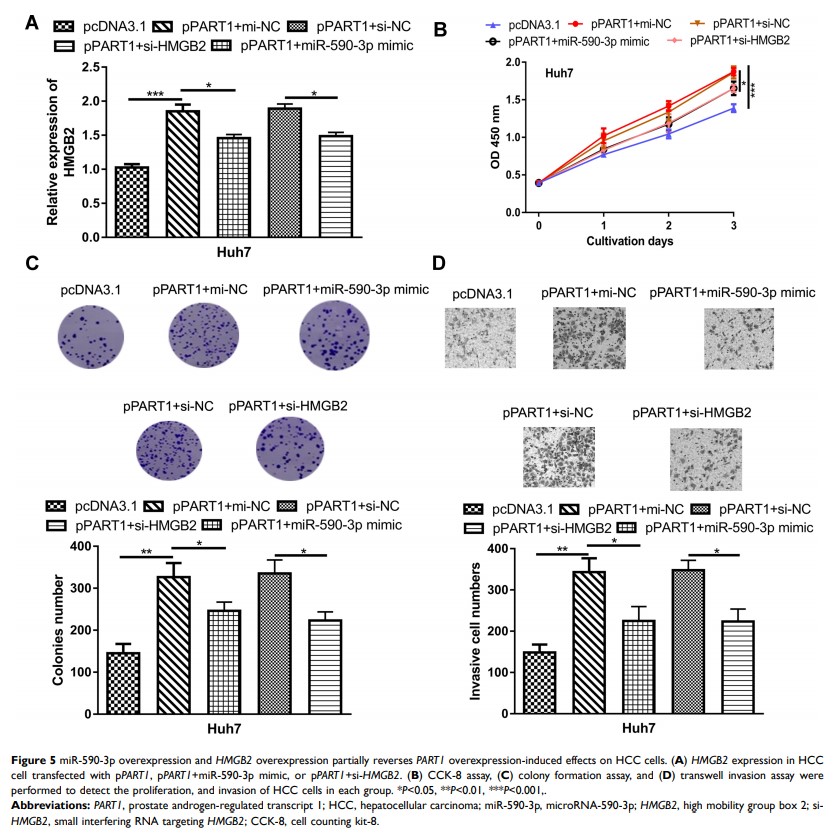
Results: PART1 expression was found to be significantly upregulated in HCC tissues and cells. Functionally, silencing of PART1 significantly suppressed HCC cell proliferation, colony formation and invasion in vitro, while forcing PART1 exerts opposite biological effects. Mechanically, miR-590-3p/HMGB2 axis was downstream target of PART1 , and silencing of miR-590-3p or forcing of HMGB2 could rescue the stimulation effects of PART1 overexpression on HCC cell behaviors.
Discussion: Our results provided evidence that PART1 serves as oncogenic lncRNA through sponging miR-590-3p to upregulate HMGB2 expression in HCC.
Keywords: PART1, miR-590-3p, HMGB2, ceRNA, hepatocellular carcinoma