115195
论文已发表
注册即可获取德孚的最新动态
IF 收录期刊
- 3.6 Breast Cancer (Dove Med Press)
- 4.3 Clin Epidemiol
- 2.6 Cancer Manag Res
- 3.2 Infect Drug Resist
- 4.1 Clin Interv Aging
- 6.1 Drug Des Dev Ther
- 4.1 Int J Chronic Obstr
- 8.7 Int J Nanomed
- 2.5 Int J Women's Health
- 3.2 Neuropsych Dis Treat
- 2.4 OncoTargets Ther
- 2.6 Patient Prefer Adher
- 2.6 Ther Clin Risk Manag
- 3.1 J Pain Res
- 3.5 Diabet Metab Synd Ob
- 4.5 Psychol Res Behav Ma
- 3.4 Nat Sci Sleep
- 2.4 Pharmgenomics Pers Med
- 2.6 Risk Manag Healthc Policy
- 4.6 J Inflamm Res
- 2.3 Int J Gen Med
- 3.9 J Hepatocell Carcinoma
- 3.3 J Asthma Allergy
- 2.5 Clin Cosmet Investig Dermatol
- 3.0 J Multidiscip Healthc

新辅助放化疗后局部晚期直肠癌患者 FOXK 家族表达的预后价值
Authors Zhang Y, Xu M, Chen J, Chen K, Zhuang J, Yang Y, Liu X, Guan G
Received 3 April 2020
Accepted for publication 24 July 2020
Published 16 September 2020 Volume 2020:13 Pages 9185—9201
DOI https://doi.org/10.2147/OTT.S255956
Checked for plagiarism Yes
Review by Single anonymous peer review
Peer reviewer comments 2
Editor who approved publication: Dr Leo Jen-Liang Su
Purpose: To assess the role of the expression levels of FOXK family members, FOXK1 and FOXK2, in predicting response to neo-chemoradiotherapy (NCRT) and prognosis in locally advanced rectal cancer (LARC).
Methods: A total of 256 LARC patients who underwent NCRT and radical resection between 2011 and 2017 were enrolled in the present study. The patients were divided into a training dataset (n=169, 2011– 2015) and a validation dataset (n=87, 2016– 2017). Tumor tissues were collected before NCRT and post-surgery and were used for immunohistochemical analysis.
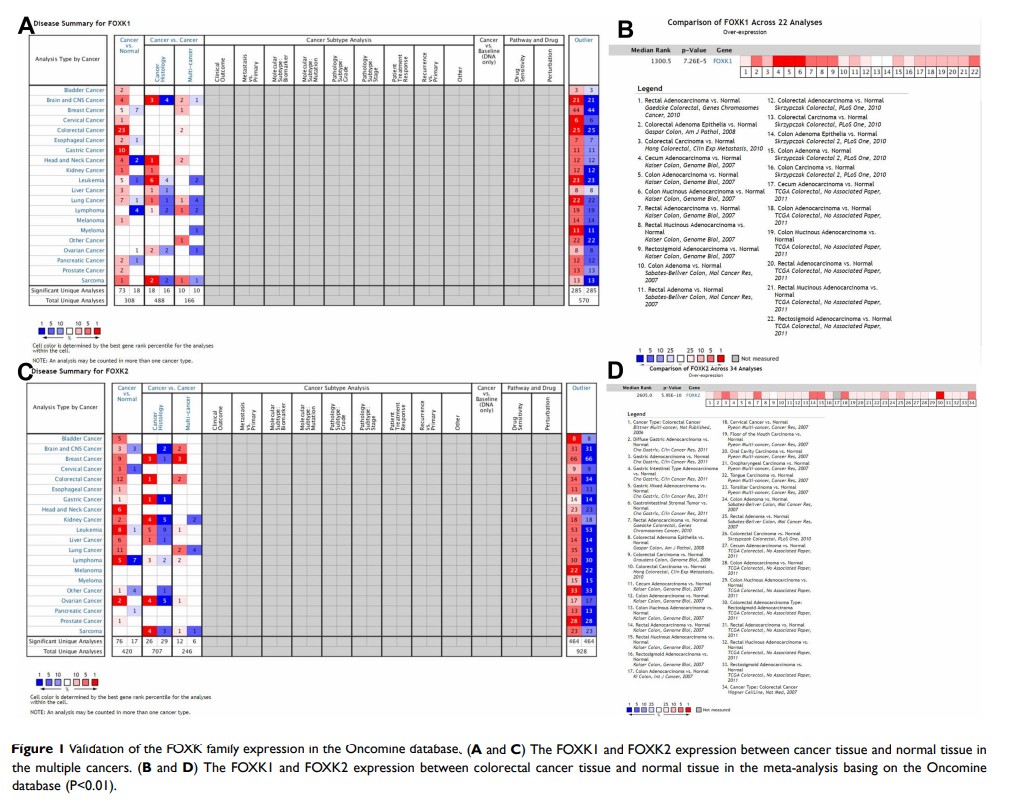
Results: Oncomine database analysis revealed that FOXK1 and FOXK2 were overexpressed in most cancers especially in colorectal cancer. Additionally, overexpression of FOXK1 and FOXK2 was associated with poorer prognosis by the R2 database. In both our training and validation datasets, the expression of FOXK1 and FOXK2 was lower in the pathological complete response (pCR) group compared with the non-pCR group (P< 0.05). Cox regression analysis demonstrated that pathological N stage (HR=1.810, 95% CI 1.159– 2.827, P=0.009), FOXK1 expression (HR=5.831, 95% CI 2.925– 11.625, P< 0.001), and FOXK2 expression (HR=2.390, 95% CI 11.272– 4.491, P=0.007) were independent predictors of disease-free survival (DFS). Based on the Cox multivariate analysis, we constructed a risk score model that served as a prognostic biomarker and had a powerful ability to predict pCR in LARC patients upon NCRT in both training and validation groups.
Conclusion: Expression levels of FOXK family members were associated with chemoradiotherapy resistance and prognosis of LARC patients following NCRT and were used to construct a risk score model that is a promising biomarker for LARC.
Keywords: rectal cancer, neoadjuvant chemoradiotherapy, FOXK1, FOXK2, prognosis