115195
论文已发表
注册即可获取德孚的最新动态
IF 收录期刊
- 3.6 Breast Cancer (Dove Med Press)
- 4.3 Clin Epidemiol
- 2.6 Cancer Manag Res
- 3.2 Infect Drug Resist
- 4.1 Clin Interv Aging
- 6.1 Drug Des Dev Ther
- 4.1 Int J Chronic Obstr
- 8.7 Int J Nanomed
- 2.5 Int J Women's Health
- 3.2 Neuropsych Dis Treat
- 2.4 OncoTargets Ther
- 2.6 Patient Prefer Adher
- 2.6 Ther Clin Risk Manag
- 3.1 J Pain Res
- 3.5 Diabet Metab Synd Ob
- 4.5 Psychol Res Behav Ma
- 3.4 Nat Sci Sleep
- 2.4 Pharmgenomics Pers Med
- 2.6 Risk Manag Healthc Policy
- 4.6 J Inflamm Res
- 2.3 Int J Gen Med
- 3.9 J Hepatocell Carcinoma
- 3.3 J Asthma Allergy
- 2.5 Clin Cosmet Investig Dermatol
- 3.0 J Multidiscip Healthc

青少年与成人鼻咽癌患者的预后比较:倾向评分匹配分析
Authors Chen C, Chen Q, Xu Y, Zheng W, Lin Z, Wu Z, Ye W, Huang X, Lin X, Bai P
Received 29 April 2020
Accepted for publication 7 August 2020
Published 18 September 2020 Volume 2020:12 Pages 8613—8621
DOI https://doi.org/10.2147/CMAR.S260402
Checked for plagiarism Yes
Review by Single anonymous peer review
Peer reviewer comments 2
Editor who approved publication: Dr Kenan Onel
Purpose: To investigate whether juvenile patients with nasopharyngeal carcinoma (NPC) in China have better prognosis than their adult counterparts in the intensity-modulated radiation therapy (IMRT) era, after controlling for potential confounding variables.
Methods: Data pertaining to 1139 patients with newly diagnosed NPC without metastasis, who were treated with IMRT at our hospital, were retrospectively analyzed. Of these, 60 patients were juvenile (age ≤ 18 years) diagnosed between January 2003 and December 2018, while 1079 patients were adults (≤ 65 years) diagnosed between January 2013 and December 2014. To minimize the influence of selection and confounding bias, 1:2 propensity score matching (PSM) was used. Overall survival (OS), disease-free survival (DFS), locoregional relapse-free survival (LRFS), and distant metastasis-free survival (DMFS) were estimated using the Kaplan–Meier method and between-group differences assessed using the Log rank test. The long-term toxicity of the juvenile patients was evaluated according to the criteria of the Radiation Therapy Oncology Group (RTOG) and the Common Terminology Criteria for Adverse Events (CTCAE) version 5.0.
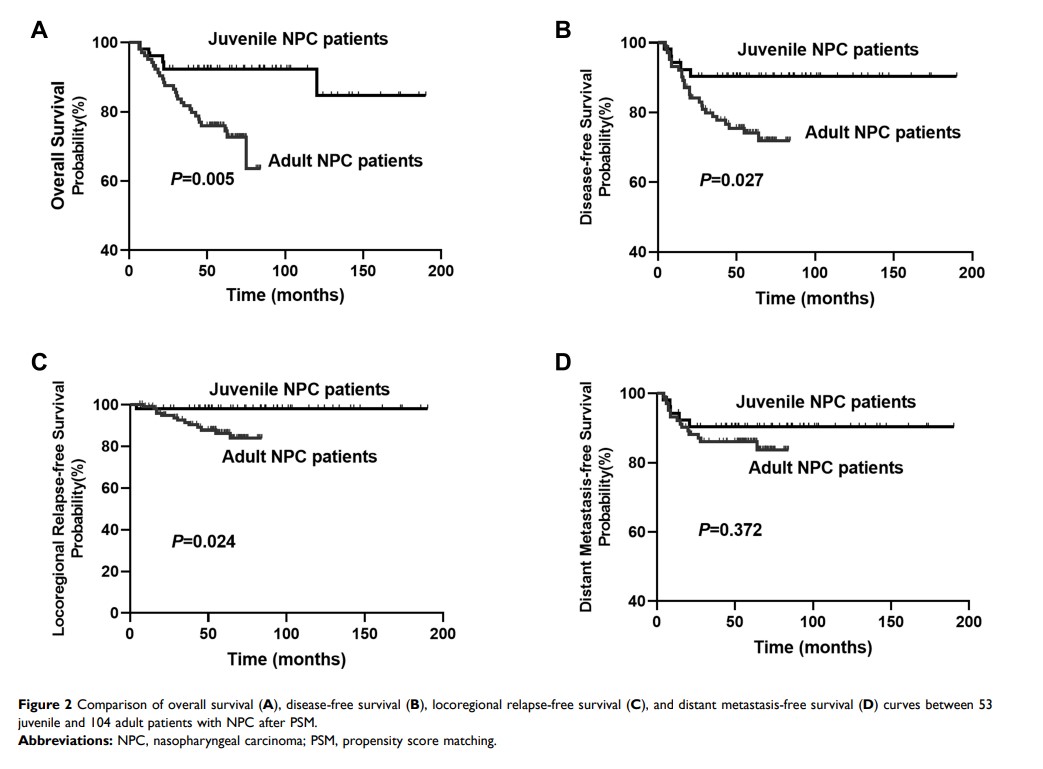
Results: Five-year OS of juvenile and adult patients were 88.07% and 85.08%, respectively. Before PSM, OS, PFS, DMFS, or LRFS were comparable in the two groups (all P > 0.05). After PSM, OS, DFS, and LRFS in the juvenile group were markedly longer than that in adults (P = 0.005, P = 0.027, and P = 0.024, respectively). With respect to long-term toxicity, the most common adverse effects in juvenile patients were cervix fibrosis, ototoxicity, and xerostomia. However, except for two patients who developed grade 3 ototoxicity, all adverse effects were within grade 2.
Conclusion: In the IMRT era, juvenile Chinese patients with NPC had better 5-year OS, DFS, and LRFS than their adult counterparts. The adverse events in the juvenile cohort were relatively mild; however, the risk of severe ototoxicity should not be neglected.
Keywords: juvenile nasopharyngeal carcinoma, intensity-modulated radiotherapy, prognosis