115195
论文已发表
注册即可获取德孚的最新动态
IF 收录期刊
- 3.6 Breast Cancer (Dove Med Press)
- 4.3 Clin Epidemiol
- 2.6 Cancer Manag Res
- 3.2 Infect Drug Resist
- 4.1 Clin Interv Aging
- 6.1 Drug Des Dev Ther
- 4.1 Int J Chronic Obstr
- 8.7 Int J Nanomed
- 2.5 Int J Women's Health
- 3.2 Neuropsych Dis Treat
- 2.4 OncoTargets Ther
- 2.6 Patient Prefer Adher
- 2.6 Ther Clin Risk Manag
- 3.1 J Pain Res
- 3.5 Diabet Metab Synd Ob
- 4.5 Psychol Res Behav Ma
- 3.4 Nat Sci Sleep
- 2.4 Pharmgenomics Pers Med
- 2.6 Risk Manag Healthc Policy
- 4.6 J Inflamm Res
- 2.3 Int J Gen Med
- 3.9 J Hepatocell Carcinoma
- 3.3 J Asthma Allergy
- 2.5 Clin Cosmet Investig Dermatol
- 3.0 J Multidiscip Healthc

血浆纤维蛋白原和 CA19-9 联合治疗对非远处转移性乳腺癌手术患者的预后价值
Authors Hu W, Zheng C, Quan R, Dai X, Zhang X
Received 8 July 2020
Accepted for publication 13 August 2020
Published 23 September 2020 Volume 2020:12 Pages 8875—8886
DOI https://doi.org/10.2147/CMAR.S270385
Checked for plagiarism Yes
Review by Single anonymous peer review
Peer reviewer comments 2
Editor who approved publication: Dr Sanjeev Srivastava
Purpose: This article aimed to study the prognostic value of preoperative plasma fibrinogen and CA19-9 in non-distant metastatic breast cancer (BC).
Patients and Methods: A total of 343 non-distant metastatic BC patients were included in this study. The optimal cut-off values of plasma fibrinogen and CA19-9 were obtained by receiver operating characteristic (ROC) curve analysis. Univariate and multivariate Cox regression analyses were used to evaluate prognostic factors for overall survival (OS). Survival data were assessed using Kaplan–Meier survival analysis with the Log-rank test. Based on the cut-off values, we classified the fibrinogen-CA19-9 score as follows: 2 (both hyperfibrinogenemia and high CA19-9), 1 (either hyperfibrinogenemia or high CA19-9), and 0 (neither hypefibrinogenemia nor high CA19-9).
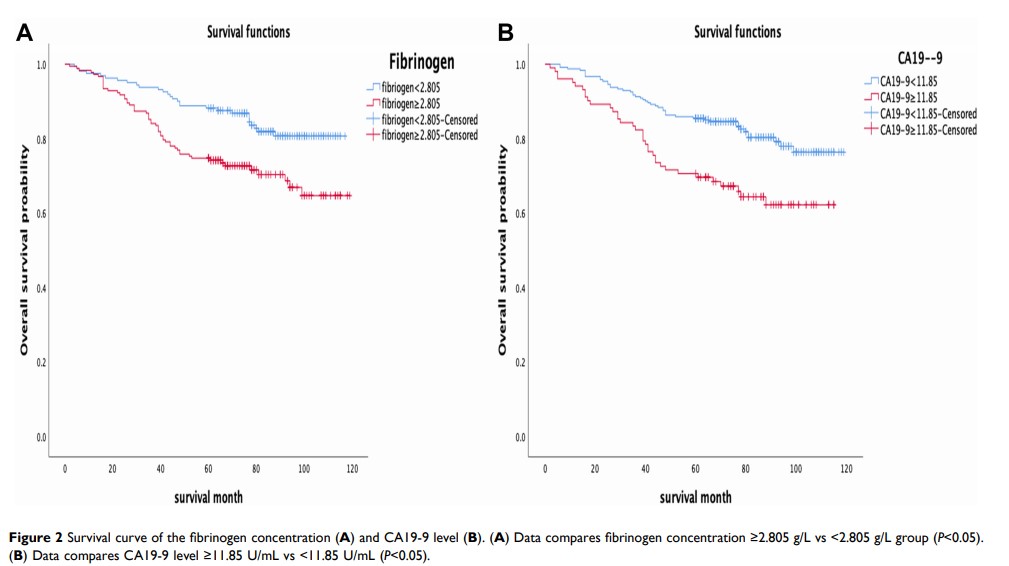
Results: Our follow-up time totaled 10 years, the median follow-up time was 77 months (range=2– 119 months), and 82 (23.9%) of 343 patients died during the follow-up period. The optimal cut-off values of plasma fibrinogen and CA19-9 were 2.805 g/L and 11.85 U/mL, respectively. The multivariate Cox analysis results suggested that there was a significant association between worse OS and elevated preoperative plasma fibrinogen and CA19-9 levels (HR=2.016, 95% CI=1.216– 3.342, P =0.007; and HR=2.042, 95% CI=1.282– 3.253, P =0.003). The area under the ROC curve (AUC) increased from 0.589 (for plasma fibrinogen) and 0.594 (for CA19-9) to 0.640 when these two parameters were combined. When we added this combined factor to the multivariate analysis, it was an independent prognostic factor for BC (P < 0.001). According to the above results, we chose four prognostic factors to construct our nomogram. The AUC was 0.724, which indicates that the nomogram performs well.
Conclusion: The combination of plasma fibrinogen and CA19-9 could be used as a valid independent prognostic factor for non-distant metastatic BC compared with either parameter alone and could easily be applied in clinical practice.
Keywords: non-distant metastatic BC, fibrinogen, CA19-9, survival, nomogram