115195
论文已发表
注册即可获取德孚的最新动态
IF 收录期刊
- 3.6 Breast Cancer (Dove Med Press)
- 4.3 Clin Epidemiol
- 2.6 Cancer Manag Res
- 3.2 Infect Drug Resist
- 4.1 Clin Interv Aging
- 6.1 Drug Des Dev Ther
- 4.1 Int J Chronic Obstr
- 8.7 Int J Nanomed
- 2.5 Int J Women's Health
- 3.2 Neuropsych Dis Treat
- 2.4 OncoTargets Ther
- 2.6 Patient Prefer Adher
- 2.6 Ther Clin Risk Manag
- 3.1 J Pain Res
- 3.5 Diabet Metab Synd Ob
- 4.5 Psychol Res Behav Ma
- 3.4 Nat Sci Sleep
- 2.4 Pharmgenomics Pers Med
- 2.6 Risk Manag Healthc Policy
- 4.6 J Inflamm Res
- 2.3 Int J Gen Med
- 3.9 J Hepatocell Carcinoma
- 3.3 J Asthma Allergy
- 2.5 Clin Cosmet Investig Dermatol
- 3.0 J Multidiscip Healthc

建立一个评分模型以预测老年人跌倒致伤的风险:多中心急性病医院的回顾性病例对照研究
Authors Zhao M, Li S, Xu Y, Su X, Jiang H
Received 22 April 2020
Accepted for publication 11 August 2020
Published 24 September 2020 Volume 2020:15 Pages 1767—1778
DOI https://doi.org/10.2147/CIA.S258171
Checked for plagiarism Yes
Review by Single anonymous peer review
Peer reviewer comments 2
Editor who approved publication: Prof. Dr. Zhi-Ying Wu
Purpose: Injurious falls seriously threaten the safety of elderly patients. Identifying risk factors for predicting the probability of injurious falls is an important issue that still needs to be solved urgently. We aimed to identify predictors and develop a nomogram for distinguishing populations at high risk of injurious falls from older adults in acute settings.
Patients and Methods: A retrospective case–control study was conducted at three hospitals in Shanghai, China. Elderly patients with injurious falls from January 2014 to December 2018 were taken as cases, and control patients who did not have falls were randomly matched based on the admission date and the department. The data were collected through a medical record review and adverse events system. The original data set was randomly divided into a training set and a validation set at a 7:3 ratio. A nomogram was established based on the results of the univariate analysis and multivariate logistic regression analysis, and its discrimination and calibration were verified to confirm the accuracy of the prediction. The cut-off value of risk stratification was determined to help medical staff identify the high-risk groups.
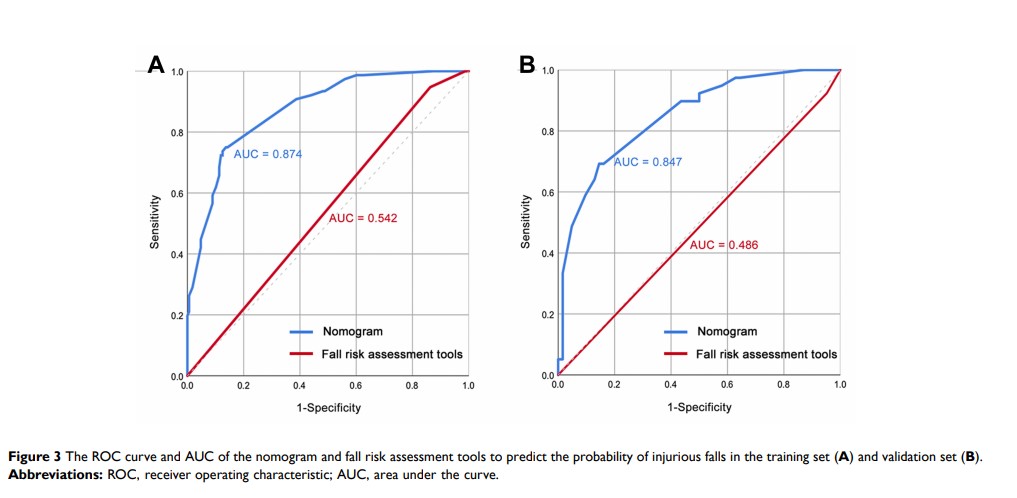
Results: A total of 115 elderly patients with injurious falls and 230 controls were identified. History of fractures, orthostatic hypotension, functional status, sedative-hypnotics and level of serum albumin were independent risk factors for injurious falls in elderly patients. The C-indexes of the training and validation sets were 0.874 (95% CI: 0.784− 0.964) and 0.847 (95% CI: 0.771– 0.924), respectively. Calibration curves were drawn and showed acceptable predictive performance. The cut-off values of the training and validation sets were 146.3 points (sensitivity: 73.7%; specificity: 87.5%) and 157.2 points (sensitivity: 69.2%; specificity: 85.5%), respectively.
Conclusion: The established nomogram facilitates the identification of high-risk populations among elderly patients, providing a new assessment tool to forecast the individual risk of injurious falls.
Keywords: acute hospitalization, elderly adults, injurious falls, nomogram, prediction tool