115195
论文已发表
注册即可获取德孚的最新动态
IF 收录期刊
- 3.6 Breast Cancer (Dove Med Press)
- 4.3 Clin Epidemiol
- 2.6 Cancer Manag Res
- 3.2 Infect Drug Resist
- 4.1 Clin Interv Aging
- 6.1 Drug Des Dev Ther
- 4.1 Int J Chronic Obstr
- 8.7 Int J Nanomed
- 2.5 Int J Women's Health
- 3.2 Neuropsych Dis Treat
- 2.4 OncoTargets Ther
- 2.6 Patient Prefer Adher
- 2.6 Ther Clin Risk Manag
- 3.1 J Pain Res
- 3.5 Diabet Metab Synd Ob
- 4.5 Psychol Res Behav Ma
- 3.4 Nat Sci Sleep
- 2.4 Pharmgenomics Pers Med
- 2.6 Risk Manag Healthc Policy
- 4.6 J Inflamm Res
- 2.3 Int J Gen Med
- 3.9 J Hepatocell Carcinoma
- 3.3 J Asthma Allergy
- 2.5 Clin Cosmet Investig Dermatol
- 3.0 J Multidiscip Healthc

肺功能对患有或不患有 COPD 的美国成年人肺外疾病和全因死亡率的影响
Authors Yang K, Wu Y, Chen D, Liu S, Chen R
Received 3 July 2020
Accepted for publication 20 August 2020
Published 25 September 2020 Volume 2020:12 Pages 997—1005
DOI https://doi.org/10.2147/CLEP.S270599
Checked for plagiarism Yes
Review by Single anonymous peer review
Peer reviewer comments 2
Editor who approved publication: Dr Eyal Cohen
Objective: Spirometric lung function is usually used to evaluate respiratory health. However, the impact of lung function on extra-pulmonary diseases and all-cause mortality has not been fully elucidated, especially in people without chronic obstructive pulmonary disease (COPD).
Patients and Methods: Participants aged ≥ 20 and underwent spirometry test from the US National Health and Nutrition Examination Surveys (NHANES) 2007– 2012 were analyzed in this study. Multivariate logistic and Cox regressions were used to evaluate the impact of forced expiratory volume in 1 second percent of predicted (FEV1% predicted) and forced vital capacity percent of predicted (FVC% predicted) on 14 extra-pulmonary diseases and all-cause morbidity after adjusting for multiple confounders.
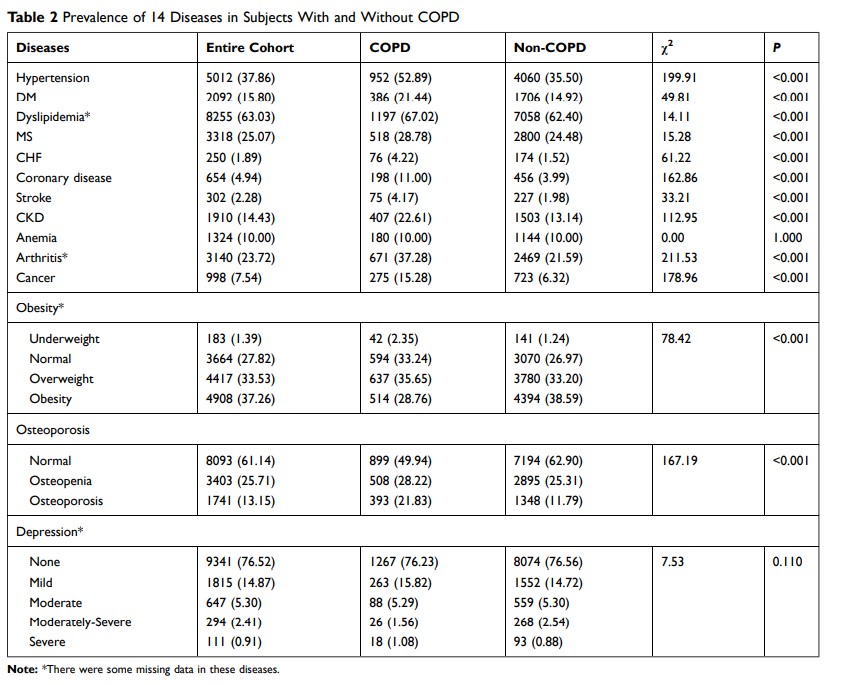
Results: During 2007– 2012, 1800 COPD patients and 11,437 non-COPD subjects were included. The prevalence of hypertension, diabetes mellitus (DM), dyslipidemia, metabolic syndrome (MS), congestive heart failure (CHF), coronary disease, stroke, chronic kidney disease (CKD), arthritis, cancer, underweight and osteoporosis in COPD patients was higher than that in the non-COPD population. After adjusting for confounders, the decrease of FEV1% predicted and FVC% predicted was related with higher odds of having hypertension, DM, obesity, MS, CHF, coronary disease and depression (OR > 1, P < 0.05) in both the COPD and non-COPD populations. These 2 indices were also related with higher odds of dyslipidemia, CKD, arthritis and osteoporosis in the non-COPD population. The risk of stroke, anemia and cancer was not related with the decrease of lung function. In addition, the decrease of lung function was independent risk factors for the increase of all-cause mortality. These risks were gradually increased with the decrease of lung function.
Conclusion: The decrease of FEV1% predicted and FVC% predicted was related with higher risk of multiple extra-pulmonary diseases and all-cause mortality in both the COPD and non-COPD population.
Keywords: lung function, mortality, extra-pulmonary diseases, COPD