115195
论文已发表
注册即可获取德孚的最新动态
IF 收录期刊
- 3.6 Breast Cancer (Dove Med Press)
- 4.3 Clin Epidemiol
- 2.6 Cancer Manag Res
- 3.2 Infect Drug Resist
- 4.1 Clin Interv Aging
- 6.1 Drug Des Dev Ther
- 4.1 Int J Chronic Obstr
- 8.7 Int J Nanomed
- 2.5 Int J Women's Health
- 3.2 Neuropsych Dis Treat
- 2.4 OncoTargets Ther
- 2.6 Patient Prefer Adher
- 2.6 Ther Clin Risk Manag
- 3.1 J Pain Res
- 3.5 Diabet Metab Synd Ob
- 4.5 Psychol Res Behav Ma
- 3.4 Nat Sci Sleep
- 2.4 Pharmgenomics Pers Med
- 2.6 Risk Manag Healthc Policy
- 4.6 J Inflamm Res
- 2.3 Int J Gen Med
- 3.9 J Hepatocell Carcinoma
- 3.3 J Asthma Allergy
- 2.5 Clin Cosmet Investig Dermatol
- 3.0 J Multidiscip Healthc

DPP-4 抑制剂利拉列汀可改善氧化低密度脂蛋白诱导的 THP-1 巨噬细胞源泡沫细胞的形成和炎症
Authors Wang H, Li Y, Zhang X, Xu Z, Zhou J, Shang W
Received 21 March 2020
Accepted for publication 12 August 2020
Published 25 September 2020 Volume 2020:14 Pages 3929—3940
DOI https://doi.org/10.2147/DDDT.S249846
Checked for plagiarism Yes
Review by Single anonymous peer review
Peer reviewer comments 4
Editor who approved publication: Professor Manfred Ogris
Introduction: Atherosclerosis is one of the major causes of cardiovascular diseases. Lipid uptake and accumulation in macrophages play a major role in atherosclerotic plaque formation from its initiation to advanced atheroma formation. The dipeptidyl peptidase-4 (DPP-4) inhibitor Linagliptin is commonly used to lower blood glucose in type 2 diabetes patients. Recent studies report that Linagliptin has cardiovascular protective and anti-inflammatory effects.
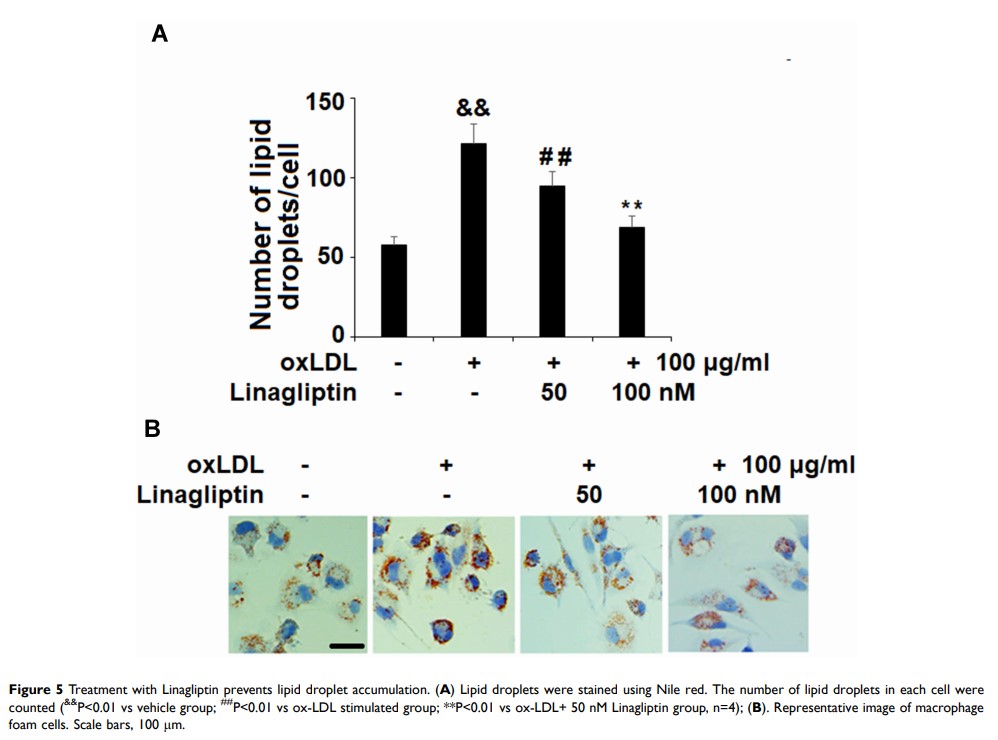
Methods: THP-1 macrophage cells were treated with 100 nM PMA for 72 hour to induce foam cell formation. The differentiated cells were exposed to 100 μg/mL ox-LDL in the presence or absence of the DPP-4 inhibitor Linagliptin. The expression levels of DPP-4 and inflammatory cytokines were detected by RT-PCR, ELISA, and Western blot experiments. The cellular ROS level was measured by staining the cells with the fluorescent probe DCFH-DA. The separation of lipoprotein fractions was achieved by high-performance liquid chromatography (HPLC). The cells were labeled with fluorescent-labeled cholesterol to measure cholesterol efflux, and lipid droplets were revealed by Nile red staining.
Results: The presence of Linagliptin significantly reduced ox-LDL-induced cytokine production (IL-1β and IL-6) and ROS production. Linagliptin ameliorated ox-LDL-induced lipid accumulation and impaired cholesterol efflux in macrophages. Mechanistically, this study showed that Linagliptin mitigated ox-LDL-induced expression of the scavenger receptors CD36 and LOX-1, but not SRA. Furthermore, Linagliptin increased the expression of the cholesterol transporter ABCG1, but not ABCA1.
Conclusion: Linagliptin possesses a potent inhibitory effect on THP-1 macrophage-derived foam cell formation in response to ox-LDL. This effect could be mediated through a decrease in the expression of CD36 and LOX-1 on macrophages and an increase in the expression of the cholesterol transporter ABCG1. This study indicates that the DPP-4 inhibitor Linagliptin plays a critical role in preventing foam cell formation in vitro. However, future research using an atherosclerotic animal model is necessary to determine its effectiveness and to prove its potential implication in the prevention and treatment of atherosclerosis.
Keywords: atherosclerosis, foam cells, Linagliptin, CD36, LOX-1, ABCG-1, ATP binding cassette transporter G1