115195
论文已发表
注册即可获取德孚的最新动态
IF 收录期刊
- 3.6 Breast Cancer (Dove Med Press)
- 4.3 Clin Epidemiol
- 2.6 Cancer Manag Res
- 3.2 Infect Drug Resist
- 4.1 Clin Interv Aging
- 6.1 Drug Des Dev Ther
- 4.1 Int J Chronic Obstr
- 8.7 Int J Nanomed
- 2.5 Int J Women's Health
- 3.2 Neuropsych Dis Treat
- 2.4 OncoTargets Ther
- 2.6 Patient Prefer Adher
- 2.6 Ther Clin Risk Manag
- 3.1 J Pain Res
- 3.5 Diabet Metab Synd Ob
- 4.5 Psychol Res Behav Ma
- 3.4 Nat Sci Sleep
- 2.4 Pharmgenomics Pers Med
- 2.6 Risk Manag Healthc Policy
- 4.6 J Inflamm Res
- 2.3 Int J Gen Med
- 3.9 J Hepatocell Carcinoma
- 3.3 J Asthma Allergy
- 2.5 Clin Cosmet Investig Dermatol
- 3.0 J Multidiscip Healthc

血浆纤维蛋白原可预测膀胱癌患者根治性膀胱切除术后的预后
Authors Yang S, Guan H, Wang S, Wu H, Sun W, Chen Z, Li Q
Received 24 June 2020
Accepted for publication 4 September 2020
Published 29 September 2020 Volume 2020:12 Pages 9303—9314
DOI https://doi.org/10.2147/CMAR.S269244
Checked for plagiarism Yes
Review by Single anonymous peer review
Peer reviewer comments 2
Editor who approved publication: Dr Ahmet Emre Eskazan
Background: This study aimed to determine the potential utility of plasma fibrinogen as a prognostic factor in patients with bladder cancer (BCa) after radical cystectomy (RC).
Methods: Patients with BCa who underwent RC from 2014 to 2019 were analyzed retrospectively. The indexes of plasma coagulation and fibrinolysis system factors were collected. Kaplan–Meier survival curves were used to calculate the overall survival (OS) and disease-free survival (DFS). The prognostic value of plasma fibrinogen was analyzed by using Cox regression model, and a nomogram of BCa based on plasma fibrinogen was generated by R software.
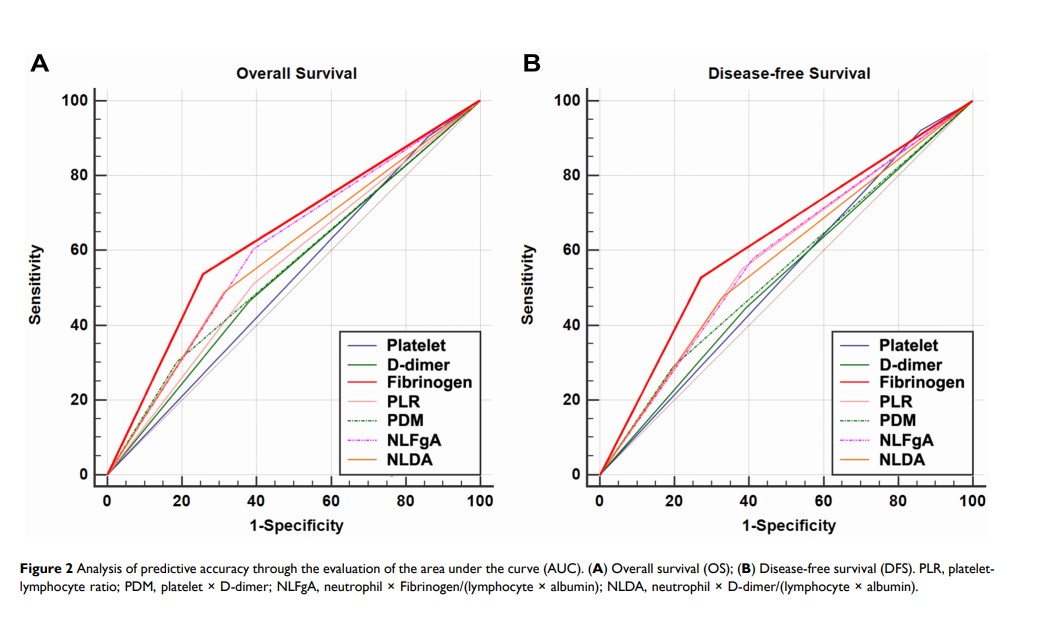
Results: Among 145 patients, the optimal cut-off value of plasma fibrinogen was 3.14g/L. High level of plasma fibrinogen was related to the poor prognosis of patients with BCa, and plasma fibrinogen has a more accurate prognostic ability than other plasma coagulation and fibrinolysis system factors. Multivariate Cox regression analysis showed that plasma fibrinogen was an independent predictor of OS (> 3.14 vs ≤ 3.14 HR, 2.58, 95% CI = 1.28– 5.23; p = 0.008) and DFS (> 3.14 vs ≤ 3.14 HR, 2.60, 95% CI = 1.20– 5.65; p = 0.016), and the nomogram based on plasma fibrinogen had better accuracy and discrimination (area under the curve (AUC): OS = 0.741, DFS = 0.733).
Conclusion: Plasma fibrinogen can be used as an independent predictor of OS and DFS for RC patients, and the nomogram based on plasma fibrinogen was a reliable model for predicting the prognosis after RC.
Keywords: bladder cancer, plasma fibrinogen, radical cystectomy, prognosis, nomogram