115195
论文已发表
注册即可获取德孚的最新动态
IF 收录期刊
- 3.6 Breast Cancer (Dove Med Press)
- 4.3 Clin Epidemiol
- 2.6 Cancer Manag Res
- 3.2 Infect Drug Resist
- 4.1 Clin Interv Aging
- 6.1 Drug Des Dev Ther
- 4.1 Int J Chronic Obstr
- 8.7 Int J Nanomed
- 2.5 Int J Women's Health
- 3.2 Neuropsych Dis Treat
- 2.4 OncoTargets Ther
- 2.6 Patient Prefer Adher
- 2.6 Ther Clin Risk Manag
- 3.1 J Pain Res
- 3.5 Diabet Metab Synd Ob
- 4.5 Psychol Res Behav Ma
- 3.4 Nat Sci Sleep
- 2.4 Pharmgenomics Pers Med
- 2.6 Risk Manag Healthc Policy
- 4.6 J Inflamm Res
- 2.3 Int J Gen Med
- 3.9 J Hepatocell Carcinoma
- 3.3 J Asthma Allergy
- 2.5 Clin Cosmet Investig Dermatol
- 3.0 J Multidiscip Healthc

新型 lncRNA SFTA1P 通过 PI3K/AKT/mTOR 信号通路下调 miR-4766-5p,以促进肝细胞癌的肿瘤生长
Authors Huang G, Yang Y, Lv M, Huang T, Zhan X, Kang W, Hou J
Received 6 February 2020
Accepted for publication 22 July 2020
Published 30 September 2020 Volume 2020:13 Pages 9759—9770
DOI https://doi.org/10.2147/OTT.S248660
Checked for plagiarism Yes
Review by Single anonymous peer review
Peer reviewer comments 4
Editor who approved publication: Dr XuYu Yang
Background: Hepatocellular carcinoma (HCC) is a common malignancy worldwide with a high mortality rate. lncRNA SFTA1P is highly expressed in HCC. We aimed to study the role of SFTA1P in HCC and its relationship with miR-4766-5p.
Materials and Methods: The levels of SFTA1P in HCC tissues and cell lines were determined. Relationship between SFTA1P and clinical features and prognosis was studied. The influence of SFTA1P on HCC cell viability, migration, invasion and apoptosis was studied in vitro. Rescue experiments were conducted after the binding site between SFTA1P and miR-4766-5p confirmed by dual-luciferase assay. The protein expression of AKT, p-AKT, mTOR and p-mTOR in HCC cells with knockdown of SFTA1P was determined by Western blotting. A tumor study in nude mice was conducted in order to assess the effects of SFTA1P on tumor growth characteristics.
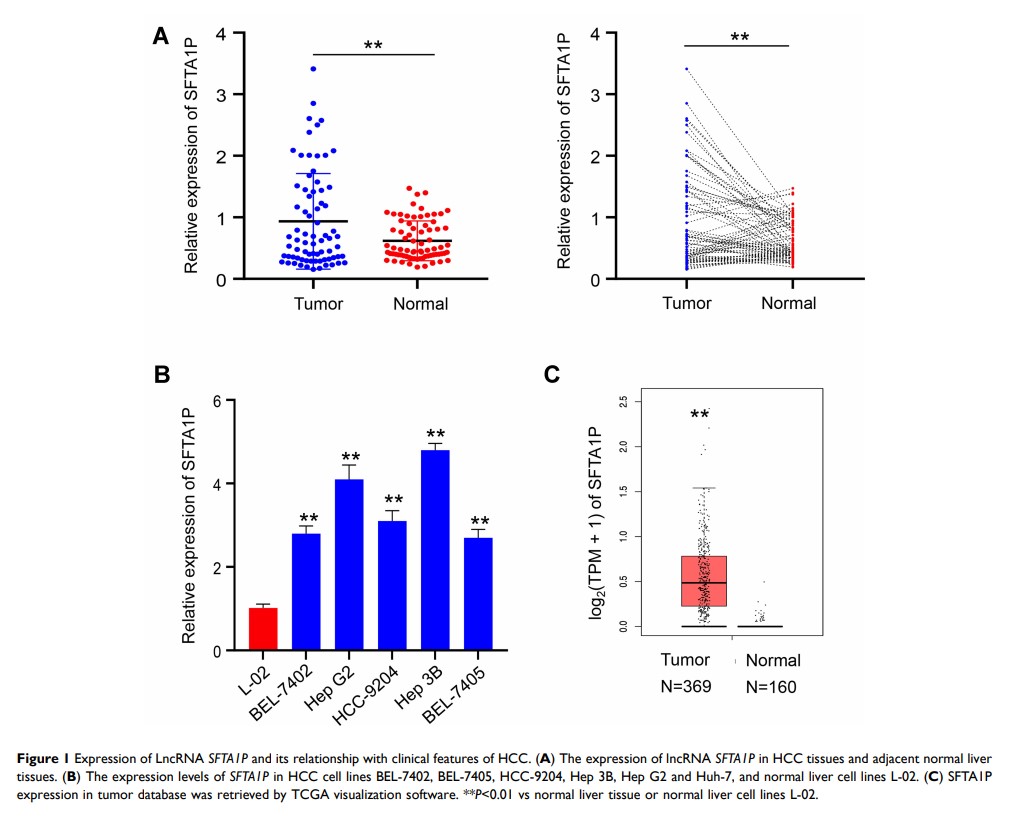
Results: SFTA1P was up-regulated in HCC tissues and cell lines. SFTA1P expression was closely related to tumor size, vascular invasion and TNM stage. Knockdown of SFTA1P inhibited HCC cell viability, migration and invasion and promoted cell apoptosis. MiR-4766-5p was a target of SFTA1P and knockdown of SFTA1P could decrease the protein expression of p-AKT and p-mTOR. Rescue experiments showed that miR-4766-5p mimics could attenuate the promoting role of SFTA1P on HCC cell viability, invasion and migration, and inhibiting role on cell apoptosis. Moreover, we used nude mice models and also found that the knockdown of SFTA1P reduced tumor volume and weight.
Conclusion: lncRNA SFTA1P could promote tumor development in HCC by down-regulating miR-4766-5p expression via PI3K/AKT/mTOR signaling pathway. It may be a potential therapeutic target for HCC.
Keywords: hepatocellular carcinoma, SFTA1P, miR-4766-5p, PI3K/AKT/mTOR signaling pathway, tumor growth