115195
论文已发表
注册即可获取德孚的最新动态
IF 收录期刊
- 3.6 Breast Cancer (Dove Med Press)
- 4.3 Clin Epidemiol
- 2.6 Cancer Manag Res
- 3.2 Infect Drug Resist
- 4.1 Clin Interv Aging
- 6.1 Drug Des Dev Ther
- 4.1 Int J Chronic Obstr
- 8.7 Int J Nanomed
- 2.5 Int J Women's Health
- 3.2 Neuropsych Dis Treat
- 2.4 OncoTargets Ther
- 2.6 Patient Prefer Adher
- 2.6 Ther Clin Risk Manag
- 3.1 J Pain Res
- 3.5 Diabet Metab Synd Ob
- 4.5 Psychol Res Behav Ma
- 3.4 Nat Sci Sleep
- 2.4 Pharmgenomics Pers Med
- 2.6 Risk Manag Healthc Policy
- 4.6 J Inflamm Res
- 2.3 Int J Gen Med
- 3.9 J Hepatocell Carcinoma
- 3.3 J Asthma Allergy
- 2.5 Clin Cosmet Investig Dermatol
- 3.0 J Multidiscip Healthc

从中国获得的启迪:国家多学科医疗救助
Authors Yang T, Shi H, Liu J, Deng J
Received 26 June 2020
Accepted for publication 29 August 2020
Published 30 September 2020 Volume 2020:13 Pages 1835—1837
DOI https://doi.org/10.2147/RMHP.S269523
Checked for plagiarism Yes
Review by Single anonymous peer review
Peer reviewer comments 3
Editor who approved publication: Professor Marco Carotenuto
Purpose: In response to the transmission of COVID-19, China adopted the “national multidisciplinary healthcare assistance”. This commentary evaluates whether it is effective and sustainable to contain the COVID-19.
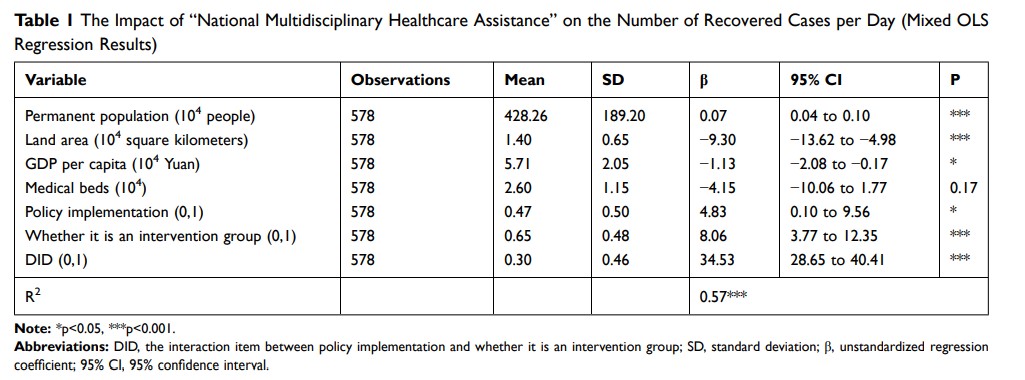
Methods: We adopted the “Difference-in-difference Method” to investigate whether the national multidisciplinary healthcare assistance policy could provide significant benefits in areas affected by COVID-19 by increasing their recovery rates. A total of 578 panel data samples were taken from the Ministry of Health in China.
Results: We observed that the number of recovered cases per day increased by 39.36 as a result of this policy. GDP per capita and land area were significantly negatively correlated with the number of recovered cases while the resident population was significantly positively correlated with it.
Conclusion: The national multidisciplinary healthcare assistance was an effective intervention to reduce the burden of COVID-19 and ease pressure on the healthcare system in Hubei and China. To quickly formulate and promulgate effective response policies for emergent public health crises, the national government should introduce the concept of emergency management into policy agendas and highlight the importance of “problem streams”.
Keywords: anti-epidemic, COVID-19, difference-in-difference method, healthcare system