115195
论文已发表
注册即可获取德孚的最新动态
IF 收录期刊
- 3.6 Breast Cancer (Dove Med Press)
- 4.3 Clin Epidemiol
- 2.6 Cancer Manag Res
- 3.2 Infect Drug Resist
- 4.1 Clin Interv Aging
- 6.1 Drug Des Dev Ther
- 4.1 Int J Chronic Obstr
- 8.7 Int J Nanomed
- 2.5 Int J Women's Health
- 3.2 Neuropsych Dis Treat
- 2.4 OncoTargets Ther
- 2.6 Patient Prefer Adher
- 2.6 Ther Clin Risk Manag
- 3.1 J Pain Res
- 3.5 Diabet Metab Synd Ob
- 4.5 Psychol Res Behav Ma
- 3.4 Nat Sci Sleep
- 2.4 Pharmgenomics Pers Med
- 2.6 Risk Manag Healthc Policy
- 4.6 J Inflamm Res
- 2.3 Int J Gen Med
- 3.9 J Hepatocell Carcinoma
- 3.3 J Asthma Allergy
- 2.5 Clin Cosmet Investig Dermatol
- 3.0 J Multidiscip Healthc

血清 lncRNA (CCAT2,LINC01133,LINC00511) 与鳞状细胞癌抗原组套作为检测宫颈鳞状细胞癌的新型非侵入性生物标记物
Authors Wang WJ, Wang D, Zhao M, Sun XJ, Li Y, Lin H, Che YQ, Huang CZ
Received 6 May 2020
Accepted for publication 26 August 2020
Published 1 October 2020 Volume 2020:12 Pages 9495—9502
DOI https://doi.org/10.2147/CMAR.S259586
Checked for plagiarism Yes
Review by Single anonymous peer review
Peer reviewer comments 2
Editor who approved publication: Dr Sanjeev Srivastava
Background: We screened long non-coding RNAs (lncRNAs) specifically expressed in the serum of cervical squamous carcinoma (CESC) patient samples and investigated the role of these specific lncRNAs in the diagnosis of CESC and cervical intraepithelial neoplasia (CIN).
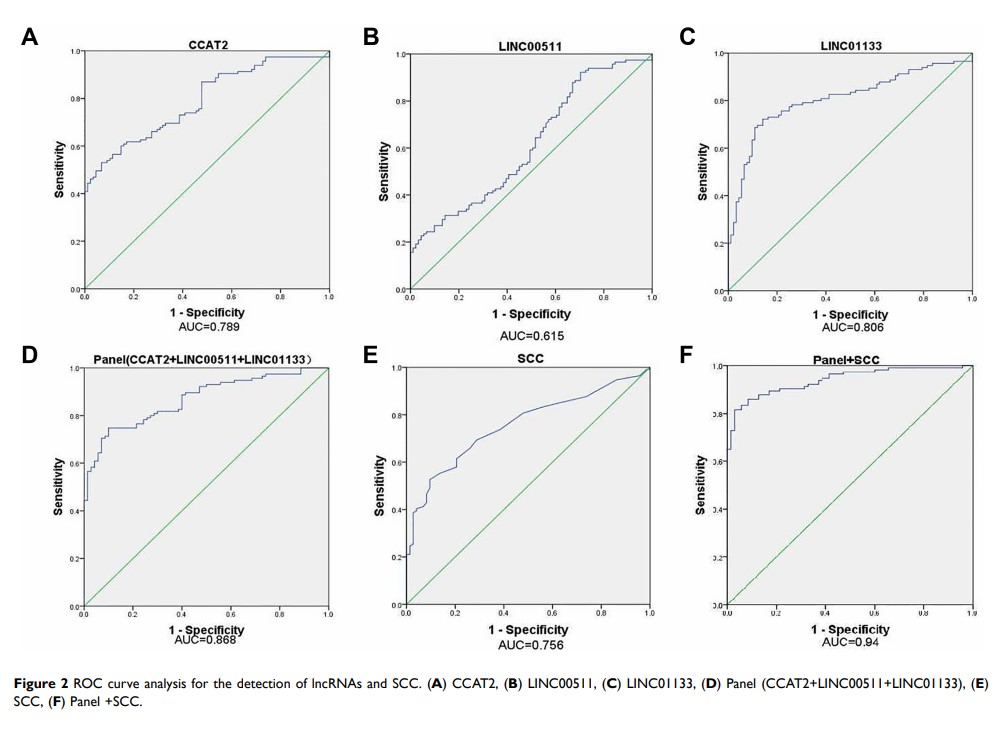
Methods: The expression levels of the lncRNAs CCAT2, LINC01133, and LINC00511 in the serum of normal controls and patient with CESC and CIN were measured using reverse transcription–quantitative polymerase chain reaction (RT-qPCR). Next, we analyzed the correlation between the serum lncRNAs levels and the clinical characteristics of CESC. Thereafter, we estimated their combined diagnostic value by receiver operating characteristic (ROC) curve analysis.
Results: The results showed that CCAT2, LINC01133, and LINC00511 were highly expressed in the serum of patients with CESC. When these lncRNAs and squamous cell carcinoma (SCC) antigen were combined, the area under the ROC curve (AUC) value reached 0.94. We also found that the AUC value of the diagnostic model combining CCAT2 and LINC01133 reached 0.894.
Conclusion: The serum lncRNAs (CCAT2, LINC01133, and LINC00511) and SCC may be new non-invasive biomarkers for the diagnosis of CESC.
Keywords: CCAT2, LINC01133, LINC00511, SCC, CESC, diagnosis