115195
论文已发表
注册即可获取德孚的最新动态
IF 收录期刊
- 3.6 Breast Cancer (Dove Med Press)
- 4.3 Clin Epidemiol
- 2.6 Cancer Manag Res
- 3.2 Infect Drug Resist
- 4.1 Clin Interv Aging
- 6.1 Drug Des Dev Ther
- 4.1 Int J Chronic Obstr
- 8.7 Int J Nanomed
- 2.5 Int J Women's Health
- 3.2 Neuropsych Dis Treat
- 2.4 OncoTargets Ther
- 2.6 Patient Prefer Adher
- 2.6 Ther Clin Risk Manag
- 3.1 J Pain Res
- 3.5 Diabet Metab Synd Ob
- 4.5 Psychol Res Behav Ma
- 3.4 Nat Sci Sleep
- 2.4 Pharmgenomics Pers Med
- 2.6 Risk Manag Healthc Policy
- 4.6 J Inflamm Res
- 2.3 Int J Gen Med
- 3.9 J Hepatocell Carcinoma
- 3.3 J Asthma Allergy
- 2.5 Clin Cosmet Investig Dermatol
- 3.0 J Multidiscip Healthc

CircNFIX 充当 miR-212-3p 海绵,通过上调 ADAM10 来增强非小细胞肺癌的恶性进展
Authors Lu J, Zhu Y, Qin Y, Chen Y
Received 15 July 2020
Accepted for publication 31 August 2020
Published 2 October 2020 Volume 2020:12 Pages 9577—9587
DOI https://doi.org/10.2147/CMAR.S272309
Checked for plagiarism Yes
Review by Single anonymous peer review
Peer reviewer comments 2
Editor who approved publication: Prof. Dr. Xueqiong Zhu
Background: Non-small cell lung cancer (NSCLC) remains the most commonly diagnosed malignancy and the leading cause of cancer death worldwide. Circular RNAs (circRNAs) have been demonstrated to play critical roles in human carcinogenesis, including NSCLC. However, it is still unclear whether circRNA nuclear factor I X (circNFIX) is implicated in the molecular pathogenesis of NSCLC.
Methods: The expression levels of circNFIX, miR-212-3p and a disintegrin and metalloproteinases 10 (ADAM10) were detected by quantitative real-time polymerase chain reaction (qRT-PCR) or Western blot. Cell viability was gauged by the Cell Counting Kit-8 (CCK-8) assay, and cell migration and invasion were determined by transwell assays. Glucose uptake and lactate product were determined using the assay kits. Targeted relationships among circNFIX, miR-212-3p and ADAM10 were verified by dual-luciferase reporter and RNA pulldown assays. Additionally, the xenograft model assays were carried out to analyze the role of circNFIX in tumor growth in vivo.
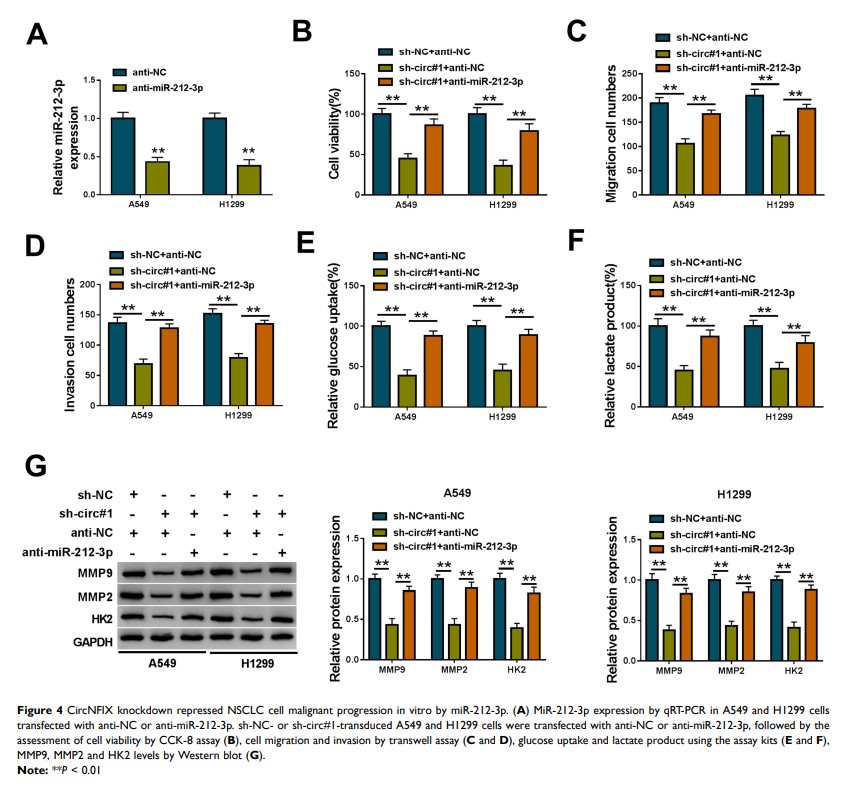
Results: Our data revealed that circNFIX was overexpressed in NSCLC and predicted poor prognosis of NSCLC patients. CircNFIX knockdown suppressed NSCLC cell viability, migration, invasion and glycolysis in vitro and hampered tumor growth in vivo. Mechanistically, CircNFIX acted as a molecular sponge of miR-212-3p, and the repressive effect of circNFIX knockdown on NSCLC cell malignant progression was mediated by miR-212-3p. Moreover, ADAM10 was a direct target of miR-212-3p, and circNFIX influenced ADAM10 expression by sponging miR-212-3p in NSCLC cells. Furthermore, the silencing of ADAM10 hindered NSCLC cell viability, migration, invasion and glycolysis in vitro.
Conclusion: Our findings first identified that the knockdown of circNFIX, a highly expressed circRNA in NSCLC, exerted a repressive role in NSCLC malignant progression at least in part through targeting the miR-212-3p/ADAM10 axis, illuminating a novel understanding of circRNA regulation in NSCLC.
Keywords: NSCLC, circNFIX, miR-212-3p, ADAM10, malignant progression