115195
论文已发表
注册即可获取德孚的最新动态
IF 收录期刊
- 3.6 Breast Cancer (Dove Med Press)
- 4.3 Clin Epidemiol
- 2.6 Cancer Manag Res
- 3.2 Infect Drug Resist
- 4.1 Clin Interv Aging
- 6.1 Drug Des Dev Ther
- 4.1 Int J Chronic Obstr
- 8.7 Int J Nanomed
- 2.5 Int J Women's Health
- 3.2 Neuropsych Dis Treat
- 2.4 OncoTargets Ther
- 2.6 Patient Prefer Adher
- 2.6 Ther Clin Risk Manag
- 3.1 J Pain Res
- 3.5 Diabet Metab Synd Ob
- 4.5 Psychol Res Behav Ma
- 3.4 Nat Sci Sleep
- 2.4 Pharmgenomics Pers Med
- 2.6 Risk Manag Healthc Policy
- 4.6 J Inflamm Res
- 2.3 Int J Gen Med
- 3.9 J Hepatocell Carcinoma
- 3.3 J Asthma Allergy
- 2.5 Clin Cosmet Investig Dermatol
- 3.0 J Multidiscip Healthc

血清外泌体 lncRNAs 作为食管鳞状细胞癌诊断和预后生物标志物的评估
Authors Yan S, Du L, Jiang X, Duan W, Li J, Xie Y, Zhan Y, Zhang S, Wang L, Li S, Wang C
Received 23 February 2020
Accepted for publication 11 August 2020
Published 7 October 2020 Volume 2020:12 Pages 9753—9763
DOI https://doi.org/10.2147/CMAR.S250971
Checked for plagiarism Yes
Review by Single anonymous peer review
Peer reviewer comments 2
Editor who approved publication: Dr Eileen O'Reilly
Background: Exosomal long non-coding RNAs (lncRNAs) have been recognised as promising stable biomarkers in cancers. The aim of this study was to identify an exosomal lncRNA panel for diagnosis and prognosis of esophageal squamous cell carcinoma (ESCC).
Materials and Methods: Exosomes were isolated from serum by ExoQuick Solution. To validate the exosomes, exosomal markers and characterization of nanoparticle were performed. Quantitative real-time PCR was used to measure the levels of lncRNAs in exosomes from ESCC patients and healthy subjects. In the training set, exosomal lncRNA profiles from 404 samples were conducted and established new models by multivariate logistic regression. In the validation set, the diagnostic performance of the panel was further validated in 222 additional individuals with a receiver operating characteristic curve (ROC). Kaplan–Meier and multivariate Cox proportional hazards analysis were applied to assess the correlation between lncRNAs and survival rate of ESCC patients.
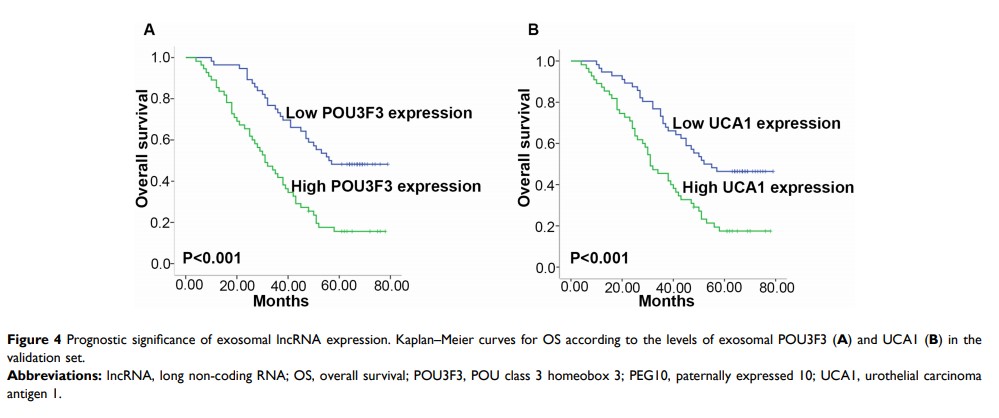
Results: A 4-lncRNA panel (UCA1, POU3F3, ESCCAL-1 and PEG10) in exosomes for ESCC diagnosis was developed by logistic regression model. The diagnostic accuracy of panel was evaluated with AUC value of 0.844 and 0.853 for training and validation stage, respectively. The corresponding AUCs for patients with TNM stage I–II and III were 0.820 and 0.935, significantly higher than squamous cell carcinoma antigen (P < 0.001), which were 0.652 and 0.642, respectively. Kaplan–Meier analysis indicated that patients with higher level of UCA1 and POU3F3 had lower survival rate (P < 0.001). Additionally, POU3F3 might be as an independent prognostic factor for ESCC patients (P =0.004).
Conclusion: These findings suggested that serum exosomal 4-lncRNA panel has considerable value for ESCC diagnosis, and POU3F3 may serve as a novel and independent prognostic predictor in clinical applications.
Keywords: biomarker, diagnosis, exosome, esophageal squamous cell carcinoma; ESCC, long non-coding RNA; lncRNA