115195
论文已发表
注册即可获取德孚的最新动态
IF 收录期刊
- 3.6 Breast Cancer (Dove Med Press)
- 4.3 Clin Epidemiol
- 2.6 Cancer Manag Res
- 3.2 Infect Drug Resist
- 4.1 Clin Interv Aging
- 6.1 Drug Des Dev Ther
- 4.1 Int J Chronic Obstr
- 8.7 Int J Nanomed
- 2.5 Int J Women's Health
- 3.2 Neuropsych Dis Treat
- 2.4 OncoTargets Ther
- 2.6 Patient Prefer Adher
- 2.6 Ther Clin Risk Manag
- 3.1 J Pain Res
- 3.5 Diabet Metab Synd Ob
- 4.5 Psychol Res Behav Ma
- 3.4 Nat Sci Sleep
- 2.4 Pharmgenomics Pers Med
- 2.6 Risk Manag Healthc Policy
- 4.6 J Inflamm Res
- 2.3 Int J Gen Med
- 3.9 J Hepatocell Carcinoma
- 3.3 J Asthma Allergy
- 2.5 Clin Cosmet Investig Dermatol
- 3.0 J Multidiscip Healthc

分化型甲状腺癌伴脊柱转移瘤的手术治疗和预后分析:单中心十年回顾性研究
Authors Liu S, Zhou X, Song A, Yao S, Wang M, Niu T, Gao C, Huo Z, Liu Y, Wang Y
Received 2 August 2020
Accepted for publication 18 September 2020
Published 9 October 2020 Volume 2020:12 Pages 9893—9904
DOI https://doi.org/10.2147/CMAR.S275176
Checked for plagiarism Yes
Review by Single anonymous peer review
Peer reviewer comments 3
Editor who approved publication: Dr Eileen O'Reill
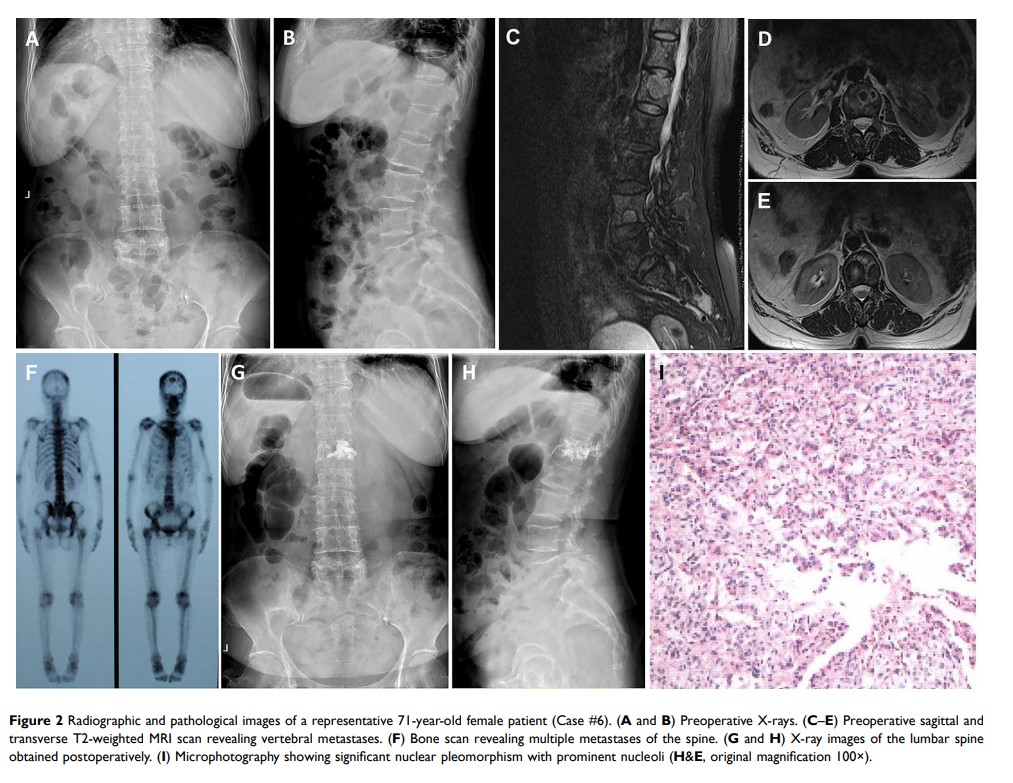
Objective: Metastatic spinal differentiated thyroid carcinoma (MSDTC) is relatively rare in the clinic and often overlooked. The objective of the current study is to analyze the clinical characteristics and prognosis of patients with MSDTC who underwent surgical treatment to determine the prognostic factors that affect survival.
Methods: This study retrospectively analyzed the clinical data and postoperative follow-up results of MSDTC patients who underwent spinal surgery at the Orthopedic Department of Peking Union Medical College Hospital from January 2010 to January 2020. Clinical data and survival time were analyzed by Kaplan–Meier analysis.
Results: Eleven patients were included, and the average age was 58.3 years (range 37‒74). The average time from the initial surgery to the discovery of spinal metastasis was 42.9 months (range 0‒132), and the average follow-up time was 21.8 months (range 3‒80). Progression was identified in seven patients, and 10 patients (90.9%) died during the follow-up period. Kaplan–Meier analysis showed that extraosseous visceral metastasis (p=0.012), revised Tokuhashi score (p=0.035), Tomita score (p=0.038), and surgical method (p=0.028) were associated with overall survival (OS). In addition, skeletal visceral metastasis (p=0.017), revised Tokuhashi score (p=0.028), Tomita score (p=0.038), and surgical method (p=0.049) were associated with progression-free survival (PFS).
Conclusion: Surgical treatment is an effective method for treating MSDTC and leads to pain relief, restored function and increased spinal stability. Based on our single-center experience, extraosseous visceral metastasis, revised Tokuhashi score, Tomita score, and surgical methods may be potential prognostic factors for OS whilst visceral metastasis, revised Tokuhashi score, Tomita score, and surgical methods may be potential prognostic factors for PFS.
Keywords: adjuvant therapy, clinical features, differentiated thyroid carcinoma, postoperative survival, prognostic factors, spinal metastasis, surgical treatment