115195
论文已发表
注册即可获取德孚的最新动态
IF 收录期刊
- 3.6 Breast Cancer (Dove Med Press)
- 4.3 Clin Epidemiol
- 2.6 Cancer Manag Res
- 3.2 Infect Drug Resist
- 4.1 Clin Interv Aging
- 6.1 Drug Des Dev Ther
- 4.1 Int J Chronic Obstr
- 8.7 Int J Nanomed
- 2.5 Int J Women's Health
- 3.2 Neuropsych Dis Treat
- 2.4 OncoTargets Ther
- 2.6 Patient Prefer Adher
- 2.6 Ther Clin Risk Manag
- 3.1 J Pain Res
- 3.5 Diabet Metab Synd Ob
- 4.5 Psychol Res Behav Ma
- 3.4 Nat Sci Sleep
- 2.4 Pharmgenomics Pers Med
- 2.6 Risk Manag Healthc Policy
- 4.6 J Inflamm Res
- 2.3 Int J Gen Med
- 3.9 J Hepatocell Carcinoma
- 3.3 J Asthma Allergy
- 2.5 Clin Cosmet Investig Dermatol
- 3.0 J Multidiscip Healthc

前列腺癌永久性近距离碘-125 放射治疗后的免疫状态分析
Authors Du E, Wang L, Li C, Zhang C, Qu Y, Liu R, Xu Y, Yang K, Zhang Z
Received 19 March 2017
Accepted for publication 27 April 2017
Published 15 May 2017 Volume 2017:10 Pages 2561—2567
DOI https://doi.org/10.2147/OTT.S137491
Checked for plagiarism Yes
Review by Single-blind
Peer reviewers approved by Dr Akshita Wason
Peer reviewer comments 3
Editor who approved publication: Dr Carlos Vigil Gonzales
Background: Permanent prostate brachytherapy (PPB) is an effective treatment choice
for low and intermediate risk prostate cancer (PCa). However, the impact of PPB
on tumor immune status is still poorly understood. This study aimed to assess
the immune status in PCa patients before and at different time points after PPB
(1, 3, 6, and 12 months).
Methods: Blood was collected from 32 patients with low and
intermediate risk PCa and 12 healthy volunteers. The frequency of
immunocompetent cells was identified by flow cytometry. The concentration of
immunoglobulins and complements was detected by ELISA.
Results: Various immunocompetent cells were dysregulated in PCa
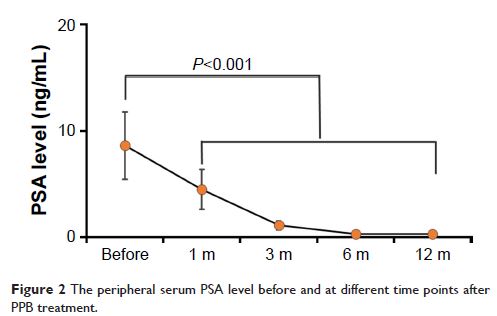
patients compared with healthy volunteers. Peripheral serum prostate-specific
antigen (PSA) decreased rapidly at the first month after PPB treatment, and the
peripheral serum PSA became very low at 6 months after PPB treatment. CD3+ T
cells, CD4+ T cells, CD3-CD16+/56+ natural killer (NK) cells were increased
significantly at certain time points after PPB. Although the percentage of the
CD8+ T cells did not change markedly, the ratio of CD4/CD8 increased
significantly at 3 months after PPB (P =0.0196). There
was no influence of PPB on B cells number, but the concentration of
immunoglobulins IgM, IgG, and IgA, and complements C3 and C4 in patients
increased at some time points after PPB.
Conclusion: The immunocompetent cells are
dysregulated in PCa patients. PPB treatment could effectively kill tumor cells
and then stimulate cellular immunity and humoral immunity in PCa patients.
Keywords: prostate cancer, iodine-125, permanent
prostate brachytherapy, immune status