115195
论文已发表
注册即可获取德孚的最新动态
IF 收录期刊
- 3.6 Breast Cancer (Dove Med Press)
- 4.3 Clin Epidemiol
- 2.6 Cancer Manag Res
- 3.2 Infect Drug Resist
- 4.1 Clin Interv Aging
- 6.1 Drug Des Dev Ther
- 4.1 Int J Chronic Obstr
- 8.7 Int J Nanomed
- 2.5 Int J Women's Health
- 3.2 Neuropsych Dis Treat
- 2.4 OncoTargets Ther
- 2.6 Patient Prefer Adher
- 2.6 Ther Clin Risk Manag
- 3.1 J Pain Res
- 3.5 Diabet Metab Synd Ob
- 4.5 Psychol Res Behav Ma
- 3.4 Nat Sci Sleep
- 2.4 Pharmgenomics Pers Med
- 2.6 Risk Manag Healthc Policy
- 4.6 J Inflamm Res
- 2.3 Int J Gen Med
- 3.9 J Hepatocell Carcinoma
- 3.3 J Asthma Allergy
- 2.5 Clin Cosmet Investig Dermatol
- 3.0 J Multidiscip Healthc

实体瘤 IMP3 高表达的预后价值: 一项综合分析
Authors Chen L, Xie Y, Li X, Gu L, Gao Y, Tang L, Chen J, Zhang X
Received 27 November 2016
Accepted for publication 30 March 2017
Published 6 June 2017 Volume 2017:10 Pages 2849—2863
DOI https://doi.org/10.2147/OTT.S128810
Checked for plagiarism Yes
Review by Single-blind
Peer reviewers approved by Dr Akshita Wason
Peer reviewer comments 2
Editor who approved publication: Dr William Cho
Background: Accumulated studies have investigated the prognostic role of
insulin-like growth factor II mRNA-binding protein 3 (IMP3) in various cancers,
but inconsistent and controversial results were obtained. Therefore, we
performed a systematic review and meta-analysis to investigate the potential
value of IMP3 in the prognostic prediction of human solid tumors.
Materials and methods: A systematic literature search in the electronic
databases PubMed, Embase, Web of Science, and Cochrane library (updated to
April 2016) was conducted to identify eligible studies. Pooled hazard ratios
(HRs) with 95% confidence intervals (CIs) for survival outcomes were calculated
and gathered using STATA 12.0 software.
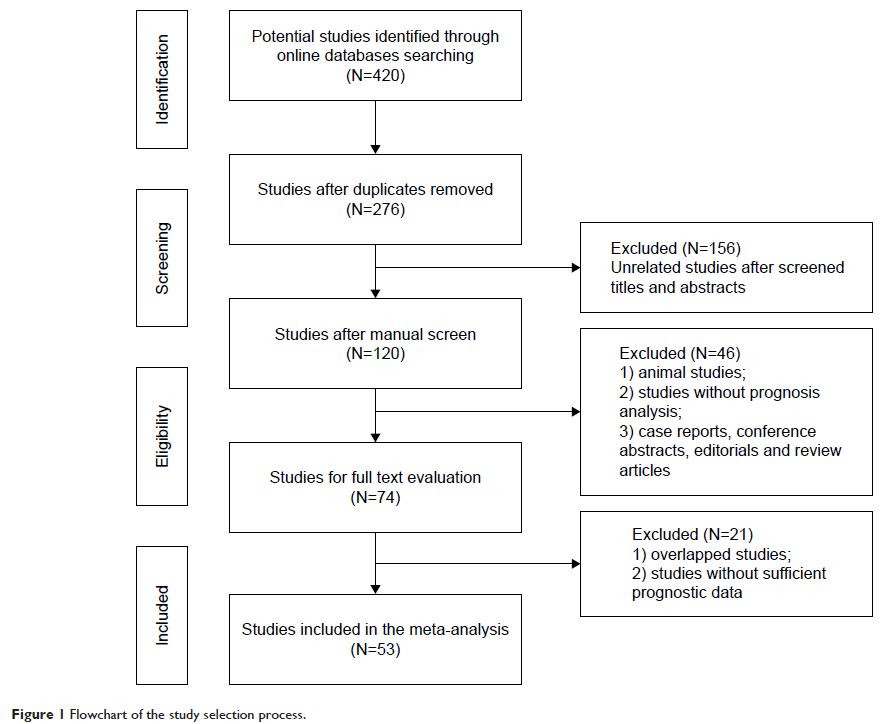
Results: A total of 53 studies containing 8,937 patients with
solid tumors were included in this meta-analysis. High IMP3 expression was
significantly associated with worse overall survival (OS) of solid tumors (HR
=2.08, 95% CI: 1.80–2.42, P <0.001). Similar results were
observed in cancer-specific survival (CSS), disease-free survival (DFS),
recurrence-free survival (RFS), progression-free survival (PFS), and
metastasis-free survival (MFS). Further subgroup analysis stratified by tumor
type showed that elevated IMP3 expression was associated with poor OS in renal
cell carcinoma (RCC), lung cancer, oral cancer, urothelial carcinoma,
hepatocellular carcinoma (HCC), colorectal cancer, pancreatic cancer, gastric
cancer, and intrahepatic cholangiocarcinoma (ICC).
Conclusion: The current evidence suggests that high IMP3
expression is associated with poor prognosis in most solid tumors. IMP3 is a
potential valuable prognostic factor and might serve as a promising biomarker
to guide clinical decisions in human solid tumors.
Keywords: IMP3,
prognosis, solid tumor, biomarker, meta-analysis