115195
论文已发表
注册即可获取德孚的最新动态
IF 收录期刊
- 3.6 Breast Cancer (Dove Med Press)
- 4.3 Clin Epidemiol
- 2.6 Cancer Manag Res
- 3.2 Infect Drug Resist
- 4.1 Clin Interv Aging
- 6.1 Drug Des Dev Ther
- 4.1 Int J Chronic Obstr
- 8.7 Int J Nanomed
- 2.5 Int J Women's Health
- 3.2 Neuropsych Dis Treat
- 2.4 OncoTargets Ther
- 2.6 Patient Prefer Adher
- 2.6 Ther Clin Risk Manag
- 3.1 J Pain Res
- 3.5 Diabet Metab Synd Ob
- 4.5 Psychol Res Behav Ma
- 3.4 Nat Sci Sleep
- 2.4 Pharmgenomics Pers Med
- 2.6 Risk Manag Healthc Policy
- 4.6 J Inflamm Res
- 2.3 Int J Gen Med
- 3.9 J Hepatocell Carcinoma
- 3.3 J Asthma Allergy
- 2.5 Clin Cosmet Investig Dermatol
- 3.0 J Multidiscip Healthc

利用腹膜后腹腔镜手术和开放手术矫正逆行输尿管的疗效和安全性比较
Authors Mao L, Xu K, Ding M, Pan J, Guo Z
Received 7 April 2017
Accepted for publication 10 May 2017
Published 6 June 2017 Volume 2017:13 Pages 697—701
DOI https://doi.org/10.2147/TCRM.S139113
Checked for plagiarism Yes
Review by Single-blind
Peer reviewers approved by Dr Hoa Le
Peer reviewer comments 2
Editor who approved publication: Professor Deyun Wang
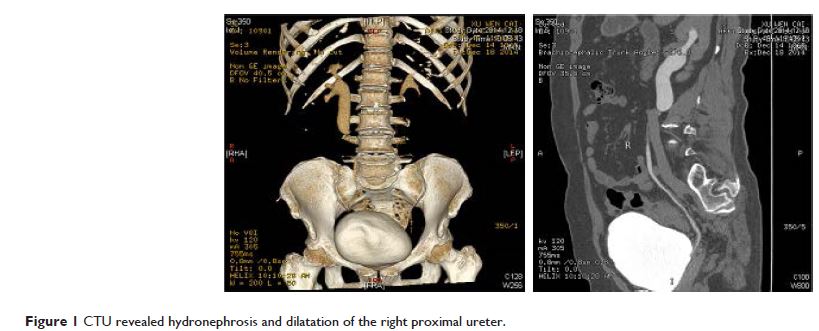
Objective: The aim of this study was to compare the clinical efficacy and safety of
retroperitoneal laparoscopic and open surgery for the correction of retrocaval
ureter.
Patients and methods: Clinical data of 14 patients with retrocaval ureter
were analyzed retrospectively. Among them, nine were treated by open surgical
therapy and five by retroperitoneal laparoscopic surgery. The ureter was
transpositioned to a normal anatomic position followed by laparoscopic
intracorporeal uretero and ureteric anastomosis.
Results: Open surgery was successfully performed in nine cases.
The mean surgery time was 95.6±22.0 min, and blood loss was
108.6±34.5 mL. The mean hospitalization time was 14.8±1.1 days, and
the recovery time was 52.8±1.3 days. Retroperitoneal laparoscopic surgery
was successfully performed in five cases without conversion to open surgery and
without severe perioperative complications. The mean surgery time was
112.0±42.1 min, and blood loss was 45.3±15.1 mL. The mean hospitalization
time was 7.3±1.9 days, and the recovery time was 23.6±2.4 days.
Postoperative urine leakage occurred in one patient. No postoperative ureter
stenosis occurred in patients who were treated by retroperitoneal laparoscopic
surgery.
Conclusion: Retroperitoneal laparoscopic ureteroplasty in patients
with retrocaval ureter is safe and effective with less trauma and faster
recovery and could be used as first choice for the treatment of retrocaval
ureter.
Keywords: retrocaval ureter, laparoscopy, open
surgery