115195
论文已发表
注册即可获取德孚的最新动态
IF 收录期刊
- 3.6 Breast Cancer (Dove Med Press)
- 4.3 Clin Epidemiol
- 2.6 Cancer Manag Res
- 3.2 Infect Drug Resist
- 4.1 Clin Interv Aging
- 6.1 Drug Des Dev Ther
- 4.1 Int J Chronic Obstr
- 8.7 Int J Nanomed
- 2.5 Int J Women's Health
- 3.2 Neuropsych Dis Treat
- 2.4 OncoTargets Ther
- 2.6 Patient Prefer Adher
- 2.6 Ther Clin Risk Manag
- 3.1 J Pain Res
- 3.5 Diabet Metab Synd Ob
- 4.5 Psychol Res Behav Ma
- 3.4 Nat Sci Sleep
- 2.4 Pharmgenomics Pers Med
- 2.6 Risk Manag Healthc Policy
- 4.6 J Inflamm Res
- 2.3 Int J Gen Med
- 3.9 J Hepatocell Carcinoma
- 3.3 J Asthma Allergy
- 2.5 Clin Cosmet Investig Dermatol
- 3.0 J Multidiscip Healthc

在广泛应用调强放射治疗的今天,使用倾向评分匹配法比较鼻咽癌治疗中采用新辅助化疗外加同步放化疗 (CCRT) 与仅进行 CCRT 的长期疗效差异
Authors Chen X, Zhu X, Liang Z, Li L, Qu S, Chen K, Pan X
Received 25 February 2017
Accepted for publication 27 April 2017
Published 9 June 2017 Volume 2017:10 Pages 2909—2921
DOI https://doi.org/10.2147/OTT.S135590
Checked for plagiarism Yes
Review by Single-blind
Peer reviewers approved by Dr Ru Chen
Peer reviewer comments 3
Editor who approved publication: Dr Carlos Vigil Gonzales
Purpose: Whether neoadjuvant chemotherapy (NCT) followed by concurrent chemoradiotherapy
(CCRT) could improve survival in nasopharyngeal carcinoma (NPC) remains
controversial especially in the era of intensity-modulated radiation therapy
(IMRT), and we explored the role of NCT for NPC patients.
Patients and
methods: A retrospective review was conducted of 255 NPC patients treated with
NCT+CCRT (n=67) or CCRT alone (n=188) based on IMRT between December 2006 and
December 2012. To control the imbalance, a 1:2 match was performed using
propensity score matching (PSM) method based on patient’s heterogeneity and
regimens of concurrent chemotherapy (CCT). The long-term treatment outcomes
and toxicity between NCT group (n=67) and concurrent chemoradiotherapy (CRT)
group (n=134) after PSM were compared.
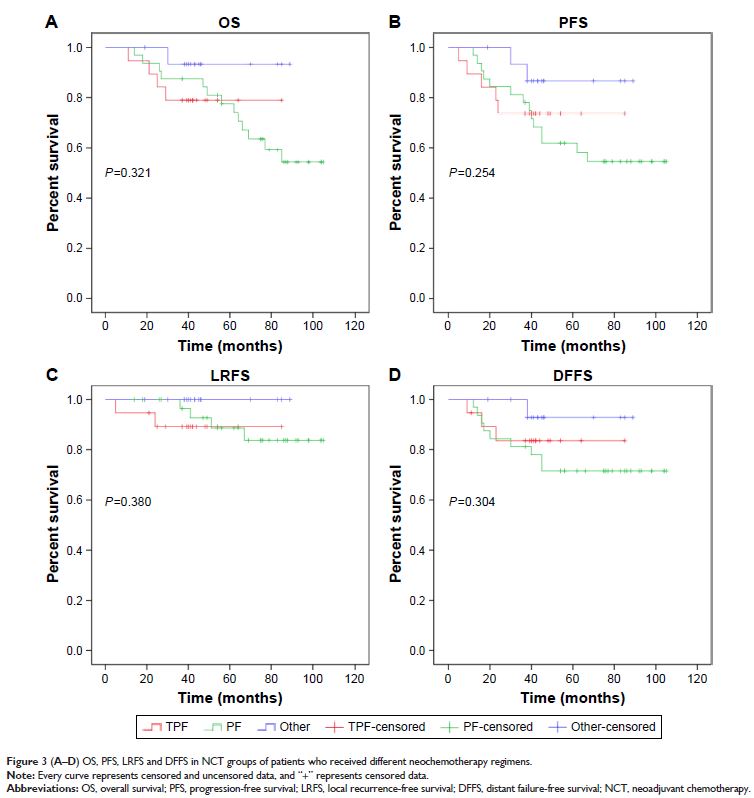
Results: The 5-year overall survival (OS), progression-free survival (PFS),
recurrence-free survival (RFS), local recurrence-free survival (LRFS), regional
recurrence-free survival (RRFS) and distant failure-free survival (DFFS) were
78.8%, 69.1%, 90.0%, 90.0%, 100% and 78.3% for NCT group, while 79.5%, 75.7%,
92.7%, 94.2%, 96.1% and 82.7% for CRT group (P =0.305, 0.448,
0.790, 0.512, 0.104 and 0.671). It indicated that the treatment method
(NCT+CCRT vs CCRT) was not the independent prognostic factor for the survival
in NPC patients, and only patients who had completed at least two cycles of CCT
got better OS, RFS and DFFS (P =0.009, 0.016 and
0.043), whether to receive NCT or not. No difference in the incidences of any
acute and most late toxicity between the two groups was shown.
Conclusion: Our study did not show the exact advantage of NCT followed by CCRT
compared with CCRT alone or higher incidences of toxicity in NCT group. It
suggests that NCT might not be necessary if two or more cycles of CCT are
finished well in the era of IMRT, and when NCT is finished well, less than two
cycles of CCT with IMRT could be enough. However, in the era of IMRT, the role
of NCT still needs to be further explored.
Keywords: propensity score matching, PSM, nasopharyngeal carcinoma, concurrent
chemotherapy, IMRT