115195
论文已发表
注册即可获取德孚的最新动态
IF 收录期刊
- 3.6 Breast Cancer (Dove Med Press)
- 4.3 Clin Epidemiol
- 2.6 Cancer Manag Res
- 3.2 Infect Drug Resist
- 4.1 Clin Interv Aging
- 6.1 Drug Des Dev Ther
- 4.1 Int J Chronic Obstr
- 8.7 Int J Nanomed
- 2.5 Int J Women's Health
- 3.2 Neuropsych Dis Treat
- 2.4 OncoTargets Ther
- 2.6 Patient Prefer Adher
- 2.6 Ther Clin Risk Manag
- 3.1 J Pain Res
- 3.5 Diabet Metab Synd Ob
- 4.5 Psychol Res Behav Ma
- 3.4 Nat Sci Sleep
- 2.4 Pharmgenomics Pers Med
- 2.6 Risk Manag Healthc Policy
- 4.6 J Inflamm Res
- 2.3 Int J Gen Med
- 3.9 J Hepatocell Carcinoma
- 3.3 J Asthma Allergy
- 2.5 Clin Cosmet Investig Dermatol
- 3.0 J Multidiscip Healthc

肝动脉灌注化疗可提高肝细胞癌在经过肝切除术治疗后的存活率
Authors Feng M, Tang C, Feng W, Bao Y, Zheng Y, Shen J
Received 12 March 2017
Accepted for publication 17 May 2017
Published 14 June 2017 Volume 2017:10 Pages 3001—3005
DOI https://doi.org/10.2147/OTT.S136806
Checked for plagiarism Yes
Review by Single-blind
Peer reviewers approved by Dr Akshita Wason
Peer reviewer comments 3
Editor who approved publication: Dr William Cho
Objective: To evaluate the effect of postoperative hepatic artery-infusion
chemotherapy (HAIC) on survival probability in patients with hepatocellular
carcinoma (HCC) after radical hepatectomy.
Patients and methods: This retrospective study included 85 patients with HCC
who received radical hepatectomy from May 2005 to May 2010. Among these
patients, 42 underwent two sessions of HAIC (5-fluoruracil [1,000 mg/m2], oxaliplatin [85 mg/m2],
and mitomycin-C [6 mg/m2]) after radical
hepatectomy (HAIC group), and 43 underwent radical hepatectomy only (the
control group). HAIC-related side effects and long-term survival were
retrospectively analyzed.
Results: The HAIC group showed a significantly higher 5-year
intrahepatic recurrence-free survival probability and lower risk of
intrahepatic recurrence (HR 0.5615, 95% CI 0.3234–0.9749 [log-rank test]; P =0.0332). The HAIC
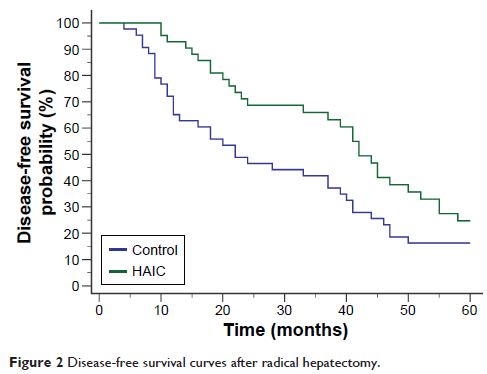
group also had significantly higher 5-year disease-free survival probability
(HR 0.591, 95% CI 0.3613–0.9666 [log-rank test]; P =0.0298) and
overall survival probability than the control group (HR 0.5768, 95% CI
0.3469–0.9589 [log-rank test]; P =0.0278). No HAIC-related deaths
in the HAIC group were reported. All toxicities and complications were
controlled, and no patients quit the treatment.
Conclusion: HAIC can effectively and safely reduce intrahepatic
recurrence and improve the long-term survival of patients with HCC after
radical hepatectomy.
Keywords: hepatocellular carcinoma, hepatic
artery-infusion chemotherapy, intrahepatic recurrence, metastasis