115195
论文已发表
注册即可获取德孚的最新动态
IF 收录期刊
- 3.6 Breast Cancer (Dove Med Press)
- 4.3 Clin Epidemiol
- 2.6 Cancer Manag Res
- 3.2 Infect Drug Resist
- 4.1 Clin Interv Aging
- 6.1 Drug Des Dev Ther
- 4.1 Int J Chronic Obstr
- 8.7 Int J Nanomed
- 2.5 Int J Women's Health
- 3.2 Neuropsych Dis Treat
- 2.4 OncoTargets Ther
- 2.6 Patient Prefer Adher
- 2.6 Ther Clin Risk Manag
- 3.1 J Pain Res
- 3.5 Diabet Metab Synd Ob
- 4.5 Psychol Res Behav Ma
- 3.4 Nat Sci Sleep
- 2.4 Pharmgenomics Pers Med
- 2.6 Risk Manag Healthc Policy
- 4.6 J Inflamm Res
- 2.3 Int J Gen Med
- 3.9 J Hepatocell Carcinoma
- 3.3 J Asthma Allergy
- 2.5 Clin Cosmet Investig Dermatol
- 3.0 J Multidiscip Healthc

早期鼻结外 NK/T-细胞淋巴瘤同步放化疗及顺序化疗治疗方式的系统比较
Authors Qian M, Tao HM, Xu W, Ji HZ
Received 7 March 2017
Accepted for publication 9 June 2017
Published 20 July 2017 Volume 2017:10 Pages 3617—3623
DOI https://doi.org/10.2147/OTT.S136386
Checked for plagiarism Yes
Review by Single-blind
Peer reviewers approved by Dr Lucy Goodman
Peer reviewer comments 3
Editor who approved publication: Dr Carlos Vigil Gonzales
Aim: Nasal
extranodal natural killer/T-cell lymphoma (nasal ENKTL), which is strongly
associated with the Epstein–Barr virus infection, is a common disease in Asia
and Latin America. We conducted a retrospective study to compare the overall
survival (OS) following concurrent or sequential treatment with radiotherapy
and chemotherapy in patients with early stage ENKTL.
Patients and
methods: The records of 58 cases from
between 2000 to 2010 were retrieved. Of these, 28 patients (15 males, with
median age of 51 years) were treated with sequential chemotherapy followed
by radiotherapy (SCRT) and 30 patients (17 males, with median age of
46 years) were treated with concurrent chemoradiotherapy (CCRT).
Subsequently, the OS, 5-year progression-free survival (PFS), 5-year
locoregional-free survival (LRFS), and relevant toxicities were analyzed.
Results: There were no significant differences in the toxicities and complete
response rate between the 2 groups (all P >0.05) during
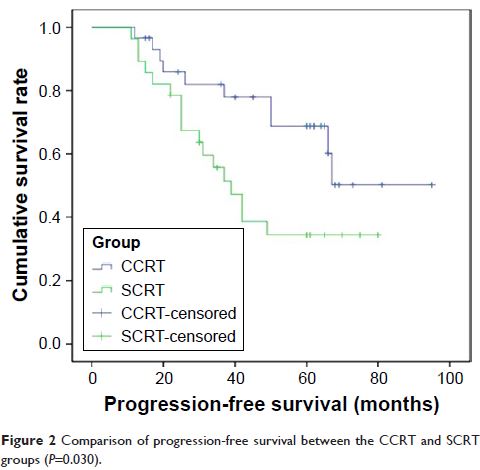
and immediately after treatment. Kaplan–Meier curve analysis demonstrated that
there were significant differences between the CCRT and SCRT groups with regard
to 5-year OS (72.9% vs 47.1%, P =0.029), 5-year
PFS (68.8% vs 34.2%, P =0.030), and LRFS
(78.9% vs 45.7%, P =0.026).
Conclusion: We have demonstrated that in comparison with SCRT, CCRT
significantly improves the survival outcome in patients with localized ENKTL,
with acceptable toxicities. Further clinical trials are needed.
Keywords: nasal extranodal natural killer/T-cell lymphoma, concurrent
chemoradiotherapy, treatment outcome