115195
论文已发表
注册即可获取德孚的最新动态
IF 收录期刊
- 3.6 Breast Cancer (Dove Med Press)
- 4.3 Clin Epidemiol
- 2.6 Cancer Manag Res
- 3.2 Infect Drug Resist
- 4.1 Clin Interv Aging
- 6.1 Drug Des Dev Ther
- 4.1 Int J Chronic Obstr
- 8.7 Int J Nanomed
- 2.5 Int J Women's Health
- 3.2 Neuropsych Dis Treat
- 2.4 OncoTargets Ther
- 2.6 Patient Prefer Adher
- 2.6 Ther Clin Risk Manag
- 3.1 J Pain Res
- 3.5 Diabet Metab Synd Ob
- 4.5 Psychol Res Behav Ma
- 3.4 Nat Sci Sleep
- 2.4 Pharmgenomics Pers Med
- 2.6 Risk Manag Healthc Policy
- 4.6 J Inflamm Res
- 2.3 Int J Gen Med
- 3.9 J Hepatocell Carcinoma
- 3.3 J Asthma Allergy
- 2.5 Clin Cosmet Investig Dermatol
- 3.0 J Multidiscip Healthc

阿帕替尼 (Apatinib) 治疗晚期食管鳞状细胞癌的疗效和安全性
Authors Li J, Wang L
Received 19 January 2017
Accepted for publication 14 June 2017
Published 7 August 2017 Volume 2017:10 Pages 3965—3969
DOI https://doi.org/10.2147/OTT.S132756
Checked for plagiarism Yes
Review by Single-blind
Peer reviewers approved by Dr Akshita Wason
Peer reviewer comments 2
Editor who approved publication: Prof. Dr. Geoffrey Pietersz
Objective: No standard chemotherapy is available for patients with advanced
esophageal squamous cell carcinoma (ESCC) who have failed prior first-line
chemotherapy. The aim of this study was to evaluate the efficacy and safety of
apatinib, an oral VEGFR-2 inhibitor, as salvage treatment for advanced ESCC.
Patients and methods: After apatinib dosing, the efficacy and toxicity were
evaluated in 62 patients with pretreated advanced ESCC from 2014 to 2016
at Zhejiang Cancer Hospital. In addition, survival analysis was performed by
the Kaplan–Meier method.
Results: Among the 62 patients, 15 achieved partial
response while 31 had stable disease with a response rate of 24.2% and a
disease control rate of 74.2%. Median progression-free survival (PFS) and
overall survival were 115 and 209 days, respectively. Grade 3/4 toxicities
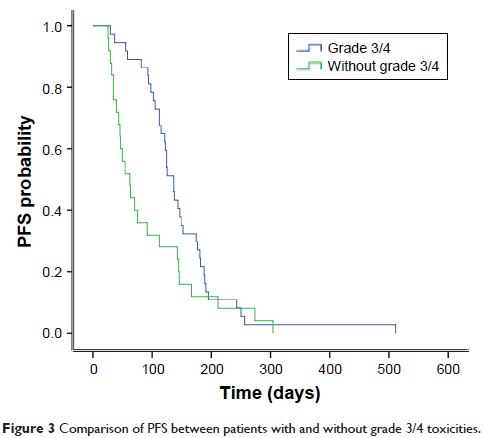
(59.7%) were acceptable. Patients with grade 3/4 toxicities showed a longer PFS
than those without (136 vs 63 days, P =0.044).
Conclusion: Apatinib is efficacious as second- or further-line
treatment for advanced ESCC.
Keywords: esophageal
squamous cell carcinoma, apatinib, vascular endothelial growth factor, toxicity