117333
论文已发表
注册即可获取德孚的最新动态
IF 收录期刊
- 3.6 Breast Cancer (Dove Med Press)
- 4.3 Clin Epidemiol
- 2.6 Cancer Manag Res
- 3.2 Infect Drug Resist
- 4.1 Clin Interv Aging
- 6.1 Drug Des Dev Ther
- 4.1 Int J Chronic Obstr
- 8.7 Int J Nanomed
- 2.5 Int J Women's Health
- 3.2 Neuropsych Dis Treat
- 2.4 OncoTargets Ther
- 2.6 Patient Prefer Adher
- 2.6 Ther Clin Risk Manag
- 3.1 J Pain Res
- 3.5 Diabet Metab Synd Ob
- 4.5 Psychol Res Behav Ma
- 3.4 Nat Sci Sleep
- 2.4 Pharmgenomics Pers Med
- 2.6 Risk Manag Healthc Policy
- 4.6 J Inflamm Res
- 2.3 Int J Gen Med
- 3.9 J Hepatocell Carcinoma
- 3.3 J Asthma Allergy
- 2.5 Clin Cosmet Investig Dermatol
- 3.0 J Multidiscip Healthc

研究异喹啉 (Isoquinoline) 衍生物通过抑制细胞凋亡蛋白抑制剂 (IAP) 治疗卵巢癌
Authors Chen C, Wu J, Zhu P, Xu C, Yao L
Received 21 March 2017
Accepted for publication 30 June 2017
Published 11 September 2017 Volume 2017:11 Pages 2697—2707
DOI https://doi.org/10.2147/DDDT.S137608
Checked for plagiarism Yes
Review by Single-blind
Peer reviewers approved by Dr Rammohan Devulapally
Peer reviewer comments 3
Editor who approved publication: Dr Qiongyu Guo
Objective: To
discover novel isoquinoline derivatives for inhibition of inhibitor of
apoptosis proteins (IAP) for the treatment of ovarian cancer.
Methods: We first synthesized 533 isoquinoline derivatives, and screened
them using CCK-8 to measure their antiproliferative activity. These compounds
were further tested by Hoechst staining and flow cytometric analysis to assess
proapoptotic activity. The in vivo antitumor efficacy and safety of the
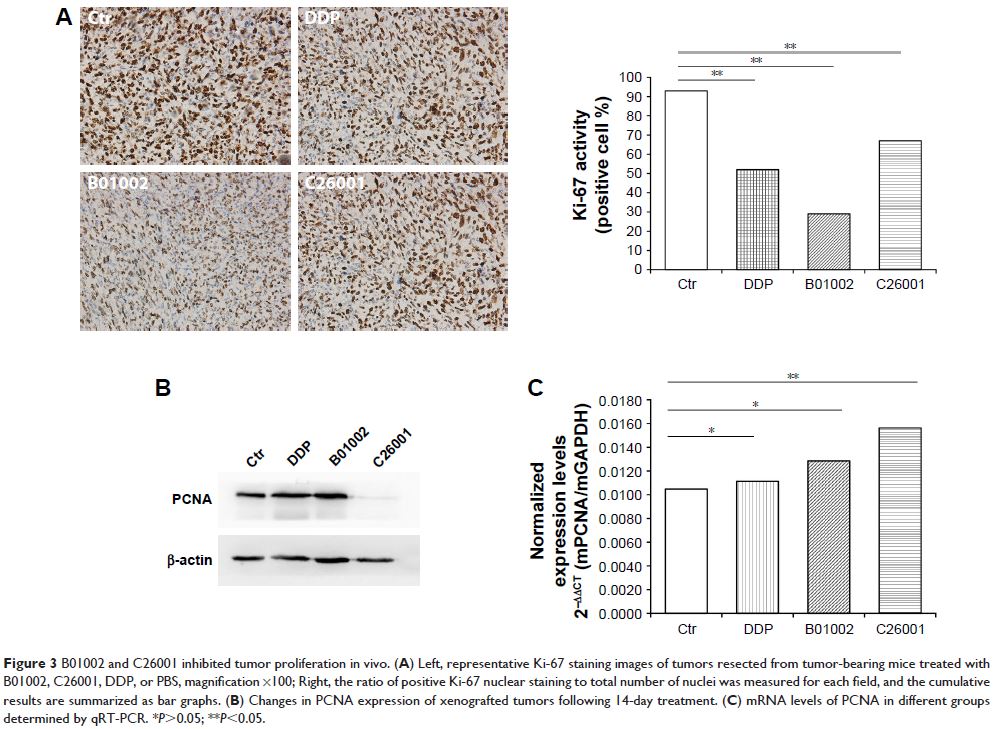
screened compounds were evaluated on the xenograft mouse model. Ki-67 staining
and TUNEL assay were used to evaluate proliferation and apoptosis in the
resected tumors, respectively. Western blot and polymerase chain reaction (PCR)
were conducted to evaluate the levels of proliferating cell nuclear antigen
(PCNA), caspase-3, PARP, and IAP in resected tumors.
Results: Compound B01002 and C26001 displayed antiproliferative and
proapoptotic activity on SKOV3 ovarian cancer with an IC50 of 7.65 and
11.68 µg/mL, respectively. Both compounds inhibited tumor growth in a
xenografted mouse model with good safety profiles, and tumor growth inhibition
(TGI) of B01002 and C26001 was 99.53% and 84.23%, respectively. Resected tumors
showed that both compounds inhibited tumor cell proliferation and induced apoptosis
in vivo. Caspase-3 and PARP were activated, whereas IAP proteins were
downregulated at the protein level.
Conclusion: Compound B01002 and C26001 could inhibit ovarian tumor growth and
promote tumor apoptosis, partly by downregulating the IAPs, and, thus, might be
promising candidates for treatment of ovarian cancer.
Keywords: isoquinoline derivatives, target-oriented syntheses, IAP
inhibitor, chemotherapy, ovarian cancer