117207
论文已发表
注册即可获取德孚的最新动态
IF 收录期刊
- 3.6 Breast Cancer (Dove Med Press)
- 4.3 Clin Epidemiol
- 2.6 Cancer Manag Res
- 3.2 Infect Drug Resist
- 4.1 Clin Interv Aging
- 6.1 Drug Des Dev Ther
- 4.1 Int J Chronic Obstr
- 8.7 Int J Nanomed
- 2.5 Int J Women's Health
- 3.2 Neuropsych Dis Treat
- 2.4 OncoTargets Ther
- 2.6 Patient Prefer Adher
- 2.6 Ther Clin Risk Manag
- 3.1 J Pain Res
- 3.5 Diabet Metab Synd Ob
- 4.5 Psychol Res Behav Ma
- 3.4 Nat Sci Sleep
- 2.4 Pharmgenomics Pers Med
- 2.6 Risk Manag Healthc Policy
- 4.6 J Inflamm Res
- 2.3 Int J Gen Med
- 3.9 J Hepatocell Carcinoma
- 3.3 J Asthma Allergy
- 2.5 Clin Cosmet Investig Dermatol
- 3.0 J Multidiscip Healthc

已发表论文
凋亡相关基因的功能性变异在晚期非小细胞肺癌患者一线含铂化疗方案治疗预后的作用
Authors Tao KY, Li XX, Xu WZ, Wang Y, Zhu SM, Xie HX, Luo WH, Xu YJ, Xu XL
Published Date January 2015 Volume 2015:8 Pages 147—155
DOI http://dx.doi.org/10.2147/OTT.S74855
Received 24 September 2014, Accepted 19 December 2014, Published 14 January 2015
Background: Single-nucleotide polymorphisms in apoptosis-related genes have been
shown to play a role in the efficacy of platinum-based chemotherapy and may
influence clinical outcomes. Our study aimed to evaluate the correlations of
four functional single-nucleotide polymorphisms – FAS −670 A>G, FAS ligand
−844 T>C, survivin −31 G>C, and survivin 9386 C>T – with drug response
and clinical outcomes in advanced non-small-cell lung cancer patients who
received platinum-based chemotherapy.
Materials and methods: Polymorphisms were evaluated using the polymerase chain reaction-based restriction fragment-length polymorphism technique.
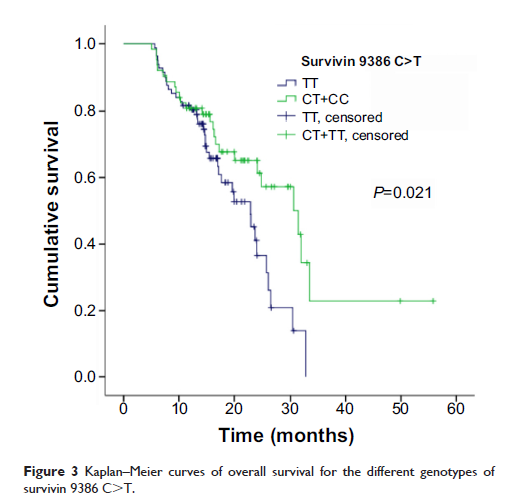
Results: Patients with the CC genotype of FAS −670 A>G had worse overall survival (OS) than those with the CT or TT genotype (P =0.044), with median OS values of 20.1 months, 22.8 months, and 26.0 months, respectively. Furthermore, progression-free survival was associated with the FAS −670 A>G polymorphism (P =0.032). In addition, patients with the TC and CC genotypes of survivin 9386 C>T experienced improved survival compared with patients with the TT genotype (median OS 31.4 months and 22.8 months, respectively).
Conclusion: The functional FAS −670 A>G and survivin 9386 C>T polymorphisms are potential independent prognostic factors in advanced non-small-cell lung cancer patients treated with platinum-based chemotherapy.
Keywords: lung cancer, FAS −670 A>G, survivin 9386 C>T, polymorphism, chemotherapy response
Materials and methods: Polymorphisms were evaluated using the polymerase chain reaction-based restriction fragment-length polymorphism technique.
Results: Patients with the CC genotype of FAS −670 A>G had worse overall survival (OS) than those with the CT or TT genotype (P =0.044), with median OS values of 20.1 months, 22.8 months, and 26.0 months, respectively. Furthermore, progression-free survival was associated with the FAS −670 A>G polymorphism (P =0.032). In addition, patients with the TC and CC genotypes of survivin 9386 C>T experienced improved survival compared with patients with the TT genotype (median OS 31.4 months and 22.8 months, respectively).
Conclusion: The functional FAS −670 A>G and survivin 9386 C>T polymorphisms are potential independent prognostic factors in advanced non-small-cell lung cancer patients treated with platinum-based chemotherapy.
Keywords: lung cancer, FAS −670 A>G, survivin 9386 C>T, polymorphism, chemotherapy response