115195
论文已发表
注册即可获取德孚的最新动态
IF 收录期刊
- 3.6 Breast Cancer (Dove Med Press)
- 4.3 Clin Epidemiol
- 2.6 Cancer Manag Res
- 3.2 Infect Drug Resist
- 4.1 Clin Interv Aging
- 6.1 Drug Des Dev Ther
- 4.1 Int J Chronic Obstr
- 8.7 Int J Nanomed
- 2.5 Int J Women's Health
- 3.2 Neuropsych Dis Treat
- 2.4 OncoTargets Ther
- 2.6 Patient Prefer Adher
- 2.6 Ther Clin Risk Manag
- 3.1 J Pain Res
- 3.5 Diabet Metab Synd Ob
- 4.5 Psychol Res Behav Ma
- 3.4 Nat Sci Sleep
- 2.4 Pharmgenomics Pers Med
- 2.6 Risk Manag Healthc Policy
- 4.6 J Inflamm Res
- 2.3 Int J Gen Med
- 3.9 J Hepatocell Carcinoma
- 3.3 J Asthma Allergy
- 2.5 Clin Cosmet Investig Dermatol
- 3.0 J Multidiscip Healthc

根治性 D2 胃癌切除术后黏液成分在胃腺癌的预后意义
Authors Cai L, Li Y, Yang X, Lian X, Guo M, Xiao S, Wang W, Zhang H
Received 26 September 2017
Accepted for publication 16 January 2018
Published 23 February 2018 Volume 2018:11 Pages 967—973
DOI https://doi.org/10.2147/OTT.S152614
Checked for plagiarism Yes
Review by Single-blind
Peer reviewers approved by Dr Lucy Goodman
Peer reviewer comments 3
Editor who approved publication: Dr Ingrid Espinoza
Background: The mucinous component is a special histologic factor in gastric
adenocarcinoma. The aim of this study was to assess the prognostic significance
of mucinous component in gastric adenocarcinoma according to proportion.
Patients and
methods: Candidate patients with gastric
adenocarcinoma were given radical D2 gastrectomies from September 2008 to May
2015 in our division. Clinicopathologic data and prognosis were monitored and
analyzed among gastric adenocarcinoma patients with various proportions of
mucinous component.
Results: A total of 690 gastric adenocarcinomas with various proportions of
mucinous component from 6,025 gastric adenocarcinoma patients were included.
Higher numbers of patients with mucinous component came from: young patients,
females, those with drinking history, at lower locations, Borrmann type III and
IV, T4 stage, and positive for dissected lymph nodes. Tumors and pathological
molecular markers showed more positivity in CEA, CA19-9, S100, and CD34. As the
various proportions increased, more mucinous component seemed to be accompanied
by more Borrmann type III and IV, T4 stage, and more positive expression of CEA
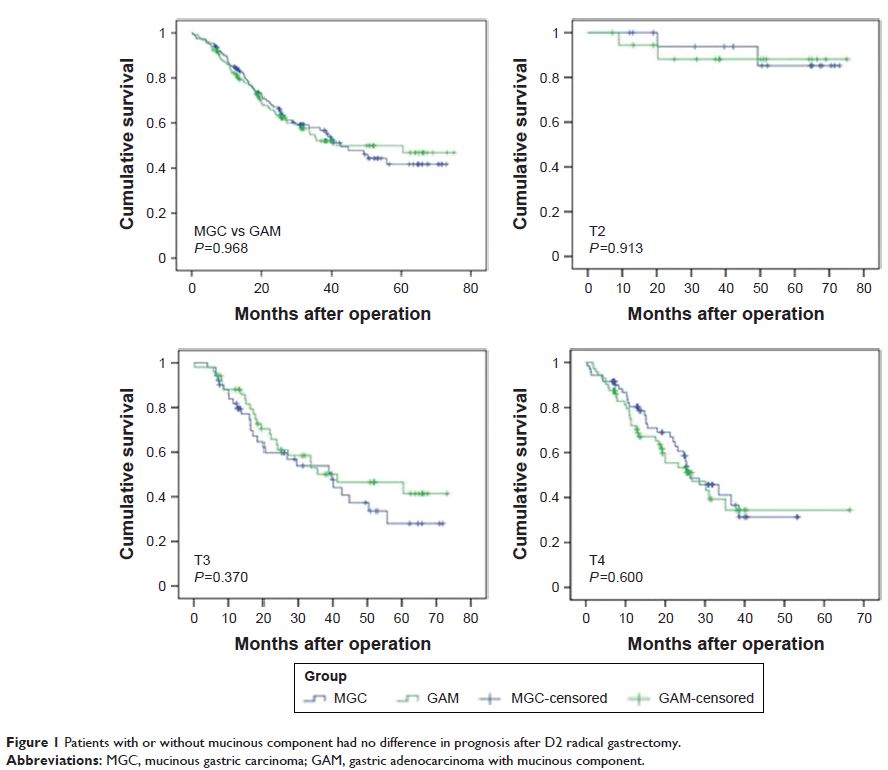
and CA19-9. However, no significant difference in 5-year overall survival rate
was observed among various proportions or existence of mucinous component.
Also, proportion or existence of mucinous component was not an independent
prognostic factor in multivariate analysis.
Conclusion: Mucinous component was not a prognostic factor for gastric
adenocarcinoma after radical D2 gastrectomy, no matter what proportion the
component comprised. However, gastric adenocarcinoma with mucinous component
showed specific clinicopathological characteristics, such as more advanced
tumor stage, different age and sex, and more positive rate of molecular
markers, which might provide a new strategy for optimal individual diagnosis
and therapies.
Keywords: mucinous component, mucinous gastric carcinoma, gastric
adenocarcinoma with mucinous component, pure gastric adenocarcinoma, radical D2
gastrectomy, prognosis