117518
论文已发表
注册即可获取德孚的最新动态
IF 收录期刊
- 3.6 Breast Cancer (Dove Med Press)
- 4.3 Clin Epidemiol
- 2.6 Cancer Manag Res
- 3.2 Infect Drug Resist
- 4.1 Clin Interv Aging
- 6.1 Drug Des Dev Ther
- 4.1 Int J Chronic Obstr
- 8.7 Int J Nanomed
- 2.5 Int J Women's Health
- 3.2 Neuropsych Dis Treat
- 2.4 OncoTargets Ther
- 2.6 Patient Prefer Adher
- 2.6 Ther Clin Risk Manag
- 3.1 J Pain Res
- 3.5 Diabet Metab Synd Ob
- 4.5 Psychol Res Behav Ma
- 3.4 Nat Sci Sleep
- 2.4 Pharmgenomics Pers Med
- 2.6 Risk Manag Healthc Policy
- 4.6 J Inflamm Res
- 2.3 Int J Gen Med
- 3.9 J Hepatocell Carcinoma
- 3.3 J Asthma Allergy
- 2.5 Clin Cosmet Investig Dermatol
- 3.0 J Multidiscip Healthc

对比机器人与腹腔镜胃大部切除术(分别联合 D2 淋巴结清扫)治疗晚期胃癌的疗效:倾向评分匹配分析
Authors Li Z, Li J, Li B, Bai B, Liu Y, Lian B, Zhao Q
Received 28 December 2017
Accepted for publication 2 February 2018
Published 10 April 2018 Volume 2018:10 Pages 705—714
DOI https://doi.org/10.2147/CMAR.S161007
Checked for plagiarism Yes
Review by Single-blind
Peer reviewers approved by Dr Lucy Goodman
Peer reviewer comments 2
Editor who approved publication: Professor Nakshatri
Background: Robotic
gastrectomy (RG) is a new surgical method alternative for gastric cancer.
However, few studies have evaluated the outcomes of RG for advanced gastric
cancer (AGC). Thus, the aim of this study was to compare the short-and
long-term outcomes of RG and laparoscopic gastrectomy (LG) with D2 lymph node
dissection for AGC.
Patients and
methods: We retrospectively evaluated 454
patients with AGC who underwent RG or LG with D2 lymph node dissection for AGC
between August 2013 and March 2017. The short-and long-term outcomes were
compared between the propensity score-matched groups.
Results: The RG group was associated with longer operation time, less
intraoperative blood loss, and higher hospital cost. Additionally, there was a
tendency favoring RG in terms of number of harvested lymph nodes, time to first
flatus, time to first start diet, and postoperative hospital stay, although the
differences were not statistically significant. The overall postoperative complication
rate was 13.4% and 11.6% in the RG and LG groups, respectively, with no
significant difference (P =0.686). The
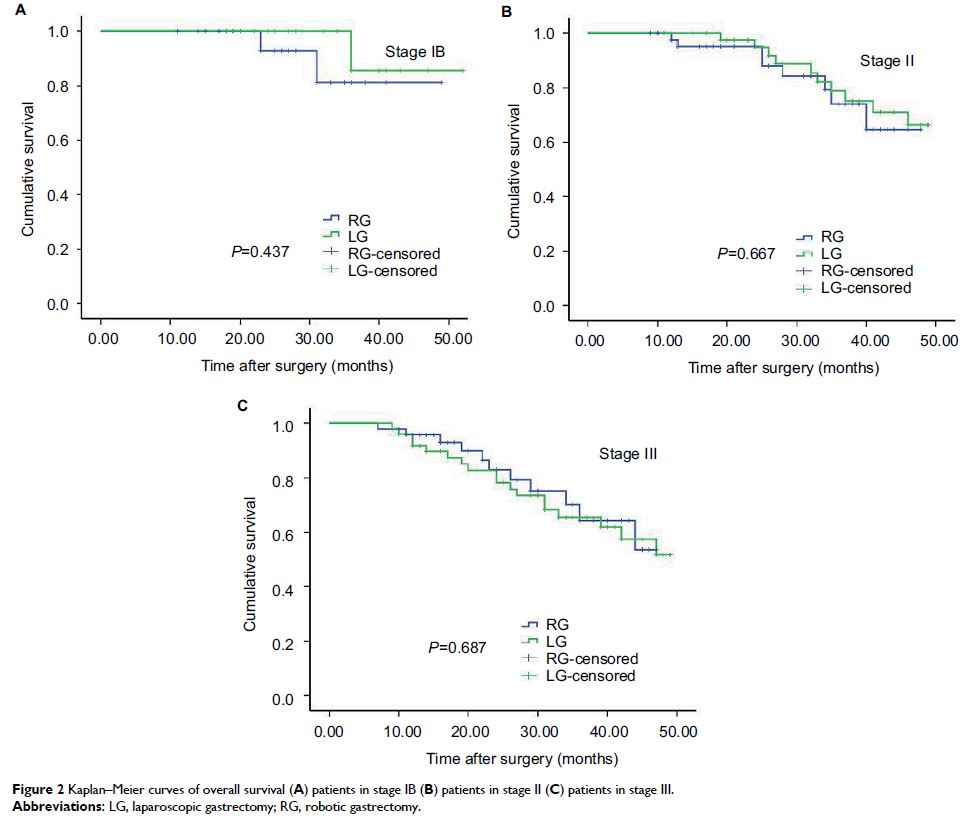
3-year overall survival and recurrence rates of the RG and LG groups were also
comparable (78.6% vs 74.1%, P =0.483; 18.8% vs
21.4%, P =0.617; respectively).
Conclusion: RG with D2 lymph node dissection is safe and feasible for AGC in
terms of both short- and long-term outcomes. High-volume randomized controlled
trials with sufficient follow-up are needed to confirm this rationale.
Keywords: robotic gastrectomy, laparoscopic gastrectomy, advanced gastric
cancer