117518
论文已发表
注册即可获取德孚的最新动态
IF 收录期刊
- 3.6 Breast Cancer (Dove Med Press)
- 4.3 Clin Epidemiol
- 2.6 Cancer Manag Res
- 3.2 Infect Drug Resist
- 4.1 Clin Interv Aging
- 6.1 Drug Des Dev Ther
- 4.1 Int J Chronic Obstr
- 8.7 Int J Nanomed
- 2.5 Int J Women's Health
- 3.2 Neuropsych Dis Treat
- 2.4 OncoTargets Ther
- 2.6 Patient Prefer Adher
- 2.6 Ther Clin Risk Manag
- 3.1 J Pain Res
- 3.5 Diabet Metab Synd Ob
- 4.5 Psychol Res Behav Ma
- 3.4 Nat Sci Sleep
- 2.4 Pharmgenomics Pers Med
- 2.6 Risk Manag Healthc Policy
- 4.6 J Inflamm Res
- 2.3 Int J Gen Med
- 3.9 J Hepatocell Carcinoma
- 3.3 J Asthma Allergy
- 2.5 Clin Cosmet Investig Dermatol
- 3.0 J Multidiscip Healthc

汉族人群中 miRNA 多态性与非小细胞肺癌的关系
Authors Li C, Zhang Y, Li Y, Ma Q, Liu S, Yao Y, Tan F, Shi L, Yao Y
Received 13 October 2017
Accepted for publication 12 February 2018
Published 10 April 2018 Volume 2018:10 Pages 697—704
DOI https://doi.org/10.2147/CMAR.S154040
Checked for plagiarism Yes
Review by Single-blind
Peer reviewers approved by Dr Colin Mak
Peer reviewer comments 2
Editor who approved publication: Dr Antonella D'Anneo
Background: MicroRNAs (miRNAs) have been demonstrated to play important roles in
cancer progression. Recently, studies have revealed that polymorphisms in
miRNAs might be associated with cancer susceptibility.
Materials and
methods: In the current study, we
investigated the associations of single nucleotide polymorphisms (SNPs) in
miRNAs (rs11134527 in pri-miR-218-2 ,
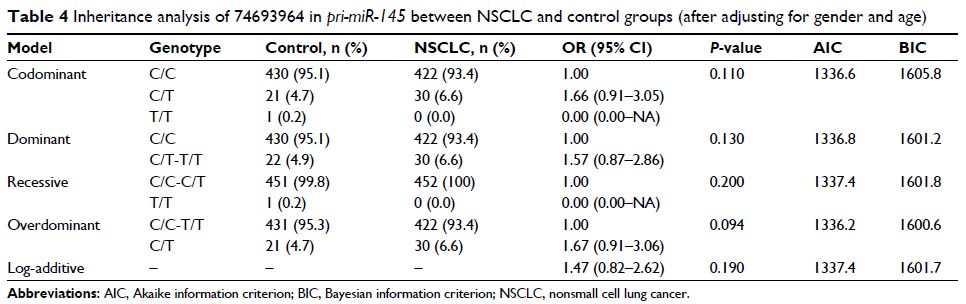
rs74693964 in pri-miR-145 ,
rs6062251 in pri-miR-133a-2 , and rs4705343
in pri-miR-143 ) with nonsmall cell
lung cancer (NSCLC) in a Han population from Yunnan Province, Southwest China
using a binary logistic regression analysis. A total of 452 patients with NSCLC
and 452 healthy individuals were recruited for polymorphism genotyping using
the TaqMan assay.
Results: Our results showed that the allelic frequencies of rs11134527 and
rs4705343 were significantly different between the NSCLC and control groups (P =0.025 and 0.029). Additionally,
the genotypic frequencies of rs11134527 were significantly different between
the NSCLC and control groups (P =0.045). The mode
of inheritance analysis showed that genotypes A/G+G/G of rs11134527 were
associated with a lower risk of NSCLC under the dominant model (OR=0.69; 95%
CI: 0.51–0.94). In addition, genotypes 2C/C+C/T of rs4705343 were associated
with an increased risk of NSCLC under the log-additive model (OR=1.25; 95% CI:
1.01–1.53). However, there was no significant difference in the other SNPs
between the NSCLC and control groups (P >0.05).
Moreover, the association analysis of these SNPs between adenocarcinoma and
squamous cell carcinoma (SCC) showed that allele A of rs11134527 was associated
with SCC (OR=0.65; 95% CI: 0.48–0.88).
Conclusion: Our results indicated that the A allele of rs11134527 might be a
risk factor (OR=1.24; 95% CI: 1.03–1.50) and that the T allele of rs4705343
might be a protective factor (OR=0.80; 95% CI: 0.66–0.98) for NSCLC in a Han
Chinese population.
Keywords: microRNA, single nucleotide polymorphism, lung cancer, Chinese
population, genetic variation