115195
论文已发表
注册即可获取德孚的最新动态
IF 收录期刊
- 3.6 Breast Cancer (Dove Med Press)
- 4.3 Clin Epidemiol
- 2.6 Cancer Manag Res
- 3.2 Infect Drug Resist
- 4.1 Clin Interv Aging
- 6.1 Drug Des Dev Ther
- 4.1 Int J Chronic Obstr
- 8.7 Int J Nanomed
- 2.5 Int J Women's Health
- 3.2 Neuropsych Dis Treat
- 2.4 OncoTargets Ther
- 2.6 Patient Prefer Adher
- 2.6 Ther Clin Risk Manag
- 3.1 J Pain Res
- 3.5 Diabet Metab Synd Ob
- 4.5 Psychol Res Behav Ma
- 3.4 Nat Sci Sleep
- 2.4 Pharmgenomics Pers Med
- 2.6 Risk Manag Healthc Policy
- 4.6 J Inflamm Res
- 2.3 Int J Gen Med
- 3.9 J Hepatocell Carcinoma
- 3.3 J Asthma Allergy
- 2.5 Clin Cosmet Investig Dermatol
- 3.0 J Multidiscip Healthc

已发表论文
利用网络药理学方法确定草药治疗风湿性关节炎的协同机制
Authors Xu XX, Bi JP, Ping L, Li P, Li F
Received 8 January 2018
Accepted for publication 12 March 2018
Published 24 April 2018 Volume 2018:12 Pages 967—979
DOI https://doi.org/10.2147/DDDT.S161904
Checked for plagiarism Yes
Review by Single-blind
Peer reviewers approved by Dr Palas Chanda
Peer reviewer comments 2
Editor who approved publication: Dr Qiongyu Guo
Purpose: The purpose of
this study was to investigate the therapeutic mechanism(s) of Clematis chinensis Osbeck/Notopterygium incisum K.C.
Ting ex H.T (CN).
Methods: A network pharmacology approach integrating prediction of ingredients, target exploration, network construction, module partition and pathway analysis was used.
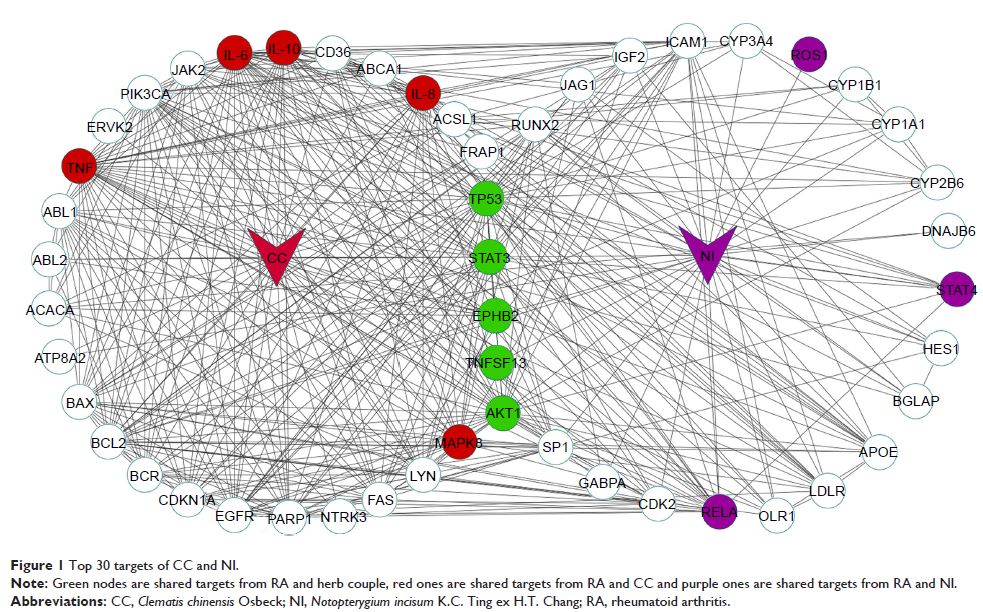
Results: This approach successfully helped to identify 12 active ingredients of CN, interacting with 13 key targets (Akt1, STAT3, TNFsf13, TP53, EPHB2, IL-10, IL-6, TNF, MAPK8, IL-8, RELA, ROS1 and STAT4). Kyoto Encyclopedia of Genes and Genomes pathway enrichment analysis indicated that CN-regulated pathways were mainly classified into signal transduction and immune system.
Conclusion: The present work may help to illustrate the mechanism(s) of action of CN, and it may provide a better understanding of antirheumatic effects.
Keywords: targets prediction, pathways analysis, action mechanism, Clematis chinensis Osbeck, Notopterygium incisum K.C. Ting ex H.T. Chang
Methods: A network pharmacology approach integrating prediction of ingredients, target exploration, network construction, module partition and pathway analysis was used.
Results: This approach successfully helped to identify 12 active ingredients of CN, interacting with 13 key targets (Akt1, STAT3, TNFsf13, TP53, EPHB2, IL-10, IL-6, TNF, MAPK8, IL-8, RELA, ROS1 and STAT4). Kyoto Encyclopedia of Genes and Genomes pathway enrichment analysis indicated that CN-regulated pathways were mainly classified into signal transduction and immune system.
Conclusion: The present work may help to illustrate the mechanism(s) of action of CN, and it may provide a better understanding of antirheumatic effects.
Keywords: targets prediction, pathways analysis, action mechanism, Clematis chinensis Osbeck, Notopterygium incisum K.C. Ting ex H.T. Chang