115195
论文已发表
注册即可获取德孚的最新动态
IF 收录期刊
- 3.6 Breast Cancer (Dove Med Press)
- 4.3 Clin Epidemiol
- 2.6 Cancer Manag Res
- 3.2 Infect Drug Resist
- 4.1 Clin Interv Aging
- 6.1 Drug Des Dev Ther
- 4.1 Int J Chronic Obstr
- 8.7 Int J Nanomed
- 2.5 Int J Women's Health
- 3.2 Neuropsych Dis Treat
- 2.4 OncoTargets Ther
- 2.6 Patient Prefer Adher
- 2.6 Ther Clin Risk Manag
- 3.1 J Pain Res
- 3.5 Diabet Metab Synd Ob
- 4.5 Psychol Res Behav Ma
- 3.4 Nat Sci Sleep
- 2.4 Pharmgenomics Pers Med
- 2.6 Risk Manag Healthc Policy
- 4.6 J Inflamm Res
- 2.3 Int J Gen Med
- 3.9 J Hepatocell Carcinoma
- 3.3 J Asthma Allergy
- 2.5 Clin Cosmet Investig Dermatol
- 3.0 J Multidiscip Healthc

已发表论文
p53 基因的积累是已绝经且患有 ER 阳性乳腺癌早期的患者的芳香化酶抑制剂耐药的预后症状
Authors Jia XQ, Hong Q, Cheng JY, Li JW, Wang YJ, Mo M, Shao ZM, Shen ZZ, Liu GY
Published Date March 2015 Volume 2015:8 Pages 549—555
DOI http://dx.doi.org/10.2147/OTT.S76879
Received 2 November 2014, Accepted 28 January 2015, Published 3 March 2015
Objective: Studies have indicated that p53 protein accumulation exerts an adverse
effect on the survival of breast cancer patients; however, the prognostic value
of p53 protein accumulation for aromatase inhibitor (AI) resistance in
ER-positive breast cancer is uncertain.
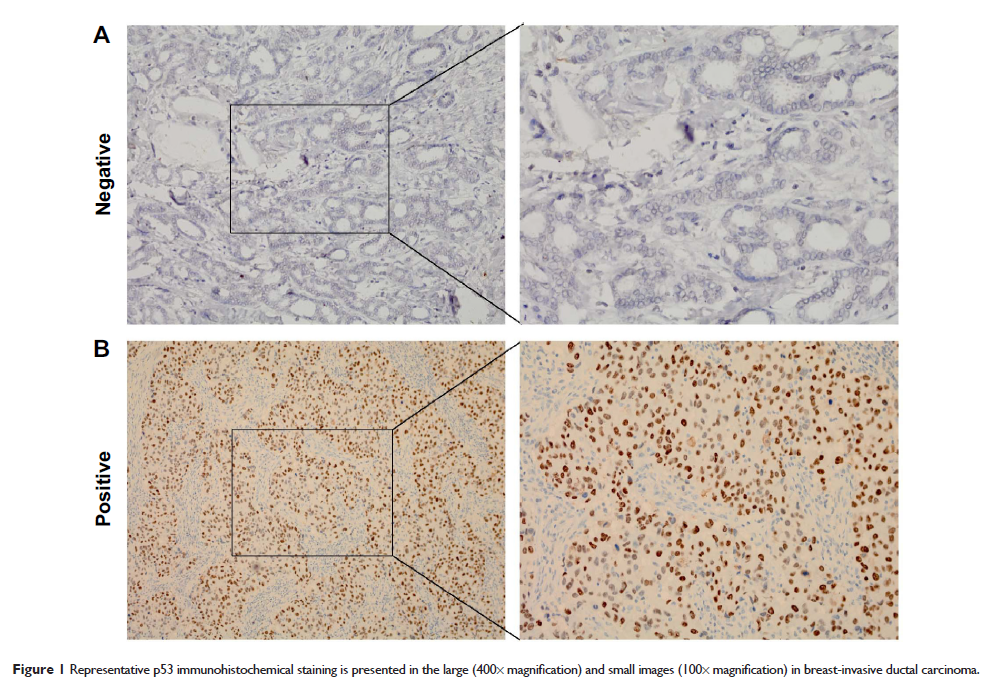
Methods: The expression level of p53 protein was detected by immunohistochemistry in primary early-stage ER-positive breast tumor specimens from 293 postmenopausal breast cancer patients who received first-line AI treatment (letrozole, anastrozole, or exemestane) until relapse, and analysis was performed to determine whether expression of p53 protein affected the response to endocrine therapy.
Results: Of the 293 invasive ductal carcinomas, 65.4% were positive for p53 protein expression. All patients received AI therapy as first-line treatment until relapse. The 5-year disease-free survival rates in p53-positive and p53-negative patients were 78% and 89%, respectively. Patients with primary breast tumors that had p53 protein accumulation showed significantly more resistance to AI treatment (hazard ratio=1.729, 95% confidence interval=1.038–2.880, P =0.035).
Conclusion: This study demonstrated that p53 protein accumulation was helpful in choosing patients who may benefit from AI treatment and is a prognostic marker in ER-positive early-stage breast cancer.
Keywords: p53, breast cancer, prognosis, endocrine resistance
Methods: The expression level of p53 protein was detected by immunohistochemistry in primary early-stage ER-positive breast tumor specimens from 293 postmenopausal breast cancer patients who received first-line AI treatment (letrozole, anastrozole, or exemestane) until relapse, and analysis was performed to determine whether expression of p53 protein affected the response to endocrine therapy.
Results: Of the 293 invasive ductal carcinomas, 65.4% were positive for p53 protein expression. All patients received AI therapy as first-line treatment until relapse. The 5-year disease-free survival rates in p53-positive and p53-negative patients were 78% and 89%, respectively. Patients with primary breast tumors that had p53 protein accumulation showed significantly more resistance to AI treatment (hazard ratio=1.729, 95% confidence interval=1.038–2.880, P =0.035).
Conclusion: This study demonstrated that p53 protein accumulation was helpful in choosing patients who may benefit from AI treatment and is a prognostic marker in ER-positive early-stage breast cancer.
Keywords: p53, breast cancer, prognosis, endocrine resistance