115195
论文已发表
注册即可获取德孚的最新动态
IF 收录期刊
- 3.6 Breast Cancer (Dove Med Press)
- 4.3 Clin Epidemiol
- 2.6 Cancer Manag Res
- 3.2 Infect Drug Resist
- 4.1 Clin Interv Aging
- 6.1 Drug Des Dev Ther
- 4.1 Int J Chronic Obstr
- 8.7 Int J Nanomed
- 2.5 Int J Women's Health
- 3.2 Neuropsych Dis Treat
- 2.4 OncoTargets Ther
- 2.6 Patient Prefer Adher
- 2.6 Ther Clin Risk Manag
- 3.1 J Pain Res
- 3.5 Diabet Metab Synd Ob
- 4.5 Psychol Res Behav Ma
- 3.4 Nat Sci Sleep
- 2.4 Pharmgenomics Pers Med
- 2.6 Risk Manag Healthc Policy
- 4.6 J Inflamm Res
- 2.3 Int J Gen Med
- 3.9 J Hepatocell Carcinoma
- 3.3 J Asthma Allergy
- 2.5 Clin Cosmet Investig Dermatol
- 3.0 J Multidiscip Healthc

使用 pH 敏感的聚合物纳米粒子提高 EGCG 的口服生物利用度:肾病综合征大鼠的表征和体内研究
Authors Zhang G, Zhang J
Received 3 May 2018
Accepted for publication 8 June 2018
Published 14 August 2018 Volume 2018:12 Pages 2509—2518
DOI https://doi.org/10.2147/DDDT.S172919
Checked for plagiarism Yes
Review by Single-blind
Peer reviewers approved by Dr Cristina Weinberg
Peer reviewer comments 2
Editor who approved publication: Dr Qiongyu Guo
Objective: Chronic kidney disease (CKD) is characterized by progressive loss of renal functions. At present, there are only limited therapeutic strategies to slow down the progress of CKD and there is an urgent need to develop new therapeutic strategies to treat CKD patients. Numerous research evidence supports the potential role of EGCG in the renal protection of CKD. However, the clinical use is still limited due to the poor oral bioavailability. The aim of this study was to develop pH-sensitive polymeric nanoparticles of EGCG to improve this deficiency.
Materials and methods: EGCG-loaded nanoparticles (EGCG NPs) were prepared by an improved emulsion evaporation method. The formulation prepared was in spherical with uniform sizes, high encapsulation efficiencies and drug loading. The therapeutic efficacy of EGCG NPs on chronic kidney disease was investigated on model of rat Nephrotic syndrome by measuring urinary protein excretion and kidney pathology score.
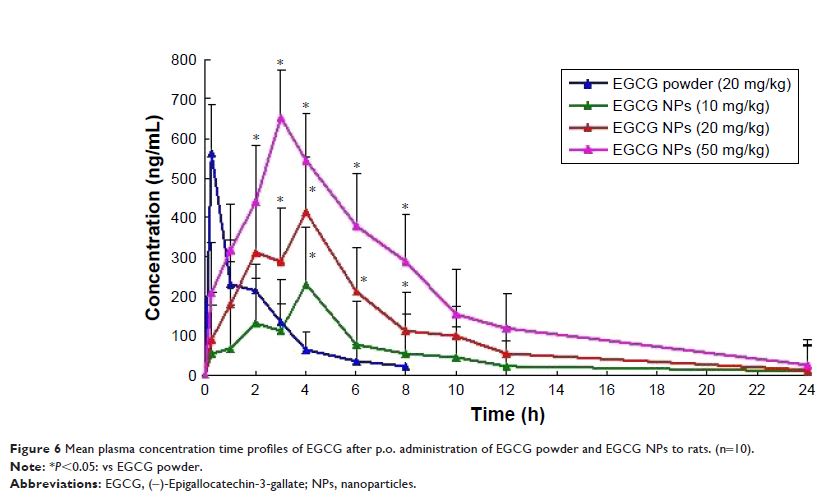
Results: The mean particle size was found to be 91.3±0.8 nm and the encapsulation efficiency% and drug loading% of the formulation were 80.8%±1.6% and 6.3%±1.4%, respectively. The powder X-ray diffraction and differential scanning calorimetry of EGCG NPs showed that EGCG existed in amorphous form in NPs. The release of EGCG from NPs exhibited the lower burst release at pH 1.2 (<10%) and with the increase of pH value, the release of EGCG also gradually increased. During the observation period (24 hours), the total release amount was almost 68%. EGCG NPs could significantly modify the pharmacokinetic profile and increase the bioavailability of EGCG by more than 2.4-fold in comparison with the EGCG powder group. At the end of the fourth and sixth week, proteinuria excretion of nephrotic syndrome rats treated with EGCG NPs was significantly lower than those treated with EGCG powder, and kidney pathology scores in EGCG NPs treated rats were also significantly lower than EGCG powder treated rats.
Conclusion: The results of pharmacodynamics showed that compared with EGCG powder treatment group, EGCG NPs treatment group had better efficacy and reduce kidney damage.
Keywords: oral bioavailability, EGCG, Eudragit S100, PLGA, nephrotic syndrome