115195
论文已发表
注册即可获取德孚的最新动态
IF 收录期刊
- 3.6 Breast Cancer (Dove Med Press)
- 4.3 Clin Epidemiol
- 2.6 Cancer Manag Res
- 3.2 Infect Drug Resist
- 4.1 Clin Interv Aging
- 6.1 Drug Des Dev Ther
- 4.1 Int J Chronic Obstr
- 8.7 Int J Nanomed
- 2.5 Int J Women's Health
- 3.2 Neuropsych Dis Treat
- 2.4 OncoTargets Ther
- 2.6 Patient Prefer Adher
- 2.6 Ther Clin Risk Manag
- 3.1 J Pain Res
- 3.5 Diabet Metab Synd Ob
- 4.5 Psychol Res Behav Ma
- 3.4 Nat Sci Sleep
- 2.4 Pharmgenomics Pers Med
- 2.6 Risk Manag Healthc Policy
- 4.6 J Inflamm Res
- 2.3 Int J Gen Med
- 3.9 J Hepatocell Carcinoma
- 3.3 J Asthma Allergy
- 2.5 Clin Cosmet Investig Dermatol
- 3.0 J Multidiscip Healthc

肺腺癌中长非编码 RNA 的表达谱
Authors Zhao B, Xu H, Ai X, Adalat Y, Tong Y, Zhang J, Yang S
Received 8 March 2018
Accepted for publication 13 May 2018
Published 6 September 2018 Volume 2018:11 Pages 5383—5390
DOI https://doi.org/10.2147/OTT.S167633
Checked for plagiarism Yes
Review by Single-blind
Peer reviewers approved by Dr Justinn Cochran
Peer reviewer comments 2
Editor who approved publication: Dr Leo Jen-Liang Su
Purpose: This study aimed to analyze expression profiles of long noncoding RNAs (lncRNAs) in lung adenocarcinoma.
Methods: lncRNA microarray technology was employed to detect lncRNA profiles of 3 pairs of lung adenocarcinoma tissues and adjacent tissues.
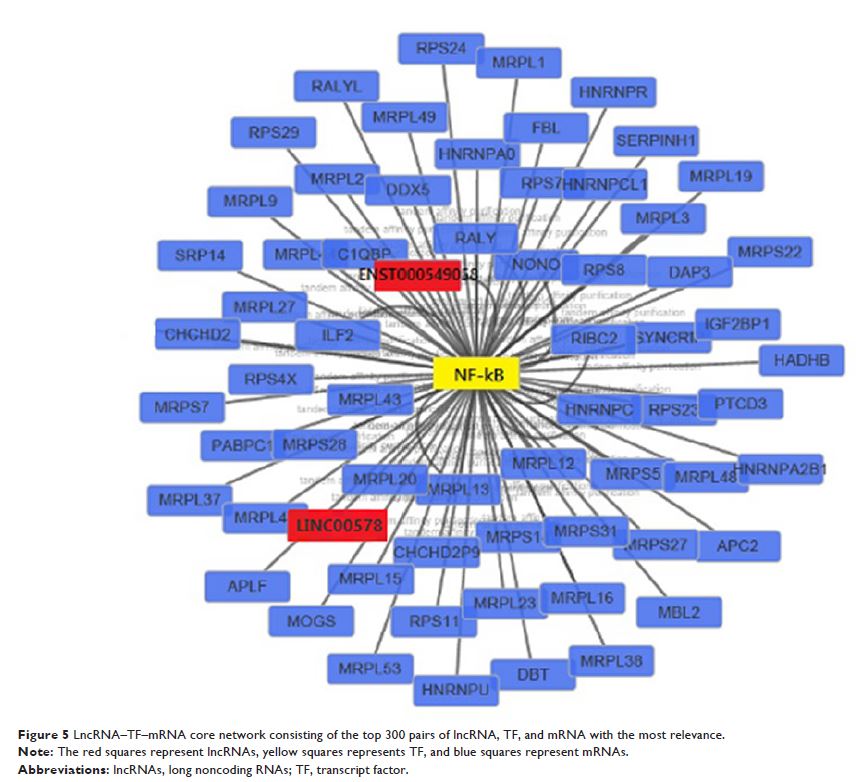
Results: We found 134 upregulated lncRNAs and 460 downregulated lncRNAs in lung adenocarcinoma tissues compared to adjacent tissues. Among them, LINC00152, LINC00691, and LINC00578 showed the most significant changes of upregulation, while LINC00668, LINC00710, and LINC00607 showed the most significant changes of downregulation. Fluorescent quantitative polymerase chain reaction (PCR) analysis of tissue samples from an additional 90 patients with lung adenocarcinoma showed significantly increased levels of LINC00152, LINC00691, and LINC00578 and decreased levels of LINC00668, LINC00710, and LINC00607 in lung adenocarcinoma tissues. In addition, LINC00578 was closely associated with the existence of metastasis of lung adenocarcinoma, but the other 5 lncRNAs showed no significant correlation with clinicopathologic characteristics such as age, gender, tumor stage, and the existence of metastasis. Further follow-up study showed that LINC00578 expression was closely associated with the survival of patients with lung adenocarcinoma.
Conclusion: We revealed the expression profiles of lncRNAs in lung adenocarcinoma and identified LINC00578 as a promising biomarker and therapeutic target for lung adenocarcinoma.
Keywords: long noncoding RNA, microarray, lung adenocarcinoma, survival