115195
论文已发表
注册即可获取德孚的最新动态
IF 收录期刊
- 3.6 Breast Cancer (Dove Med Press)
- 4.3 Clin Epidemiol
- 2.6 Cancer Manag Res
- 3.2 Infect Drug Resist
- 4.1 Clin Interv Aging
- 6.1 Drug Des Dev Ther
- 4.1 Int J Chronic Obstr
- 8.7 Int J Nanomed
- 2.5 Int J Women's Health
- 3.2 Neuropsych Dis Treat
- 2.4 OncoTargets Ther
- 2.6 Patient Prefer Adher
- 2.6 Ther Clin Risk Manag
- 3.1 J Pain Res
- 3.5 Diabet Metab Synd Ob
- 4.5 Psychol Res Behav Ma
- 3.4 Nat Sci Sleep
- 2.4 Pharmgenomics Pers Med
- 2.6 Risk Manag Healthc Policy
- 4.6 J Inflamm Res
- 2.3 Int J Gen Med
- 3.9 J Hepatocell Carcinoma
- 3.3 J Asthma Allergy
- 2.5 Clin Cosmet Investig Dermatol
- 3.0 J Multidiscip Healthc

预测中国炎症性风湿病人群的药物不依从性风险:开发和评估新的预测诺模图
Authors Wang H, Zhang L, Liu Z, Wang X, Geng S, Li J, Li T, Ye S
Received 8 December 2017
Accepted for publication 8 May 2018
Published 10 September 2018 Volume 2018:12 Pages 1757—1765
DOI https://doi.org/10.2147/PPA.S159293
Checked for plagiarism Yes
Review by Single-blind
Peer reviewers approved by Dr Justinn Cochran
Peer reviewer comments 3
Editor who approved publication: Dr Naifeng Liu
Purpose: The aim of this study was to develop and internally validate a medication nonadherence risk nomogram in a Chinese population of patients with inflammatory rheumatic diseases.
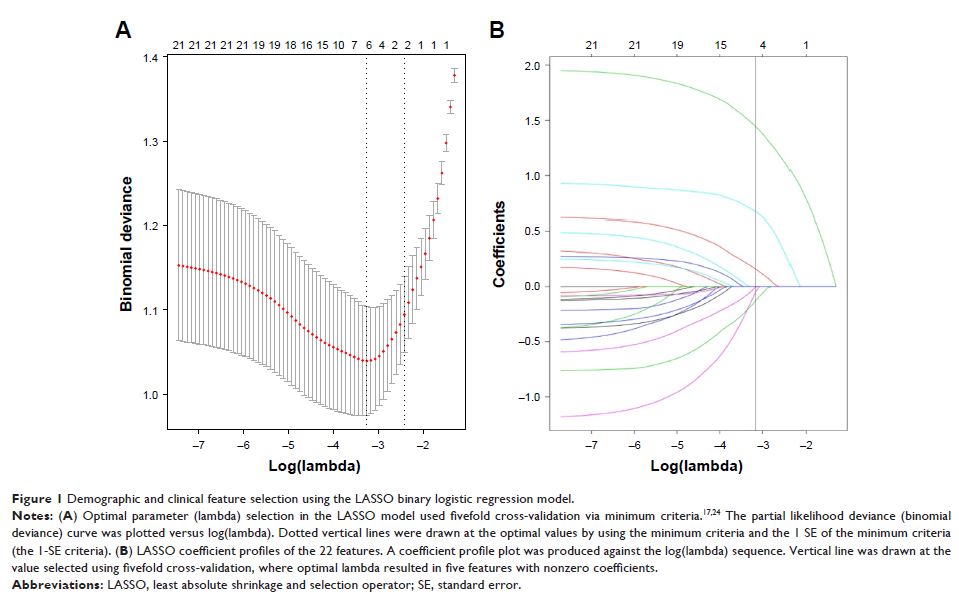
Patients and methods: We developed a prediction model based on a training dataset of 244 IRD patients, and data were collected from March 2016 to May 2016. Adherence was evaluated using 19-item Compliance Questionnaire Rheumatology. The least absolute shrinkage and selection operator regression model was used to optimize feature selection for the medication nonadherence risk model. Multivariable logistic regression analysis was applied to build a predicting model incorporating the feature selected in the least absolute shrinkage and selection operator regression model. Discrimination, calibration, and clinical usefulness of the predicting model were assessed using the C -index, calibration plot, and decision curve analysis. Internal validation was assessed using the bootstrapping validation.
Results: Predictors contained in the prediction nomogram included use of glucocorticoid (GC), use of nonsteroidal anti-inflammatory drugs, number of medicine-related questions, education level, and the distance to hospital. The model displayed good discrimination with a C -index of 0.857 (95% confidence interval: 0.807–0.907) and good calibration. High C -index value of 0.847 could still be reached in the interval validation. Decision curve analysis showed that the nonadherence nomogram was clinically useful when intervention was decided at the nonadherence possibility threshold of 14%.
Conclusion: This novel nonadherence nomogram incorporating the use of GC, the use of nonsteroidal anti-inflammatory drugs, the number of medicine-related questions, education level, and distance to hospital could be conveniently used to facilitate the individual medication nonadherence risk prediction in IRD patients.
Keywords: noadherence, inflammatory rheumatic diseases, Compliance Questionnaire Rheumatology, predictors, nomogram