115195
论文已发表
注册即可获取德孚的最新动态
IF 收录期刊
- 3.6 Breast Cancer (Dove Med Press)
- 4.3 Clin Epidemiol
- 2.6 Cancer Manag Res
- 3.2 Infect Drug Resist
- 4.1 Clin Interv Aging
- 6.1 Drug Des Dev Ther
- 4.1 Int J Chronic Obstr
- 8.7 Int J Nanomed
- 2.5 Int J Women's Health
- 3.2 Neuropsych Dis Treat
- 2.4 OncoTargets Ther
- 2.6 Patient Prefer Adher
- 2.6 Ther Clin Risk Manag
- 3.1 J Pain Res
- 3.5 Diabet Metab Synd Ob
- 4.5 Psychol Res Behav Ma
- 3.4 Nat Sci Sleep
- 2.4 Pharmgenomics Pers Med
- 2.6 Risk Manag Healthc Policy
- 4.6 J Inflamm Res
- 2.3 Int J Gen Med
- 3.9 J Hepatocell Carcinoma
- 3.3 J Asthma Allergy
- 2.5 Clin Cosmet Investig Dermatol
- 3.0 J Multidiscip Healthc

正念太极拳治疗患阈下抑郁的青少年的随机对照试验
Authors Zhang JY, Qin SD, Zhou YQ, Meng LN, Su H, Zhao S
Received 6 May 2018
Accepted for publication 28 June 2018
Published 10 September 2018 Volume 2018:14 Pages 2313—2321
DOI https://doi.org/10.2147/NDT.S173255
Checked for plagiarism Yes
Review by Single-blind
Peer reviewers approved by Dr Colin Mak
Peer reviewer comments 3
Editor who approved publication: Professor Wai Kwong Tang
Purpose: The incidence of subthreshold depression (StD) in adolescents is growing rapidly, which in turn is known to impair functioning and increase the risk of major depression. It is therefore important to provide effective intervention to prevent the transition from StD to major depression. As a traditional Chinese mind-body exercise, Tai Chi Chuan (TCC) may be an available selection. Researchers have shown the effectiveness of mindfulness-based therapy on depression; however, for the StD youth, there have been no studies to investigate whether mindfulness-based Tai Chi Chuan (MTCC) can be recommended as an effective exercise for improving their psychological state. The aim of present study was to evaluate the effect of MTCC on psychological outcomes of StD adolescents including the depression levels and mindfulness state in a randomized controlled trial (RCT).
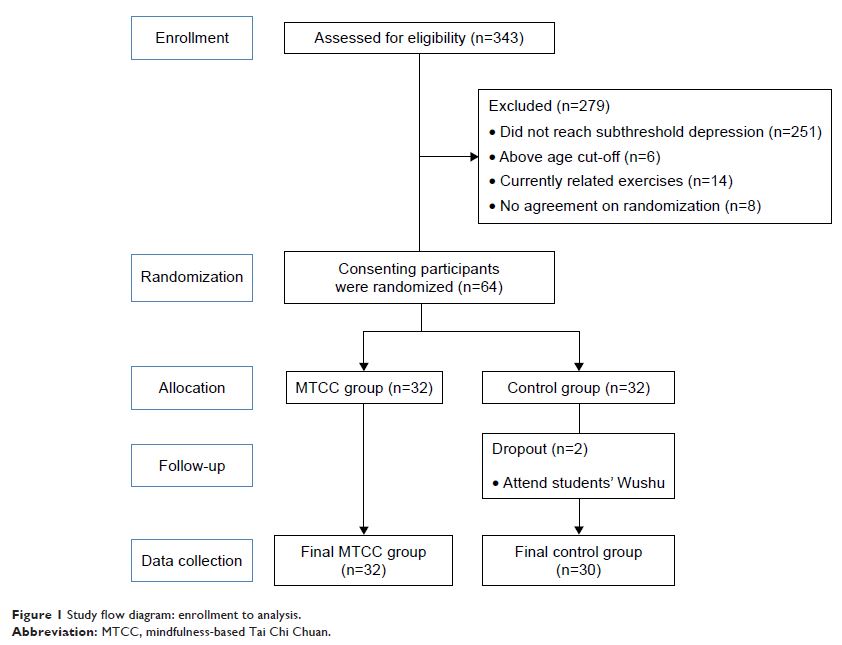
Patients and methods: An RCT was carried out. A sample of 64 participants who meet the inclusion criteria agreed to be arranged randomly to either the MTCC group (n=32) or the control group (n=32). Participants of the MTCC group received an 8-week, 2 days per week, 90-minute MTCC intervention for each session. Usual physical curriculum was administered to the participants in the control group. The effectiveness of MTCC training was measured by blinded evaluators through validated scales, which included depressive symptoms, stress, and mindfulness level before and after the intervention.
Results: Significant improvements in psychological health were observed from MTCC groups. After 8-week intervention, superior outcomes were also observed for MTCC when compared with control group for decrease in depression (F =59.482, P <0.001) and stress level (F =59.482, P <0.001) and increase in mindfulness (F =59.482, P <0.001).
Conclusion: The findings of this preliminary study indicated the effects of the MTCC intervention on depression level among StD youngsters. This study provides preliminary evidence that MTCC is suitable for Chinese adolescents and is effective in decreasing depression level.
Keywords: Tai Chi, mindfulness, college students, subthreshold depression